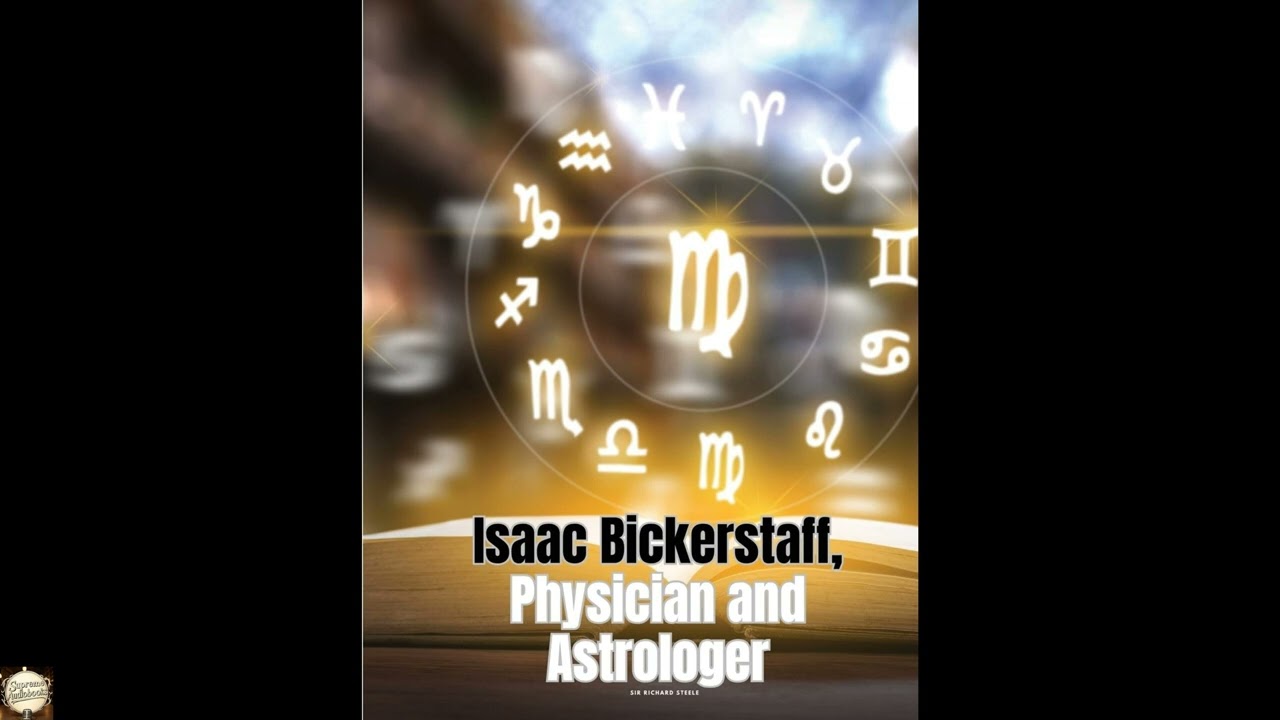
Isaac Bickerstaff, Physician and Astrologer
Step into the bustling coffeehouses and elegant drawing-rooms of early eighteenth-century London, a world Sir Richard Steele brings vividly to life through his ingenious creation, Isaac Bickerstaff, Physician and Astrologer. This collection of essays, originally published as The Tatler, offers listeners a unique window into the manners, morals, and everyday preoccupations of a society on the cusp of modernity. Bickerstaff isn't merely a character; he is a persona, a voice of wit and wisdom, whose observations on everything from fashion fads to political squabbles resonate with surprising familiarity even centuries later. He represents Steele’s audacious experiment in public discourse, designed to correct the follies of his age with a smile rather than a sermon, making the pursuit of virtue as agreeable as entertainment. For anyone seeking to understand the foundations of modern journalism, the evolution of social commentary, or simply to enjoy the sharp intellect of a literary pioneer, Bickerstaff’s gentle satire and keen insight prove as pertinent today as they were revolutionary then. Isaac Bickerstaff, the self-proclaimed Physician and Astrologer, begins his tenure as the editor of The Tatler with a clever ruse. Capitalizing on a popular almanac writer’s prediction of his own death, Bickerstaff, with Steele’s characteristic audacity, announces the man’s demise and usurps his identity. This audacious move sets the tone for the entire periodical: a blend of genuine insight, playful deception, and serious moral purpose cloaked in an air of lighthearted amusement. From his supposed "lodgings in Sheer-Lane," Bickerstaff positions himself as a genial, all-knowing uncle figure, an observer of human nature who promises to deliver news and commentary filtered through his unique perspective. He categorizes his reports by location: accounts from the coffeehouses for politics, from the chocolate-houses for gallantry, from his own apartment for learning, and from the playhouses for everything theatrical. The "plot," if one can call it that, is less a linear narrative and more a kaleidoscopic weekly chronicle of London life. Bickerstaff introduces us to a parade of characters—real and imagined—from the fashionable ladies of the court to the merchants of the Royal Exchange, from the wits of the taverns to the scholars of the academies. He addresses an astonishing array of topics: the latest modes of dress, the intricacies of courtship, the dueling customs of gentlemen, the proper upbringing of children, the state of the opera, and the often-absurd pronouncements of charlatan astrologers. His central "conflict" is not with a single antagonist, but with the pervasive human failings of vanity, affectation, ignorance, and idleness. Through subtly crafted character sketches, humorous anecdotes, and mock-serious prognostications, Bickerstaff endeavors to correct public manners and elevate the moral tone of society, always with an underlying warmth and an appeal to good sense, without resorting to overly harsh condemnation. The inventive mind behind Isaac Bickerstaff was Sir Richard Steele, an Irish writer, dramatist, and Whig politician born in Dublin in 1672. His early life saw him educated at Charterhouse School in London, where he began a lifelong friendship with Joseph Addison, a literary partnership that would profoundly shape English letters. Steele went on to Merton College, Oxford, though he left without a degree to pursue a military career, serving in the Life Guards and rising to the rank of captain. This period informed his early dramatic works, such as The Funeral (1701) and The Lying Lover (1703), plays that moved away from the more cynical wit of Restoration comedy towards a new emphasis on sentimentalism and moral virtue. It was in 1709 that Steele conceived of The Tatler, effectively inventing the genre of the periodical essay. Frustrated by the lack of serious, yet entertaining, commentary on daily life, he launched the paper under the pseudonym of Isaac Bickerstaff. The immediate success of The Tatler, which ran for 271 issues, proved the public’s appetite for this new form of sophisticated social criticism. His collaboration with Addison, which deepened over the course of The Tatler's run, led to their even more celebrated venture, The Spectator, which followed shortly after. Throughout his life, Steele was deeply involved in politics, serving as a Member of Parliament and a staunch advocate for Whig principles, often at personal and financial cost. He was knighted by King George I in 1715 for his political services and literary contributions, though financial difficulties continued to plague him until his death in Carmarthen, Wales, in 1729. Steele’s legacy lies in his pioneering role in developing a graceful, accessible English prose style and in establishing a powerful new medium for public opinion and moral instruction. At its core, Isaac Bickerstaff, Physician and Astrologer enacts themes of social critique and moral instruction through the lens of gentle satire. Bickerstaff’s initial, highly publicized "killing" of the real-life astrologer John Partridge, and his subsequent reports on Partridge’s supposed ghostly appearances, serves as a brilliant example of satire targeted at superstition and intellectual quackery. This extended jest not only entertained but also subtly encouraged readers to apply reason rather than blind faith to such matters. Beyond the more dramatic satirical pieces, Bickerstaff constantly weighs in on the everyday affectations that plague polite society. For instance, he frequently skewers the pretenses of gentlemen who feign learning they do not possess, or ladies who adopt artificial mannerisms in the pursuit of fashion, using witty observations to expose the gap between appearance and reality. Another prominent theme is the cultivation of politeness and the emerging ideal of the "public sphere." Bickerstaff often presents idealized scenes of virtuous domesticity or intelligent conversation, holding them up as models for his readers. He offers concrete advice on how to conduct oneself in company, how to speak eloquently, and how to discern true merit from superficial display. An example can be found in his numerous discussions on proper conduct in coffeehouses—the very heart of London’s intellectual and social life—where he champions intelligent discourse over gossip and intellectual honesty over contentious debate. He frequently champions acts of benevolence, genuine modesty, and sincerity over ostentation, effectively using his platform to guide readers toward a more refined and ethical way of life, thus shaping the very contours of what it meant to be "polite" in the eighteenth century. Sir Richard Steele published The Tatler and brought Isaac Bickerstaff to life during a fascinating and transitional period in English history: the reign of Queen Anne, which concluded in 1714. This was a time of relative political stability after decades of upheaval, allowing for the flourishing of arts and letters, often referred to as the Augustan Age. Culturally, London was experiencing rapid growth and a burgeoning commercial class, leading to the rise of new public spaces like coffeehouses, where people from different social strata could gather to read the news, debate politics, and socialize. This environment provided the perfect incubator for new forms of print culture. The emergence of The Tatler directly responded to a growing appetite among this new, broader readership for news, entertainment, and social commentary that transcended the often-partisan pamphlets and sensational broadsides. There was a desire for a form of popular literature that could simultaneously entertain and instruct, addressing both the frivolous and the serious aspects of daily life. Steele’s work also reflects a broader shift in moral sentiment, moving away from the perceived excesses of the Restoration period towards a more tempered, rational, and virtuous ideal, a movement strongly championed by figures like Jeremy Collier in his critiques of the stage. Bickerstaff's gentle corrective approach fit perfectly with this cultural desire for reform without Puritanical zeal, offering a blend of wit and wisdom that appealed to a wide audience eager to understand and improve their world. Listening to Isaac Bickerstaff, Physician and Astrologer as an audiobook offers a unique way to engage with these foundational texts of English prose. Steele’s essays, originally penned for immediate consumption and often read aloud in social gatherings, truly come alive through a skilled narrator. The conversational yet refined tone, the subtle ironies, and the warmth of Bickerstaff’s persona can be fully appreciated when rendered by a voice artist who understands the rhythm and intent of eighteenth-century rhetoric. The several hours of content allow for a measured pace, letting listeners absorb the nuances of each observation without feeling rushed. A good narration will capture the wry amusement in Bickerstaff’s pronouncements, the underlying sincerity in his moral appeals, and the vivid atmosphere of the London he describes, transforming what might feel like historical documents into lively, engaging dialogues with the past.
Enjoyed Isaac Bickerstaff, Physician and Astrologer? A few ways to support us
Audible & Amazon links are affiliate; we may earn a small commission at no extra cost.
About this production
Human narration by a volunteer reader from LibriVox.org, the public-domain audiobook project. LibriVox volunteers record literary works whose copyright has expired in the United States, releasing the resulting recordings into the public domain.
Isaac Bickerstaff, Physician and Astrologer by Sir Richard Steele. The underlying text is in the U.S. public domain. We do not republish any modern copyrighted edition, translation, or commentary.
The 4K cinematic visuals accompanying this audiobook are generated by an AI image model from prompts derived from the source text. No copyrighted photos, paintings, or stock footage are used. AI generation is disclosed on every video on our YouTube channel as required by YouTube's altered/synthetic content policy.
English subtitles are transcribed from the LibriVox recording with OpenAI Whisper. Translations into the 11 other supported languages are produced by Meta's NLLB-200 neural translation model. No human translator's copyrighted translation is used.
Questions about sourcing or rights? See our DMCA & Sourcing policy or contact us.
View 10 famous quotes from this book →
Enjoyed this audiobook?
If you'd like to own a copy of Isaac Bickerstaff, Physician and Astrologer or hear a professionally produced edition, the links below help support free audiobook production at no extra cost to you.
As an Amazon Associate we earn from qualifying purchases. Audible / print links are affiliate.
![MARK TWAIN'S [Date, 1601.] CONVERSATION As It WAS By The SOCIAL FIRESIDE In The TIME- Full Audiobook by Mark Twain — free full audiobook](https://img.youtube.com/vi/IBbX13QIif8/maxresdefault.jpg)