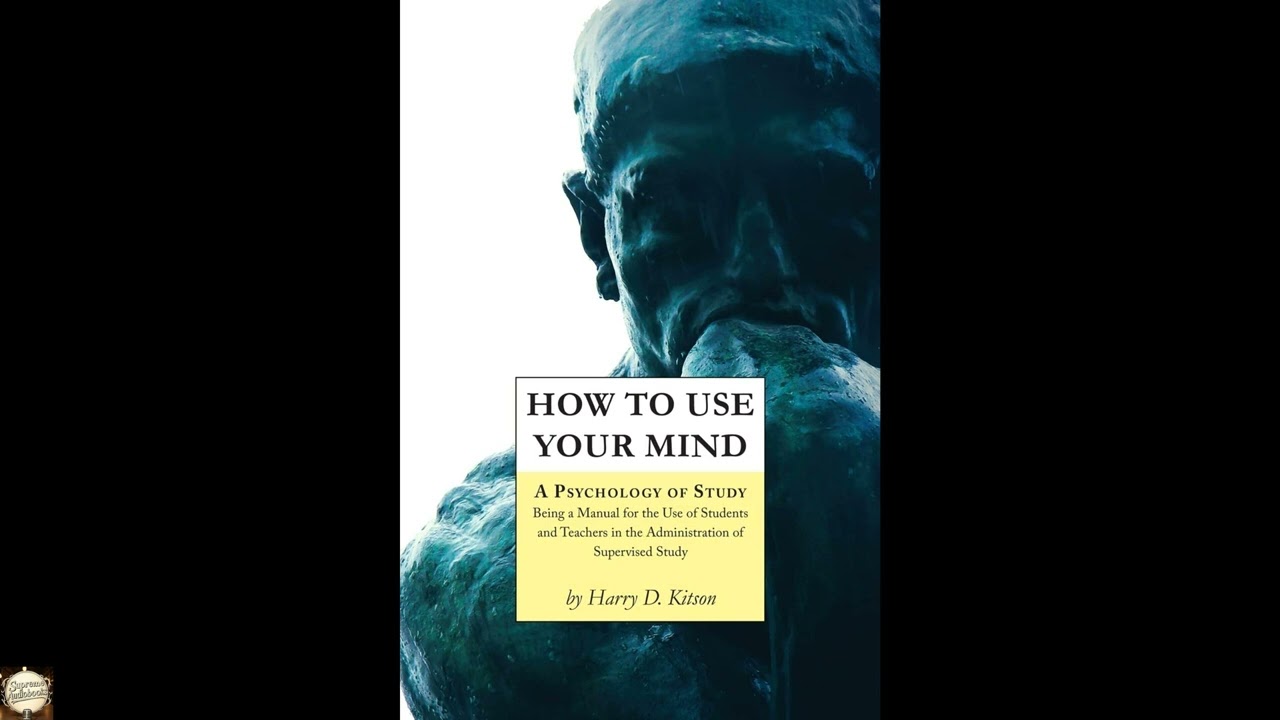
How to Use Your Mind: A Psychology of Study, Being a Manual for the Use of Students
In a world awash with information, where the sheer volume of data often eclipses true comprehension, a profound question persists: how does one truly learn, assimilate, and apply knowledge? "How to Use Your Mind: A Psychology of Study, Being a Manual for the Use of Students" offers not a quick fix, but a deep dive into the very mechanics of thought itself. This foundational text, with its focus on mental discipline and effective learning strategies, speaks to anyone who seeks to move beyond superficial understanding to genuine intellectual mastery. Its principles, though articulated long ago, resonate with startling relevance today, serving as a powerful counterpoint to the fleeting distractions and shallow consumption that define much of modern interaction with information. This is more than a guide; it is an invitation to cultivate a more potent, focused, and adaptable mind, equipping individuals to navigate any intellectual challenge with clarity and confidence. This remarkable manual establishes the landscape of the human mind as its primary setting, presenting it not as a passive receptacle, but as an active, malleable instrument capable of immense growth when properly understood and utilized. The central "character" is undoubtedly the student, or any individual committed to intellectual development, navigating the inherent struggles against mental inertia, distraction, and the pitfalls of ineffective learning habits. The narrative arc, rather than following a traditional plot, traces an intellectual progression, moving systematically through the stages of mental operation necessary for profound understanding. It begins by meticulously dissecting the foundational elements of perception and attention, illustrating how the ability to truly observe and focus forms the bedrock of all subsequent thought. The manual then advances to a detailed examination of memory, presenting it not as a simple storage facility, but as a dynamic system of encoding, retention, and retrieval that can be consciously enhanced. It differentiates between various forms of memory and provides actionable methods for strengthening recall and building durable knowledge structures. From there, the text introduces the principles of logical reasoning and critical analysis, guiding the reader on how to move beyond mere information absorption to genuine intellectual engagement—how to question, evaluate, synthesize, and ultimately, to construct new ideas. The journey culminates in a holistic approach to mental application, demonstrating how these cultivated faculties can be brought to bear on complex problems, fostering not just academic proficiency, but a more acute and effective way of apprehending the world. The manual’s overarching purpose is to transform a haphazard approach to learning into a systematic method for intellectual command. The specific origins of "How to Use Your Mind" are unrecorded, its author's identity lost to the annals of history, yet its very anonymity lends it a universal authority. Such works often emerge from a collective wisdom, a distillation of pedagogical experience and philosophical insight gathered over generations, rather than from a single, named individual. It stands as a testament to ideas so fundamental and practical that they transcended the particularities of their creator's life story, persisting solely through their inherent truth and utility. This places the manual within a long and esteemed tradition of practical philosophy and educational treatise, where the focus remains steadfastly on the content—the methods, principles, and techniques—rather than the persona of the one who articulated them. Its enduring presence suggests it likely represents the crystallization of best practices and profound insights into human cognition from an era that valued the systematic cultivation of the intellect. At its core, this manual enacts several potent themes. Foremost among them is mental discipline, presented not as a punitive restriction but as a liberating practice that unlocks greater intellectual freedom. For instance, the text provides specific techniques for sustained concentration, showing how to systematically direct attention away from distractions and toward the task at hand, framing focus as a skill that can be honed through consistent effort, much like an athlete trains a muscle. Another central theme is active learning, which posits that true understanding comes from engaging with material, rather than passively receiving it. The manual champions methods of interrogating information, such as formulating questions before reading or rephrasing concepts in one’s own words, thereby transforming rote memorization into a process of personal synthesis. A third significant theme is memory as a cultivated skill. The text rejects the notion of memory as a fixed, innate capacity, instead presenting it as a complex process improved by structured techniques. It offers practical advice, such as methods for linking new information to existing knowledge frameworks or employing visual associations, thereby building a more robust and accessible internal library of facts and concepts. Finally, the work champions critical thinking, encouraging students to question assumptions, evaluate evidence, and form independent judgments. It outlines ways to identify logical fallacies and differentiate between credible and specious arguments, providing a toolkit for discerning truth in a complex world. These themes, presented with remarkable clarity and practicality, underscore the manual's lasting literary and educational significance as a foundational text in understanding effective human cognition. While the precise historical moment of its creation remains unconfirmed, the existence of such a manual points to recurring patterns in human civilization: the establishment of formal education and the perennial human desire to optimize intellectual effort. This kind of work would have emerged during periods when systematic learning was gaining prominence, perhaps within ancient academies where rhetoric and logic were paramount, or during medieval eras when universities began to codify curriculum. It could also resonate with later periods, such as the Enlightenment, which emphasized rational thought and systematic inquiry, or the burgeoning psychological movements of the late nineteenth and early twentieth centuries that sought to understand and improve human mental faculties. Regardless of its exact period, the manual speaks to an intellectual climate that valued not just the accumulation of facts, but the cultivation of the mind itself as a primary tool for progress and understanding, anticipating many contemporary insights into cognitive science. Listening to "How to Use Your Mind" as an audiobook offers a uniquely enriching experience. A skilled narrator, with a calm and measured voice, transforms what might appear on the page as didactic instruction into an intimate, guiding presence. The several hours of content can be absorbed in digestible segments, fitting seamlessly into daily routines—whether during a morning walk, a commute, or as a prelude to a focused study session. The steady pacing allows for deep assimilation of the material, encouraging the listener to pause, reflect, and internalize the methods being discussed. The narrator’s clear articulation and thoughtful intonation help to highlight key principles, transforming complex psychological concepts into accessible, actionable advice. This auditory format creates a focused mental space, free from the visual clutter of a printed text, enabling the listener to fully immerse themselves in the cultivation of their own mental faculties, making the process of learning about learning itself a meditative and deeply productive act.
Enjoyed How to Use Your Mind: A Psychology of Study, Being a Manual for the Use of Students? A few ways to support us
Audible & Amazon links are affiliate; we may earn a small commission at no extra cost.
About this production
Human narration by a volunteer reader from LibriVox.org, the public-domain audiobook project. LibriVox volunteers record literary works whose copyright has expired in the United States, releasing the resulting recordings into the public domain.
How to Use Your Mind: A Psychology of Study, Being a Manual for the Use of Students by Harry Dexter Kitson. The underlying text is in the U.S. public domain. We do not republish any modern copyrighted edition, translation, or commentary.
The 4K cinematic visuals accompanying this audiobook are generated by an AI image model from prompts derived from the source text. No copyrighted photos, paintings, or stock footage are used. AI generation is disclosed on every video on our YouTube channel as required by YouTube's altered/synthetic content policy.
English subtitles are transcribed from the LibriVox recording with OpenAI Whisper. Translations into the 11 other supported languages are produced by Meta's NLLB-200 neural translation model. No human translator's copyrighted translation is used.
Questions about sourcing or rights? See our DMCA & Sourcing policy or contact us.
Enjoyed this audiobook?
If you'd like to own a copy of How to Use Your Mind: A Psychology of Study, Being a Manual for the Use of Students or hear a professionally produced edition, the links below help support free audiobook production at no extra cost to you.
As an Amazon Associate we earn from qualifying purchases. Audible / print links are affiliate.