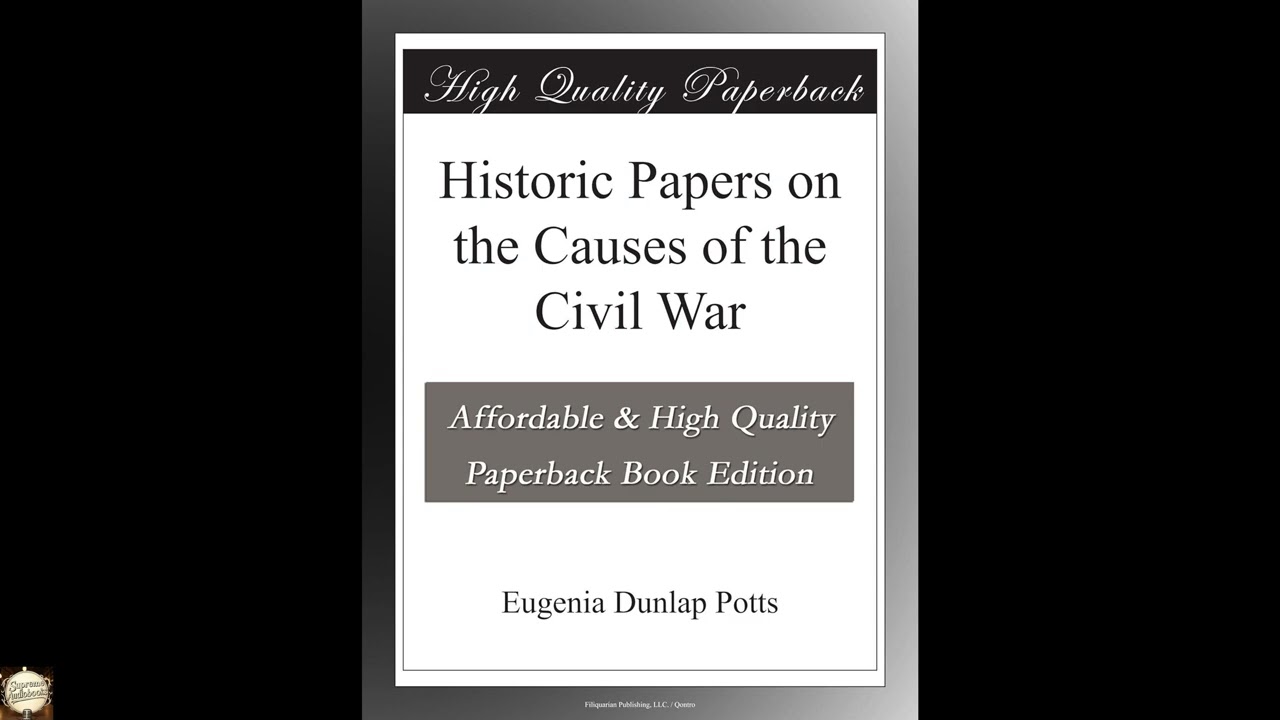
Historic Papers on the Causes of the Civil War
The profound echoes of the American Civil War continue to resonate through the nation's consciousness, shaping its identity and fueling ongoing debates. Eugenia Dunlap Potts's Historic Papers on the Causes of the Civil War offers an essential key to understanding the origins of this pivotal conflict. Far from a mere dry recitation of facts, this collection brings listeners directly into the fiery intellectual and political arenas of pre-war America. It presents the very documents—the speeches, declarations, legal arguments, and public pronouncements—that forged the paths to secession and ultimate combat. To hear these foundational texts is to stand at the precipice of a divided nation, witnessing the arguments unfold in real time, and gaining insight into why the irreconcilable differences of the era remain so vital to our understanding of American history and identity even today. This compilation transports the listener back to a nation teetering on the brink, decades before the first shots were fired at Fort Sumter. The setting is broad: the halls of Congress, state legislatures, public forums, and the quiet studies where influential minds wrestled with the future of the republic. The "characters" are not individuals in a narrative sense, but rather the compelling, often competing, ideologies and perspectives expressed by the leading figures of the time. These are the voices of Southern planters and Northern industrialists, states' rights advocates and federalists, abolitionists and defenders of the peculiar institution. Each document serves as a window into the mind of its author, revealing the deeply held beliefs, economic motivations, moral convictions, and political calculations that drove a nation towards its greatest internal strife. The central conflict animating these papers is the fundamental disagreement over the nature of the Union itself. Was it a compact of sovereign states, each retaining the right to withdraw, or an indissoluble nation, forever bound by a single federal authority? Woven into this overarching question are the intertwined issues of slavery's expansion, economic disparities between agricultural and industrial economies, and the interpretation of the Constitution. The arc of the story, as presented through these documents, is one of increasing polarization and hardening positions. Listeners will encounter the incremental steps—the compromises attempted and failed, the escalating rhetoric, the legal precedents invoked, and the moral imperatives asserted—that transformed regional tensions into an existential struggle for the soul of America. The collection meticulously traces the intellectual lineage of the conflict, revealing how various factions articulated their grievances and demands, pushing the nation relentlessly towards a breaking point. Eugenia Dunlap Potts, as the compiler of this significant volume, performed a vital act of historical scholarship. While specific biographical details about her life may be elusive, her contribution lies in the diligent curation of these primary sources. She worked in a period when the memory of the Civil War was still a fresh wound, but also when the systematic documentation and analysis of its origins began to take shape. Her effort reflects a keen understanding that to comprehend the war, one must first grasp the arguments and pronouncements that preceded it. Potts's methodology was to gather the direct statements of those who shaped the debates, allowing their original words to speak for themselves. This approach makes her work not just a historical accounting, but a lasting academic and cultural contribution, offering future generations direct access to the intellectual battles that defined an era. She saw the imperative of preserving these seminal documents, recognizing their enduring power to illuminate the complexities of the past. The enduring themes within Historic Papers on the Causes of the Civil War are as relevant now as they were in their original context. One central theme is the perennial tension between states' rights and federal authority. Listeners encounter this repeatedly, for instance, in the pronouncements of Southern governors asserting the sovereignty of their individual states against federal mandates, or in the congressional debates over tariffs and land policy where states jealously guarded their prerogatives. Another potent theme is the profound moral and economic conflict surrounding slavery. While some documents present legalistic defenses of the institution as property, others, often subtly or indirectly, reveal the deep moral unease or fervent abolitionist sentiment stirring in the North. A fiery resolution passed by a state legislature might declare slavery an essential part of its economic fabric, directly clashing with the burgeoning industrial ethic and moral condemnation found in Northern speeches. This collection also showcases the theme of constitutional interpretation, as each side marshaled legal arguments to support their positions, demonstrating how the same foundational document could be read in profoundly different, ultimately irreconcilable, ways. This work emerged at a critical juncture in American history, likely in the decades following the Civil War. It was a time when the nation grappled with the trauma of conflict, the monumental task of Reconstruction, and the imperative to understand "why." Culturally, there was an intense desire to process the war's legacy, often leading to the formation of distinct narratives in the North and South. Politically, the questions of federal power, citizenship, and racial equality continued to dominate discourse. In the literary and academic world, there was a growing recognition of the importance of primary sources in historical analysis. Historic Papers stands as a testament to this impulse—a dedication to presenting the unfiltered voices of the past, allowing subsequent generations to engage directly with the genesis of the conflict. It provided a crucial resource for citizens and scholars alike who sought to comprehend the deep-seated divisions that tore the Union apart and to learn from the tragic lessons of that era. Listening to Historic Papers on the Causes of the Civil War as an audiobook offers a uniquely powerful experience. The measured cadence of a skilled narrator breathes life into these weighty historical documents, transforming what might otherwise be dense text into an accessible and compelling oral history. The several hours of listening time allow for sustained engagement, giving listeners ample opportunity to absorb the nuanced arguments and appreciate the rhetorical artistry of the original authors. Pay attention to the subtle shifts in tone in the narration—the gravitas assigned to a constitutional argument, the urgency conveyed in a secessionist declaration, or the quiet conviction in an appeal for compromise. Hearing these speeches and papers delivered aloud helps to recreate the atmosphere of intense debate and intellectual struggle that defined the era, reminding us that these were not abstract ideas, but vital words spoken or penned by individuals facing immense pressure and profound choices. The performance brings forward the human element behind the historical record, ensuring that these seminal documents retain their capacity to inform and move us.
Enjoyed Historic Papers on the Causes of the Civil War? A few ways to support us
Audible & Amazon links are affiliate; we may earn a small commission at no extra cost.
About this production
Human narration by a volunteer reader from LibriVox.org, the public-domain audiobook project. LibriVox volunteers record literary works whose copyright has expired in the United States, releasing the resulting recordings into the public domain.
Historic Papers on the Causes of the Civil War by Eugenia Dunlap Potts. The underlying text is in the U.S. public domain. We do not republish any modern copyrighted edition, translation, or commentary.
The 4K cinematic visuals accompanying this audiobook are generated by an AI image model from prompts derived from the source text. No copyrighted photos, paintings, or stock footage are used. AI generation is disclosed on every video on our YouTube channel as required by YouTube's altered/synthetic content policy.
English subtitles are transcribed from the LibriVox recording with OpenAI Whisper. Translations into the 11 other supported languages are produced by Meta's NLLB-200 neural translation model. No human translator's copyrighted translation is used.
Questions about sourcing or rights? See our DMCA & Sourcing policy or contact us.
Enjoyed this audiobook?
If you'd like to own a copy of Historic Papers on the Causes of the Civil War or hear a professionally produced edition, the links below help support free audiobook production at no extra cost to you.
As an Amazon Associate we earn from qualifying purchases. Audible / print links are affiliate.