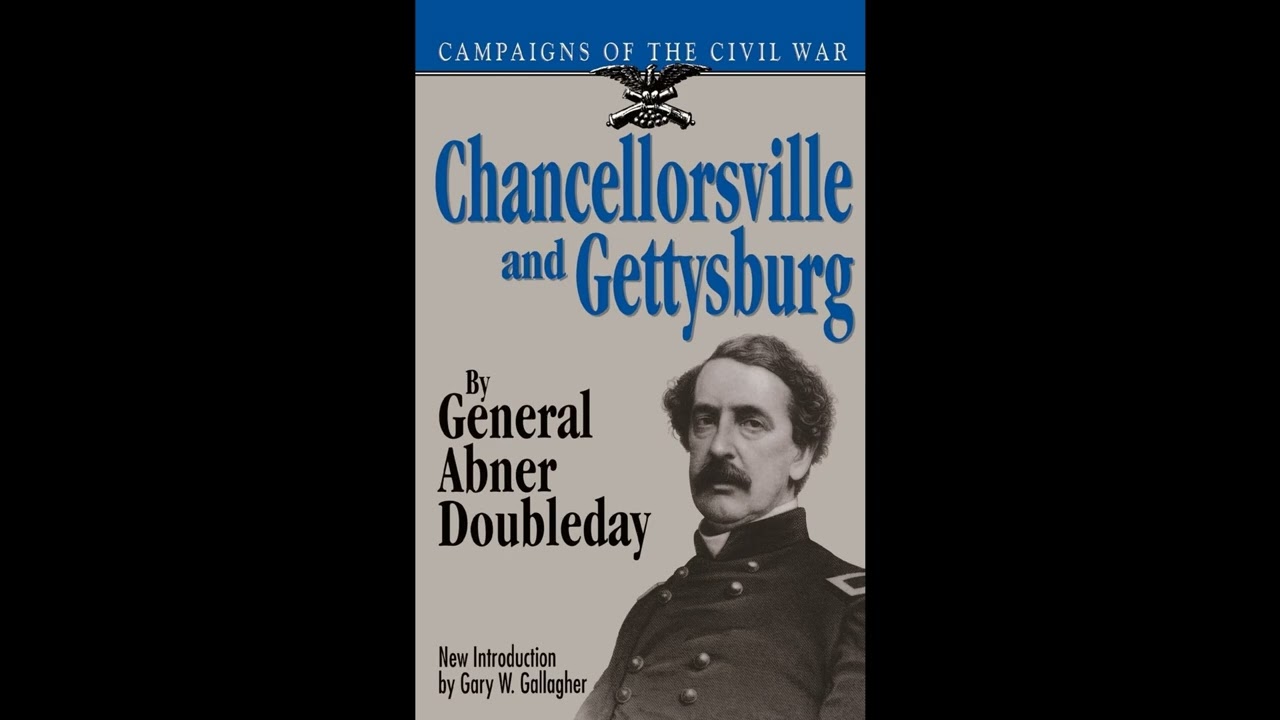
Chancellorsville And Gettysburg (Campaigns of the Civil War)
To truly understand the American Civil War, one must grasp the turning points—the moments where the nation’s fate hung most precariously. Abner Doubleday’s Chancellorsville And Gettysburg, a foundational account from a participant in these very events, offers precisely that window. Far more than a mere chronology, this volume presents a firsthand narrative of two of the conflict’s most pivotal campaigns, offering not just the facts but the immediate perspective of a general who commanded troops amidst the thunder and smoke. For the modern listener, it is an unparalleled opportunity to stand alongside those who shaped history, to comprehend the immense sacrifices, the strategic gambles, and the sheer human will that defined the struggle to preserve—or divide—a nation. It’s a vital piece of American history, rendered with the authority only an eyewitness can provide, making the echoes of 1863 resonate with urgency even today. The narrative plunges the listener into the spring and summer of 1863, a period of profound uncertainty for the Union. The story begins in the aftermath of the Union defeat at Fredericksburg, setting a grim stage for the audacious plans of General Joseph Hooker, the new commander of the Army of the Potomac. Hooker’s strategy to outmaneuver Robert E. Lee’s Confederate Army of Northern Virginia culminates in the Battle of Chancellorsville, fought in the dense thickets of the Wilderness. Doubleday, a division commander, provides an intimate view of the complex maneuvers, the unexpected turns, and the brutal fighting that characterized this engagement. The account details the hopes and frustrations of the Union command as they grappled with Lee’s brilliant but risky tactics, which saw the Confederate general divide his forces multiple times to achieve stunning, though costly, success. As Chancellorsville concludes, the stage is set for Lee’s boldest move: an invasion of the North. The book meticulously tracks the Confederate Army’s push into Pennsylvania, forcing the Union Army into a desperate pursuit. The narrative shifts from the strategic chess match to the grim reality of forced marches and the frantic preparations for an inevitable confrontation. This culminates in the epic clash at Gettysburg, where the Union Army, now under the command of General George G. Meade, takes up defensive positions. Doubleday’s account of Gettysburg is particularly compelling, as he was directly involved in the fighting, his division holding crucial ground on the first day. The listener is brought into the heart of the battle, experiencing the fierce engagements for control of the ridges and hills, the relentless assaults, and the determined resistance that defined the three days of combat, all building towards an explosive climax that would seal the fate of Lee’s northern advance without revealing the specific outcome of the overall campaign. Abner Doubleday was an unlikely figure to achieve such historical prominence. Born in Ballston Spa, New York, in 1819, he graduated from West Point in 1842, beginning a distinguished military career that would span over four decades. His early service included the Mexican-American War and frontier duty, but it was the Civil War that etched his name into the annals of American history. Doubleday is famously credited with firing the first Union shot in defense of Fort Sumter in April 1861, marking the true commencement of hostilities. From that dramatic beginning, he rose steadily through the ranks, eventually commanding a division in the crucial I Corps of the Army of the Potomac. He was present and active at nearly every major Eastern Theater engagement, including Antietam and Fredericksburg, before his pivotal role at Chancellorsville and Gettysburg. Beyond his military service, Doubleday is perhaps most widely known, albeit inaccurately, for his purported invention of baseball. While modern historical research has largely debunked the myth that he codified the game’s rules in Cooperstown, New York, in 1839, the enduring legend speaks to his place in the broader American consciousness—a figure associated with both military valor and the nascent sports culture of the young nation. After the Civil War, Doubleday continued his service, eventually retiring as a colonel in 1873 but receiving a promotion to major general on the retired list. He spent his later years writing his memoirs and contributing to the historical record, ensuring his perspective on the war’s critical moments would be preserved, ultimately passing away in Mendham, New Jersey, in 1893. His writings, including Chancellorsville And Gettysburg, are valued for their candidness and their vantage point from the highest echelons of Union command. One of the central themes that emerges from Doubleday’s narrative is the profound impact of leadership and decision-making under extreme pressure. The book provides a stark contrast between General Hooker’s initial bold, flanking maneuver at Chancellorsville, which promised a decisive victory, and his subsequent hesitation and withdrawal into a defensive posture. Doubleday offers a participant’s view of the confusion and frustration within the Union ranks as opportunities slipped away. Conversely, the narrative highlights Robert E. Lee’s audacious risk-taking—dividing his forces in the face of a numerically superior enemy—demonstrating the perilous balance between boldness and recklessness in command. At Gettysburg, the text illustrates General Meade’s rapid, pragmatic decisions to fortify strong defensive positions, reacting swiftly to Lee’s invasion and the initial clashes, thereby setting the stage for the dramatic confrontation. These examples underscore how individual choices at the highest level could swing the momentum of entire campaigns. Another compelling theme is the brutality and chaos of battlefield experience, rendered through the eyes of a commanding officer. Doubleday does not shy away from describing the unforgiving terrain of the Wilderness, where visibility was low and fighting became a desperate, close-quarters affair. His accounts convey the disorienting effects of smoke, the deafening roar of artillery, and the sheer physicality of moving thousands of men and supplies through difficult landscapes under enemy fire. While maintaining a general’s perspective, the book still communicates the immense human cost, illustrating the ferocity of the fighting at places like Hazel Grove and the desperate Confederate assaults at Gettysburg. These descriptions immerse the listener in the sensory overload of combat, making clear the sheer courage required to stand firm amidst such destruction and disarray. Doubleday’s Chancellorsville And Gettysburg emerged during a period of intense reflection and historical consolidation in the United States, roughly two decades after the Civil War had concluded. Published as part of the “Campaigns of the Civil War” series in the early 1880s, his work contributed to a broader cultural effort to document, understand, and interpret the conflict. The nation was still grappling with the war’s immense legacy—Reconstruction had largely ended, and the process of national healing and reconciliation was ongoing, often fraught with competing narratives. Veterans on both sides felt compelled to share their experiences and often to justify their actions or those of their commanders. Doubleday’s account, therefore, served as a crucial Union perspective, counteracting some of the emerging “Lost Cause” narratives that sought to romanticize the Confederacy and downplay its strategic failures. This was a time when military history was becoming more formalized, and firsthand accounts from generals provided invaluable primary source material for future generations of historians and strategists. Listening to Chancellorsville And Gettysburg as an audiobook offers a singular opportunity to engage with history not just as information, but as a living narrative. The several hours of content allow for a sustained immersion in Doubleday’s account, carried by the rhythm and gravitas of a skilled narrator’s voice. As the narrator recounts the strategic movements, the descriptions of terrain, and the intense moments of combat, listeners will find themselves drawn into the tension and drama of 1863. Pay close attention to the shifts in pacing—how the narrative slows for detailed descriptions of battle plans and then accelerates through the heat of engagement, mirroring the ebb and flow of the campaigns. The direct, clear prose of a general recounting his war allows the weight of his experience and authority to shine through, transforming a historical text into a compelling sonic journey through one of America’s most critical eras.
Enjoyed Chancellorsville And Gettysburg (Campaigns of the Civil War)? A few ways to support us
Audible & Amazon links are affiliate; we may earn a small commission at no extra cost.
About this production
Human narration by a volunteer reader from LibriVox.org, the public-domain audiobook project. LibriVox volunteers record literary works whose copyright has expired in the United States, releasing the resulting recordings into the public domain.
Chancellorsville And Gettysburg (Campaigns of the Civil War) by Abner Doubleday. The underlying text is in the U.S. public domain. We do not republish any modern copyrighted edition, translation, or commentary.
The 4K cinematic visuals accompanying this audiobook are generated by an AI image model from prompts derived from the source text. No copyrighted photos, paintings, or stock footage are used. AI generation is disclosed on every video on our YouTube channel as required by YouTube's altered/synthetic content policy.
English subtitles are transcribed from the LibriVox recording with OpenAI Whisper. Translations into the 11 other supported languages are produced by Meta's NLLB-200 neural translation model. No human translator's copyrighted translation is used.
Questions about sourcing or rights? See our DMCA & Sourcing policy or contact us.
Enjoyed this audiobook?
If you'd like to own a copy of Chancellorsville And Gettysburg (Campaigns of the Civil War) or hear a professionally produced edition, the links below help support free audiobook production at no extra cost to you.
As an Amazon Associate we earn from qualifying purchases. Audible / print links are affiliate.
More Audiobooks
Historic Papers on the Causes of the Civil War
Speeches of the Hon. Jefferson Davis, of Mississippi; Delivered During the Summer
Si Klegg, Book 2 Thru the Stone River Campaign and in Winter Quarters at Murfreesbo
Abraham Lincoln and the Union: A Chronicle of the Embattled North