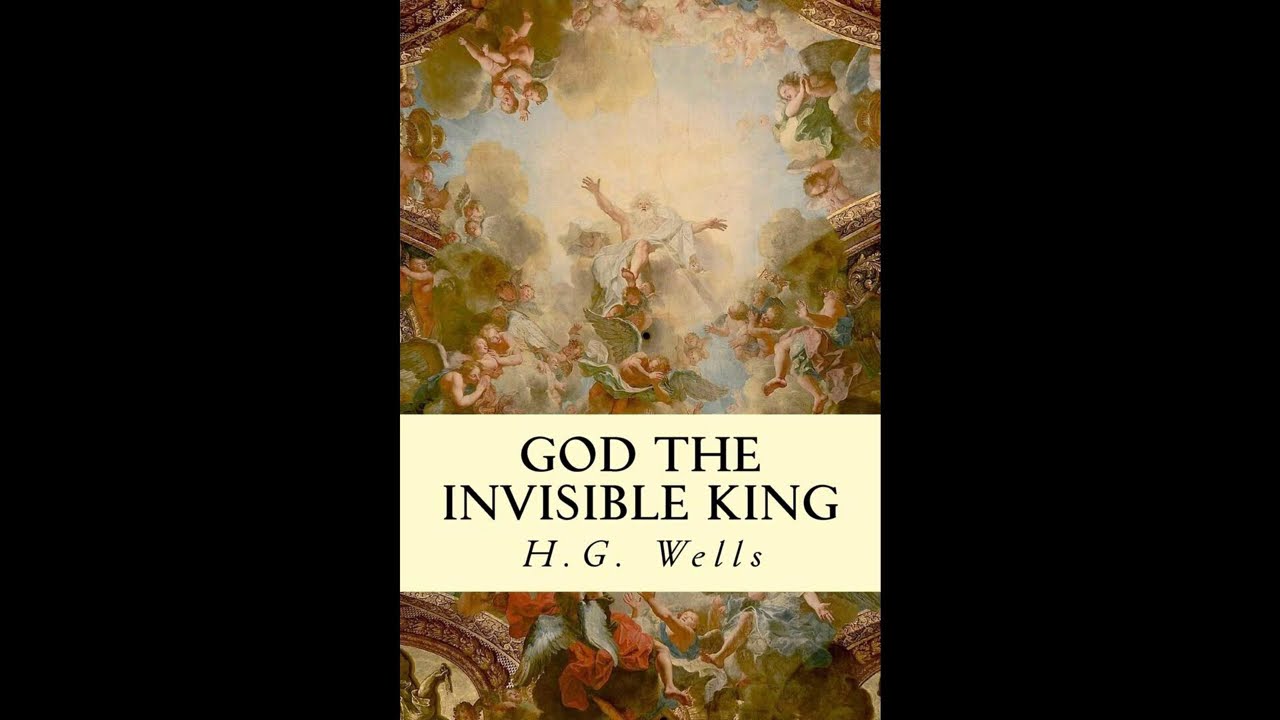
God The Invisible King
H.G. Wells, a name most readily associated with the fantastic voyages through time and space or the terrifying invasions from Mars, presents a decidedly different kind of challenge and vision in God The Invisible King. This isn't a science fiction novel, nor is it a conventional theological text, but rather a profoundly personal and intellectually rigorous statement from one of the twentieth century's most influential thinkers. It offers a re-imagining of faith, ethics, and humanity's purpose in a world increasingly shaped by scientific discovery and social upheaval. For listeners today, this work remains remarkably prescient, grappling with fundamental questions about how belief systems adapt to a rational age, how human collective action can forge a better future, and whether there is still a place for the divine amidst the complexities of modern existence. It’s a foundational text for understanding the expansive, often startling breadth of Wells's worldview, revealing the moral and spiritual core that underpinned his futuristic imaginings. Rather than a narrative with characters and a conventional plot, God The Invisible King presents a meticulously argued philosophical treatise, guiding the listener through Wells’s considered attempt to redefine spirituality for an enlightened age. The setting is not a physical place but the intellectual landscape of the early twentieth century, marked by rapid scientific advancements and a deep yearning for meaning in a world increasingly seen through a materialist lens. Wells himself serves as the primary voice, articulating his intellectual process and moral convictions. The central concept, the "Invisible King," is introduced not as a remote, supernatural being, but as a finite, personal, and actively struggling God—a deity whose very existence and power depend upon human recognition, devotion, and cooperative action. The arc of Wells's argument begins by dissecting and critiquing what he perceives as the failures and inadequacies of traditional, institutionalized religions. He finds them laden with dogma, superstition, and an insistence on a detached, omnipotent God that seems incompatible with the observable universe and human experience. He then sets about constructing his alternative: a God who is not all-powerful, but rather a leader, a general in a cosmic struggle against chaos and evil, a force for good that operates primarily within and through humanity. This Invisible King demands not blind obedience but active participation, inspiring individuals to unite in a universal brotherhood dedicated to progress, knowledge, and the establishment of a just world order. Wells thereby reshapes the spiritual quest into a practical, ethical, and collaborative endeavor, relocating the divine from the distant heavens into the very heart of human striving and collective will. The author, Herbert George Wells, was born in Bromley, Kent, England, in 1866, and passed away in London in 1946. His early life was marked by humble origins, the son of a shopkeeper and a domestic servant, yet his formidable intellect earned him a scholarship to the Royal College of Science, where he studied biology under the renowned T.H. Huxley. This scientific background profoundly shaped his writing, grounding his fantastical premises in a veneer of plausible detail. Wells was a polymath and a prolific writer, renowned for his "scientific romances" that effectively launched the modern science fiction genre. Beyond his groundbreaking work in speculative fiction, such as The Time Machine, The War of the Worlds, and The Island of Doctor Moreau, Wells was also a prominent social critic, a tireless advocate for utopian ideals, and an active member of the Fabian Society, a socialist organization. His later career saw him turn increasingly to social commentary, history, and philosophical works, including the ambitious The Outline of History. He was a man deeply engaged with the political, social, and scientific currents of his time, consistently seeking to understand and shape the future of humanity through his writing and public advocacy. One of the foundational themes animating God The Invisible King is the redefinition of God and spirituality. Wells rejects the traditional conception of an omnipotent, transcendent God, proposing instead a finite, struggling, and immanent deity. For instance, he argues that the Invisible King is not a remote creator of the universe but a personal, ever-present force felt in moments of conscience, moral imperative, and unifying love. This vision radically shifts the focus from worship of an all-powerful being to active participation with a God who needs human cooperation to realize a better world. Connected to this is the theme of human agency and collective action. Wells’s God operates through humanity’s conscious will to improve itself and its world. The Invisible King is not a miracle-worker but an inspiring leader, and the text insists that humanity’s collective effort – a universal brotherhood – is the means by which this spiritual force gains strength and purpose, enacting positive change on Earth. Furthermore, the book directly confronts the tension between science and religion, seeking to reconcile them rather than seeing them as irreconcilable foes. Wells, a scientist by training, endeavors to strip away the superstitious elements of religion, arguing for a God whose existence is evidenced not by supernatural occurrences but by ethical impulses and the progressive unfolding of human potential. This links directly to Wells's broader social reform and utopian vision. His theological framework is inherently tied to his belief in humanity's capacity for creating a better society, a rational and just world order. The Invisible King acts as a unifying banner, a moral compass guiding humanity towards the realization of its collective potential, making spirituality a driving force for societal improvement rather than an escape from worldly concerns. This philosophical work emerged during a period of profound global upheaval. While the specific publication year is not noted, it reflects the intellectual ferment of the early twentieth century, an era reeling from the scientific revolutions of Darwin and the dawning of modern physics, and deeply scarred by the cataclysm of the Great War. Old certainties, including traditional religious doctrines and established political orders, were being questioned or outright shattered. Wells, like many intellectuals of his generation, found himself searching for a new moral framework, a coherent worldview that could offer hope and direction in a world seemingly spiraling into chaos. God The Invisible King can be seen as his attempt to provide such a framework, offering a rational yet spiritually resonant alternative to traditional faith, one suited to a future shaped by science, collective action, and the urgent need for global peace. Listening to God The Invisible King as an audiobook offers a unique opportunity to engage deeply with Wells's intricate arguments. The sustained attention required for philosophical prose is greatly aided by a skilled narrator, whose voice can bring clarity and intellectual passion to the often abstract concepts. For a work of "several hours" in length, it’s an ideal companion for focused listening—perhaps during quiet reflection, long walks, or dedicated study sessions. A thoughtful narration allows the listener to absorb the nuances of Wells's critiques and proposals, discerning the precise pacing and emphasis in his carefully constructed reasoning. The absence of traditional dialogue in this non-fiction work means the narrator’s voice becomes the singular conduit for Wells's powerful and persuasive voice, establishing an intimate, almost lecture-like atmosphere that draws the listener directly into the mind of this visionary thinker.
Enjoyed God The Invisible King? A few ways to support us
Audible & Amazon links are affiliate; we may earn a small commission at no extra cost.
About this production
Human narration by a volunteer reader from LibriVox.org, the public-domain audiobook project. LibriVox volunteers record literary works whose copyright has expired in the United States, releasing the resulting recordings into the public domain.
God The Invisible King by H. G. Wells. The underlying text is in the U.S. public domain. We do not republish any modern copyrighted edition, translation, or commentary.
The 4K cinematic visuals accompanying this audiobook are generated by an AI image model from prompts derived from the source text. No copyrighted photos, paintings, or stock footage are used. AI generation is disclosed on every video on our YouTube channel as required by YouTube's altered/synthetic content policy.
English subtitles are transcribed from the LibriVox recording with OpenAI Whisper. Translations into the 11 other supported languages are produced by Meta's NLLB-200 neural translation model. No human translator's copyrighted translation is used.
Questions about sourcing or rights? See our DMCA & Sourcing policy or contact us.
Enjoyed this audiobook?
If you'd like to own a copy of God The Invisible King or hear a professionally produced edition, the links below help support free audiobook production at no extra cost to you.
As an Amazon Associate we earn from qualifying purchases. Audible / print links are affiliate.
More by H. G. Wells


More Audiobooks

St. George and St. Michael, Volume I

Magic: In Which Are Given Clear and Concise Explanations of All the Well-known Illu

The Light of Egypt: Volume Two, the Science of the Soul and the Stars
A Son of the Gods and a Horseman in the Sky, and the Damned Thing