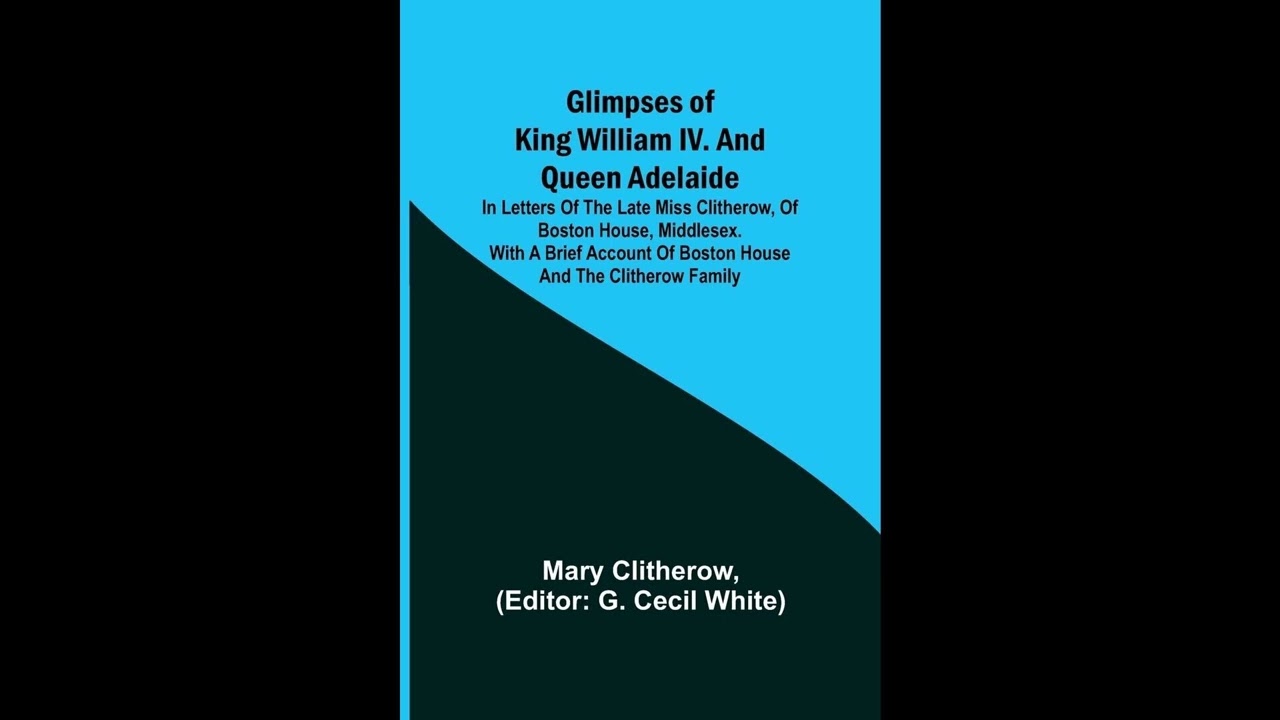
Glimpses of King William IV. and Queen Adelaide; In Letters of the Late Miss Clither- Full Audiobook
Imagine peering through a private keyhole into the royal court of early nineteenth-century Britain, not through the grand pronouncements of official histories, but through the intimate, whispered observations of a woman living amidst the gilded cage of monarchy. Glimpses of King William IV. and Queen Adelaide; In Letters of the Late Miss Clither- Full Audiobook offers just such an unparalleled access, a collection of personal correspondences that bring to vivid, human life two monarchs often overshadowed by their more famous predecessors and successors. Why should these letters resonate today? Because they strip away the pomp and circumstance, revealing the personalities, daily routines, and quiet struggles of a king and queen through the eyes of a keen, discerning observer. This work is a testament to the enduring power of individual perspective, a chance to rediscover a pivotal moment in British history through a profoundly personal lens, offering not just facts, but the very texture of an era. The narrative of this compelling collection unfolds entirely through the voice of its primary observer, Miss Clither, whose letters serve as both a chronicle and a commentary on the reign of King William IV and his consort, Queen Adelaide. Set against the backdrop of British society in the 1830s—a period of significant political and social transformation—Miss Clither’s correspondence paints a nuanced portrait of the royal couple and their immediate circle. We meet William IV, affectionately known as the "Sailor King," a monarch who ascended the throne later in life, bringing with him a more informal, sometimes blunt, approach to his duties than his flamboyant predecessor, George IV. Alongside him stands Queen Adelaide, a figure of quiet dignity and deep devotion, whose personal rectitude and philanthropic efforts garnered widespread respect, even as she navigated the complex expectations placed upon a royal consort. Through Miss Clither's eyes, we are transported from the bustling corridors of palaces to the private drawing-rooms where decisions were discussed and characters revealed. There isn't a conventional "plot" in the sense of a rising action or a dramatic climax, but rather a cumulative unfolding of character and circumstance. The "story" becomes the slow revelation of William and Adelaide's true natures—their strengths, their foibles, their interactions with their subjects and their court—all filtered through the discerning gaze of a woman clearly positioned close enough to observe but distant enough to offer candid reflections. The central thread is Miss Clither's evolving understanding and portrayal of these public figures as private individuals, a subtle and sustained act of observation that allows listeners to construct their own understanding of these monarchs and their world. The person behind these illuminating letters, Miss Clither, remains largely a figure shrouded in a degree of delightful historical mystery. While her full biographical details elude definitive identification, the very existence and content of her correspondence strongly suggest she was a woman of considerable education, social standing, and close proximity to the royal court, or at least to individuals within its immediate orbit. Her writing style indicates an observant mind, a facility with language, and a keen interest in both the grand political machinations and the intimate personal details of those in power. Such epistolary collections were a common, if often privately circulated, form of record-keeping and social commentary during the eighteenth and nineteenth centuries, offering a counterpoint to official histories and public narratives. Miss Clither represents a tradition of astute female observers whose private thoughts, when brought to light, offer invaluable insights into societies that often marginalized their public voices. Her status as a semi-anonymous, yet deeply personal, chronicler adds to the authenticity and allure of her observations, making them feel like genuine confidences rather than polished historical accounts. Within the candid prose of Miss Clither's letters, several potent themes surface repeatedly, lending the work its enduring significance. Foremost among these is the humanization of royalty. Rather than depicting William and Adelaide as distant, almost mythological figures, Miss Clither consistently reveals their very human qualities. She might describe, for instance, a moment where King William, known for his naval background, throws protocol aside to engage with a common sailor, or detail Queen Adelaide's quiet but firm disapproval of courtly excesses, showing her compassion through charitable endeavors that often went unheralded in official reports. This portrayal chips away at the formal facade, inviting empathy and understanding for the burdens and joys of a crown. Another significant theme is the power of observation and perspective. The letters highlight how a seemingly ordinary individual’s viewpoint can offer unparalleled historical insight. Miss Clither’s narrative often contrasts with the prevailing public opinion or official communiqués of the day, perhaps capturing a subtle shift in court mood after a political event, or recounting a private conversation that illuminates a public decision in a wholly new light. Her personal, immediate reactions provide a refreshing counter-narrative to the often-sanitized versions of history. Further, the collection powerfully demonstrates the epistolary form as a historical record. The very act of writing these letters, often in direct response to events as they unfolded, creates an unmediated, spontaneous chronicle of an era. We read not a retrospective analysis, but the immediate impressions and emotional responses of someone living through these times. This immediacy lends an urgent authenticity to her observations, for example, when she reacts to the passage of a significant bill in Parliament, or describes the atmosphere surrounding a royal birth or death. Finally, the letters offer subtle yet telling insights into gender and social hierarchy in 19th-century England. Miss Clither's own position—a woman within or near aristocratic circles—inherently shapes her observations. She offers glimpses into the roles and expectations placed upon women at court, the power dynamics between male and female figures, and the subtle ways women influenced, observed, and participated in a world largely dominated by men. Her focus on Queen Adelaide’s quiet influence and personal virtue stands as a testament to the forms of power available to women of that era. The period spanning William IV’s reign (1830-1837) was a pivotal, transitional era in British history, and Miss Clither's letters provide a unique lens into its currents. Culturally, it stood between the flamboyant, often scandalous Regency period of George IV and the dawn of the more austere, morally earnest Victorian age. Politically, it was a time of immense reform, most notably the passage of the Great Reform Act of 1832, which significantly broadened the electoral franchise and shifted power away from the landed aristocracy. This era saw growing public engagement with political issues, increased scrutiny of the monarchy, and profound social changes driven by industrialization and the rise of a powerful middle class. William IV himself was a less polished, more accessible monarch compared to his predecessors, often lauded for his relative simplicity and directness, which endeared him to many but sometimes ruffled the feathers of the establishment. Miss Clither's work emerged from and contributed to this cultural climate, capturing the shifting tides of public opinion and the evolving relationship between the crown and its people. Her letters provide a vital, contemporary perspective on a moment when the very nature of British monarchy was being redefined amidst a rapidly modernizing nation. Listening to Glimpses of King William IV. and Queen Adelaide; In Letters of the Late Miss Clither as an audiobook transforms the experience of engaging with this historical document. The inherent intimacy of letters—their direct address, their conversational tone, their revelation of personal thought—is perfectly suited to the audio format. A skilled narrator can imbue Miss Clither's voice with the precise blend of observation, wit, and occasional discretion that defines her writing, making the listener feel less like a reader and more like an eavesdropper on confidences from a bygone era. Over its several hours of listening time, the audiobook allows for sustained immersion in this specific historical moment, allowing the nuances of Miss Clither’s descriptions and reflections to truly sink in. Listen for the subtle shifts in the narrator’s pacing and voice as Miss Clither describes a bustling court function versus a quiet moment of personal reflection. The spoken word brings the characters to life, making the often-understated dialogue and descriptions vivid and immediate, conjuring the very atmosphere of early 19th-century British court life, making history not merely something to be read, but something to be experienced.
Enjoyed Glimpses of King William IV. and Queen Adelaide; In Letters of the Late Miss Clither- Full Audiobook? A few ways to support us
Audible & Amazon links are affiliate; we may earn a small commission at no extra cost.
About this production
Human narration by a volunteer reader from LibriVox.org, the public-domain audiobook project. LibriVox volunteers record literary works whose copyright has expired in the United States, releasing the resulting recordings into the public domain.
Glimpses of King William IV. and Queen Adelaide; In Letters of the Late Miss Clither- Full Audiobook by Miss Clitherowe. The underlying text is in the U.S. public domain. We do not republish any modern copyrighted edition, translation, or commentary.
The 4K cinematic visuals accompanying this audiobook are generated by an AI image model from prompts derived from the source text. No copyrighted photos, paintings, or stock footage are used. AI generation is disclosed on every video on our YouTube channel as required by YouTube's altered/synthetic content policy.
English subtitles are transcribed from the LibriVox recording with OpenAI Whisper. Translations into the 11 other supported languages are produced by Meta's NLLB-200 neural translation model. No human translator's copyrighted translation is used.
Questions about sourcing or rights? See our DMCA & Sourcing policy or contact us.
View 10 famous quotes from this book →
Enjoyed this audiobook?
If you'd like to own a copy of Glimpses of King William IV. and Queen Adelaide; In Letters of the Late Miss Clither- Full Audiobook or hear a professionally produced edition, the links below help support free audiobook production at no extra cost to you.
As an Amazon Associate we earn from qualifying purchases. Audible / print links are affiliate.
More Audiobooks
Victoria: The Queen: An Intimate Biography of the Woman Who Ruled an Empire
Memoirs of Lady Fanshawe: Wife of Sir Richard Fanshawe, Bart., Ambassador from Charl- Full Audiobook
The Letter-Bag of Lady Elizabeth Spencer-Stanhope, Volume 1
Lives of John Donne, Henry Wotton, Rich'd Hooker, George Herbert, &c, Volume 2