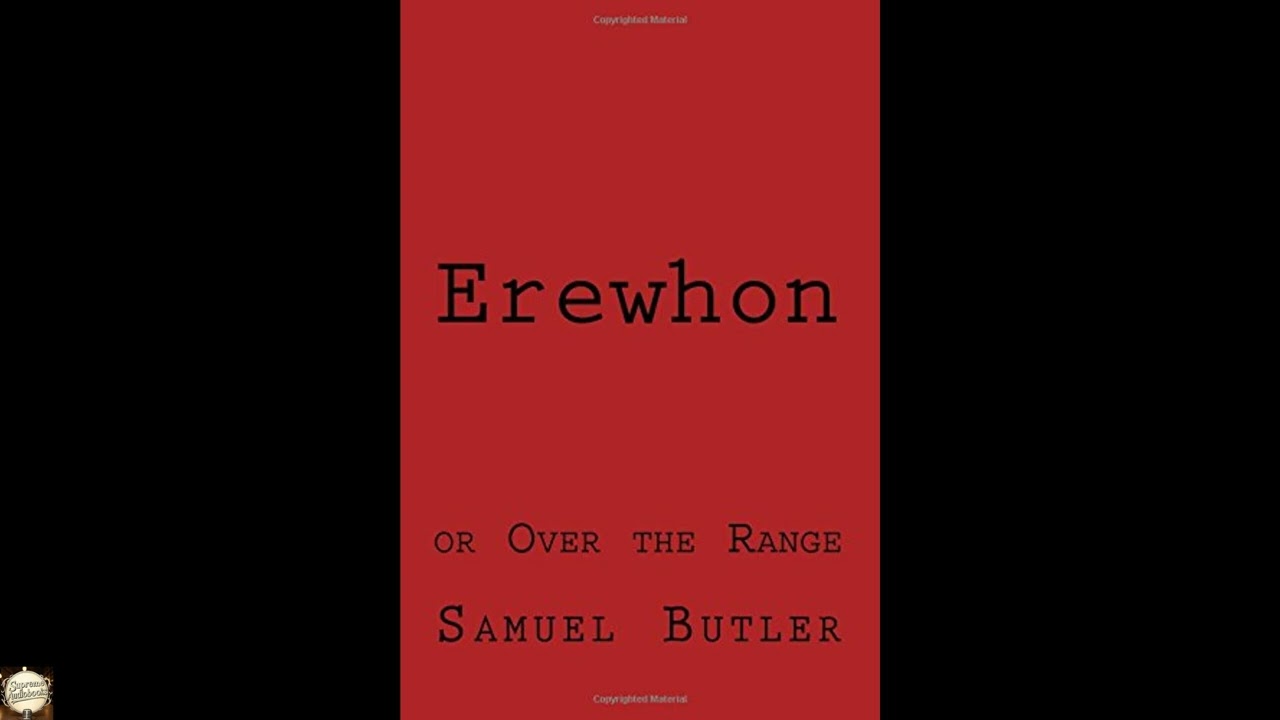
Erewhon: or Over the Range
Imagine a world turned upside down, where the conventions of our society are not merely questioned but inverted with a bewildering, often hilarious, logic. Samuel Butler’s Erewhon: or Over the Range invites listeners into just such a place, a speculative fiction that remains astonishingly resonant today. Published in 1872, this seminal novel is far more than a Victorian curiosity; it acts as a biting social satire, a philosophical thought experiment, and a surprisingly prescient warning against the unchecked march of progress. It forces us to confront the arbitrary nature of our own moral, social, and technological assumptions, making it essential listening for anyone who enjoys sharp wit and provocative ideas about human nature and the societies we build. The story begins with Higgs, a young English shepherd working in a British colonial outpost. Growing restless and sensing the limits of his known world, Higgs becomes obsessed with a formidable mountain range, a barrier few have dared to cross. Driven by a thirst for the unknown, and perhaps a touch of romantic idealism, he ventures "over the range" into the forbidden territory. His arduous ascent, fraught with danger and solitude, eventually leads him to a hidden, seemingly idyllic valley—the land of Erewhon, a name that, when read backwards, hints at its elusive and dreamlike quality. Upon his arrival, Higgs is immediately struck by the beauty and peculiar customs of Erewhonian society. He quickly learns, however, that appearances can be deceiving. The inhabitants, while outwardly charming and well-mannered, live by a code of ethics that is the precise inversion of Victorian sensibilities. Illness is considered a crime, carrying severe penalties, while moral failings—what we might call vices—are treated as diseases requiring compassionate medical attention. Machines, too, are viewed with profound suspicion and have been systematically destroyed centuries ago, based on an ancient prophecy warning of their potential to evolve and dominate humanity. Higgs struggles to navigate this bizarre new reality, attempting to blend in while simultaneously documenting the unsettling absurdities he encounters. His observations form the backbone of the narrative, revealing the fundamental flaws and hypocrisies within the Erewhonian system, even as he recognizes parallels to the world he left behind. Samuel Butler, born in Nottinghamshire, England in 1835, was a fiercely independent and often controversial figure who challenged the prevailing orthodoxies of his Victorian age. The son of a clergyman, he endured a strained relationship with his father, a conflict that deeply influenced his later literary output. Rather than follow the expected path into the church, Butler chose to emigrate to Canterbury, New Zealand, in 1859, where he spent five formative years as a sheep farmer. His experiences in this distant, rugged land provided him with a unique perspective on English society and the self-reliance necessary to carve out a new existence, elements that would clearly inform the pioneering spirit of Erewhon. After returning to England in 1864, Butler dedicated himself to writing, painting, and studying. He became a significant intellectual voice, contributing to debates on Darwinism, religion, and social conventions. While Erewhon brought him initial recognition, his most enduring literary achievement is often considered to be his posthumously published autobiographical novel, The Way of All Flesh. This biting satire of Victorian family life and education further cemented his reputation as a cultural critic who possessed a sharp intellect and a profound distrust of institutional hypocrisy. Butler’s critical stance and willingness to question established norms positioned him as a unique figure within the late Victorian literary landscape. One of the central themes Butler enacts in Erewhon is the arbitrary nature of societal morality and justice. He brilliantly skewers Victorian hypocrisy through the Erewhonian treatment of crime and illness. For instance, a character suffering from consumption is sentenced to hard labor and public opprobrium, while a swindler, caught cheating, is gently nursed back to moral health by compassionate doctors. This inversion forces the listener to question the foundations of judgment and compassion, asking whether our own systems are truly more rational or merely culturally ingrained. Another powerful theme is the fear of technological advancement and its potential for unchecked evolution. Butler vividly presents the Erewhonian "Book of the Machines," a philosophical treatise that argues for the destruction of all complex machinery lest it develop consciousness and subjugate humanity. This prescient anxiety about artificial intelligence and its implications for human agency remains strikingly relevant in our contemporary discussions about technology. Butler also satirizes religious institutions and practices, particularly through the concept of the "musical banks." These institutions, reminiscent of traditional churches, demand adherence to certain rituals and the exchange of a specialized, worthless currency. While people attend the musical banks regularly, their practices are seen as largely symbolic and divorced from everyday life, highlighting the superficiality of some religious observance. Furthermore, the novel critically examines the concept of evolution, engaging with Darwinian ideas that were highly contentious at the time. Through the Erewhonian fear of machine evolution, Butler playfully extends Darwin's theories to inanimate objects, provoking thought about the very definition of life, progress, and humanity's place in the natural order. Erewhon emerged during a period of immense change and intellectual ferment in Victorian England. The mid-to-late nineteenth century witnessed rapid industrialization, bringing both unprecedented prosperity and significant social upheaval. Charles Darwin's On the Origin of Species, published just a decade before Erewhon, had rocked the foundations of religious belief and scientific understanding, sparking widespread debate about human origins and natural selection. Socially, the era was characterized by a strong moral rectitude, class stratification, and a fervent belief in progress, often tied to empire and technological advancement. Butler's novel directly challenged many of these deeply held Victorian convictions, using the fictional setting of Erewhon as a critical mirror to reflect upon his own society's assumptions about morality, technology, religion, and the very definition of civilization. It was a period ripe for satirical commentary on the pace and direction of human development. Listening to Erewhon as an audiobook provides an exceptional opportunity to fully appreciate Butler’s dry wit and the subtly ironic tone that permeates the narrative. A skilled narrator brings Higgs's bewildered observations to life, giving voice to the strange pronouncements of the Erewhonians, from their bizarre legal codes to their peculiar philosophical texts. The novel’s observational style and the gradual unfolding of Erewhonian customs lend themselves perfectly to sustained listening, allowing the listener to absorb the satirical nuances and philosophical questions at a measured pace. The several hours of narration offer a chance to immerse oneself completely in this thought-provoking world, making it an ideal companion for long commutes, quiet evenings, or any moment desiring intellectual stimulation and a good, clever story.
Enjoyed Erewhon: or Over the Range? A few ways to support us
Audible & Amazon links are affiliate; we may earn a small commission at no extra cost.
About this production
Human narration by a volunteer reader from LibriVox.org, the public-domain audiobook project. LibriVox volunteers record literary works whose copyright has expired in the United States, releasing the resulting recordings into the public domain.
Erewhon: or Over the Range by Samuel Butler. The underlying text is in the U.S. public domain. We do not republish any modern copyrighted edition, translation, or commentary.
The 4K cinematic visuals accompanying this audiobook are generated by an AI image model from prompts derived from the source text. No copyrighted photos, paintings, or stock footage are used. AI generation is disclosed on every video on our YouTube channel as required by YouTube's altered/synthetic content policy.
English subtitles are transcribed from the LibriVox recording with OpenAI Whisper. Translations into the 11 other supported languages are produced by Meta's NLLB-200 neural translation model. No human translator's copyrighted translation is used.
Questions about sourcing or rights? See our DMCA & Sourcing policy or contact us.
Enjoyed this audiobook?
If you'd like to own a copy of Erewhon: or Over the Range or hear a professionally produced edition, the links below help support free audiobook production at no extra cost to you.
As an Amazon Associate we earn from qualifying purchases. Audible / print links are affiliate.