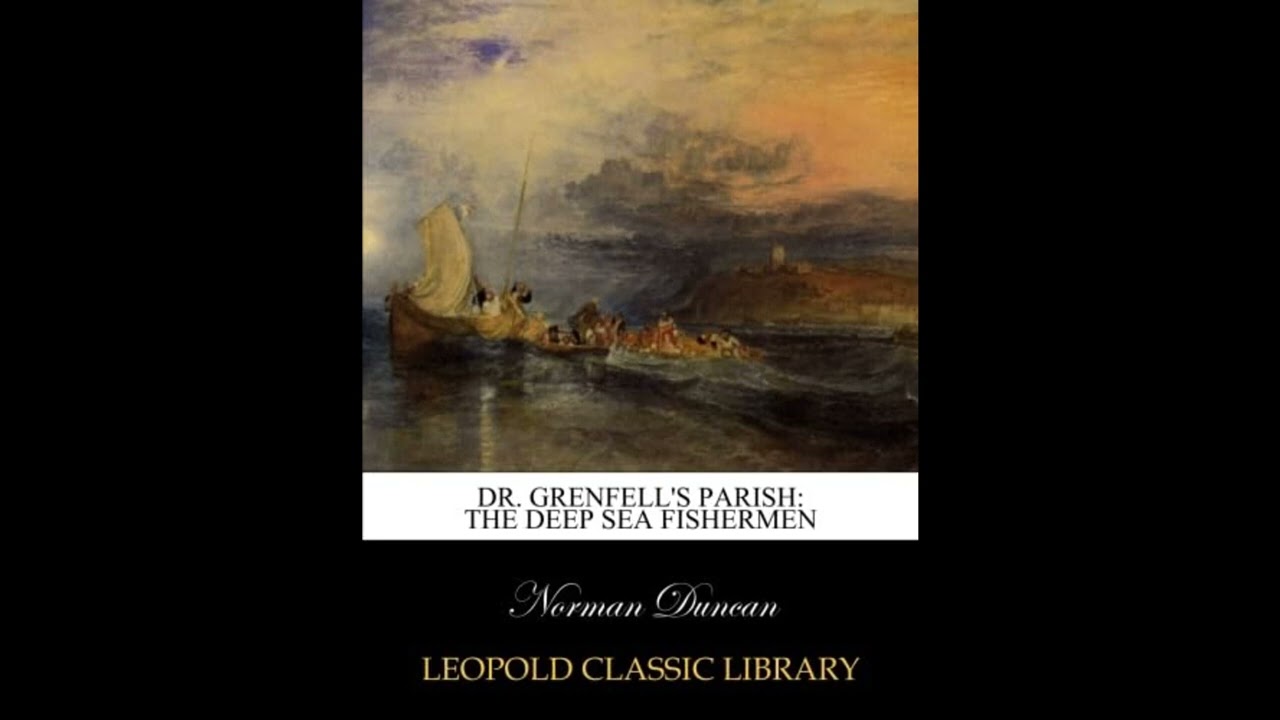
Dr. Grenfell's Parish: the deep sea fishermen
Life on the Labrador coast at the turn of the twentieth century meant facing the raw, untamed power of the North Atlantic, a struggle for survival waged daily against ice, storm, and an unforgiving sea. Norman Duncan’s Dr. Grenfell's Parish: the deep sea fishermen offers a unique window into this stark reality, a collection of profoundly human stories that illuminate the stoicism, courage, and simple dignity of those who wrestled their livelihood from the ocean’s depths. This is not merely a historical record but a testament to the enduring human spirit, showcasing how communities carve out existence and meaning in the harshest of environments. Listeners today will recognize in these tales the universal themes of resilience, the strength of communal bonds, and the quiet heroism found in everyday lives, struggles that continue to resonate in a world where adversity still tests the limits of human endurance. Duncan's book transports the listener to the remote fishing outports and schooners of Newfoundland and Labrador, a place where civilization’s amenities were scarce, and existence hung precariously on the whims of weather and fishing fortunes. The central figure, Dr. Wilfred Grenfell, is not so much a character as a guiding presence, an indefatigable medical missionary whose work provided a crucial lifeline to these isolated populations. Through Duncan’s observant prose, we encounter the deep-sea fishermen—hard-bitten, weather-beaten men whose lives are defined by the cycle of the seasons, the perilous hunt for cod and seals, and the constant threat of disaster. We are introduced to their families, the women who keep the homes alight through long, dark winters, and the children who learn the ways of the sea almost before they can walk. The story, told as a series of sketches and vignettes, follows no singular protagonist but rather paints a collective portrait of a people. Duncan chronicles their daily routines, their quiet triumphs, and their profound tragedies—the sudden squalls that claim lives, the diseases that ravage communities, the endless toil for meager returns. There are moments of shared laughter, quiet acts of selflessness, and the stark beauty of a landscape both brutal and breathtaking. The author renders these experiences with a compassionate eye, capturing the rhythmic ebb and flow of life in the "parish" Grenfell served, demonstrating how hope and despair were often two sides of the same coin in this remote corner of the world. It is a narrative built upon observation and empathy, inviting us to witness a way of life that, while dramatically different from our own, reveals much about the shared human condition. Norman Duncan, born in Norwich, Ontario, in 1871, carved out a distinctive place in Canadian and American letters during his relatively short life, which ended in 1916. After graduating from the University of Toronto, he pursued a career in journalism, eventually working for the New York Evening Post and later teaching at the University of Kansas. It was during his years as a journalist and burgeoning author that Duncan undertook expeditions to the remote coasts of Newfoundland and Labrador, experiences that would profoundly shape his literary output. He spent time living among the deep-sea fishermen, witnessing their struggles and their indomitable spirit firsthand, often collaborating with or observing the work of Dr. Wilfred Grenfell. These formative years in the North Atlantic led to some of his most acclaimed works, earning him a reputation as a compassionate chronicler of maritime life. Beyond Dr. Grenfell's Parish, his notable titles include The Way of the Sea (1903), a collection of short stories that further cemented his reputation for realistic depictions of fishing communities, and Doctor Luke of the Labrador (1904), a novel inspired by Grenfell’s work. He also penned popular children's adventure stories set in the region, such as The Adventures of Billy Topsail (1906). Duncan belonged to a literary era that valued regionalism and realism, seeking to capture the authentic voices and experiences of specific locales and occupations. His work stands as a poignant record of a demanding way of life, securing his place as a significant voice in early 20th-century North American literature. At its core, Dr. Grenfell's Parish enacts several powerful themes. One central idea is the remarkable resilience of the human spirit in the face of overwhelming adversity. Duncan vividly portrays the fishermen who, despite the constant threat of death on the open sea or the gnawing hunger of lean years, continue to rise each day, mend their nets, and push their boats into the frigid waters. An example of this is seen in the quiet fortitude of a widow who, having lost her husband and sons to the sea, still finds the strength to care for her remaining family and contribute to the community, her grief subsumed by the relentless demand for survival. This determination is a testament to an unbreakable will to persist against elemental forces. Another prominent theme is the profound importance of community and mutual aid in isolated settings. In a place where government support was minimal and individual survival often impossible, neighbors relied entirely on one another. The book showcases how, when a fisherman’s boat is lost in a storm, the entire outport rallies, pooling resources and labor to help the family rebuild, sharing meager catches and offering comfort. This web of interdependence, born of necessity, fosters a deep sense of loyalty and shared destiny. Furthermore, the narrative highlights the spiritual fortitude that underpins these lives, demonstrating how faith often provides solace and purpose amidst immense hardship, helping individuals to face their grim realities with a measure of peace. This compelling collection of observations emerged from a specific historical moment—the early 1900s—a period witnessing both the apex of traditional deep-sea fishing as a vital industry in regions like Newfoundland and Labrador, and the growing recognition of the dire social and medical needs in such remote communities. Before widespread communication, improved transportation, or robust social safety nets, these settlements were profoundly isolated, their well-being directly tethered to the bounty of the sea. The work of medical missionaries like Dr. Wilfred Grenfell—who established hospitals, orphanages, and cooperative stores—was groundbreaking and revolutionary, addressing a stark vacuum of public services. Culturally, this era also saw a renewed interest in documenting diverse American and Canadian experiences, moving away from purely urban narratives to embrace the unique challenges and characters of rural and frontier life. Authors like Norman Duncan were part of a literary trend that sought to give voice to the often-unseen struggles of working people in specific, geographically defined regions. His firsthand accounts of life in Grenfell’s "parish" resonated with a public increasingly aware of social inequalities and the harsh realities faced by those living on the margins of industrial society, providing both a glimpse into a vanishing world and a call for humanitarian concern. Listening to Dr. Grenfell's Parish as an audiobook offers a singularly immersive experience, allowing the raw, sensory details of Duncan’s prose to truly come alive. At several hours in length, it provides ample opportunity to sink into the rhythms of life on the Labrador coast, feeling the chill of the wind, hearing the crash of waves, and understanding the quiet fortitude of its people. A skilled narrator can bring authentic voice to the fishermen’s stoic dialogue, the doctor’s unwavering resolve, and the author’s keen observations, enriching the atmosphere with a sense of place and period. The pacing of the narration can echo the slow, deliberate pace of life in these remote communities, punctuated by moments of sudden drama and profound reflection, inviting listeners to truly connect with the struggles and triumphs of these resilient individuals.
Enjoyed Dr. Grenfell's Parish: the deep sea fishermen? A few ways to support us
Audible & Amazon links are affiliate; we may earn a small commission at no extra cost.
About this production
Human narration by a volunteer reader from LibriVox.org, the public-domain audiobook project. LibriVox volunteers record literary works whose copyright has expired in the United States, releasing the resulting recordings into the public domain.
Dr. Grenfell's Parish: the deep sea fishermen by Norman Duncan. The underlying text is in the U.S. public domain. We do not republish any modern copyrighted edition, translation, or commentary.
The 4K cinematic visuals accompanying this audiobook are generated by an AI image model from prompts derived from the source text. No copyrighted photos, paintings, or stock footage are used. AI generation is disclosed on every video on our YouTube channel as required by YouTube's altered/synthetic content policy.
English subtitles are transcribed from the LibriVox recording with OpenAI Whisper. Translations into the 11 other supported languages are produced by Meta's NLLB-200 neural translation model. No human translator's copyrighted translation is used.
Questions about sourcing or rights? See our DMCA & Sourcing policy or contact us.
Enjoyed this audiobook?
If you'd like to own a copy of Dr. Grenfell's Parish: the deep sea fishermen or hear a professionally produced edition, the links below help support free audiobook production at no extra cost to you.
As an Amazon Associate we earn from qualifying purchases. Audible / print links are affiliate.