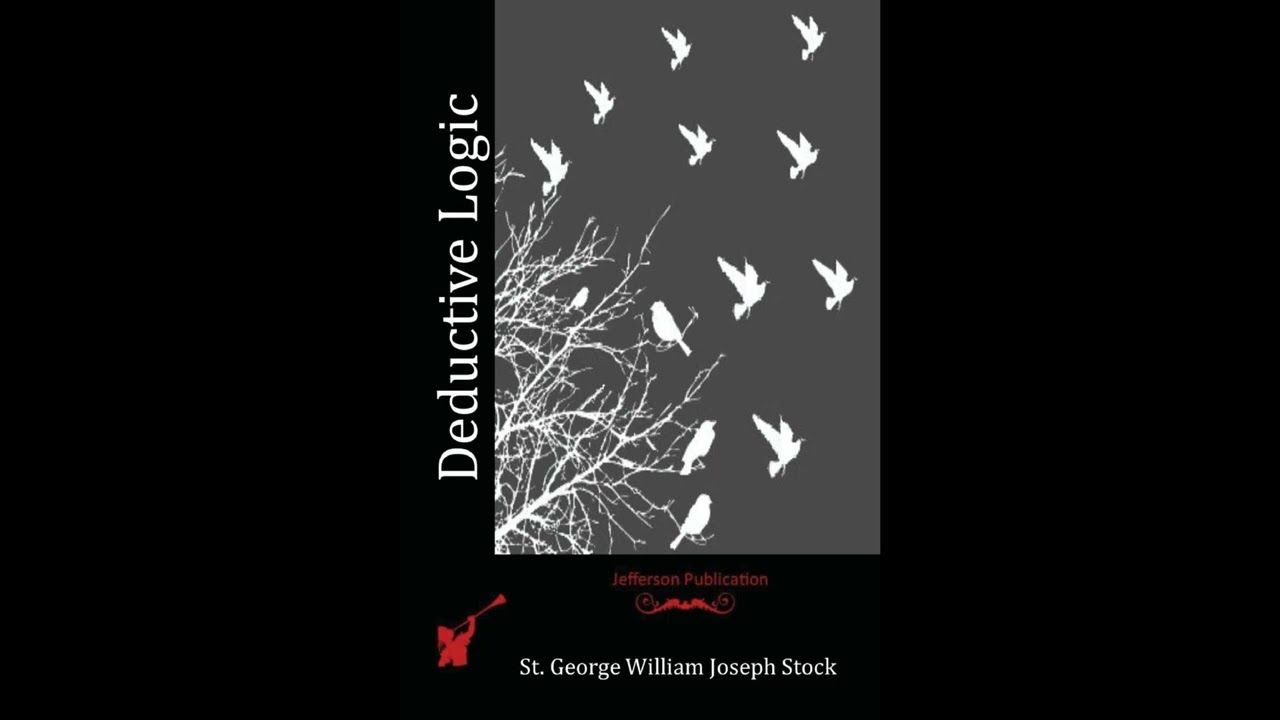
Deductive Logic
At a time when information floods our senses and the ability to discern fact from fallacy feels more urgent than ever, the foundational principles of sound reasoning stand as a steadfast anchor. St. George William Joseph Stock's Deductive Logic, presented here as an essential audiobook, is not merely a historical artifact but a potent toolkit for navigating modern thought. This isn't a dry academic exercise; it's an invitation to sharpen your understanding, to build arguments with clarity, evaluate claims with precision, and ultimately, to think with greater power and independence. Listeners today will find within these teachings the enduring wisdom necessary to cut through ambiguity, identify flawed reasoning, and construct cogent arguments in any facet of life. Rather than following characters through a narrative, Deductive Logic guides the listener through the internal architecture of thought itself, charting a course from fundamental concepts to sophisticated analytical methods. The intellectual progression begins with a grounding in basic building blocks: terms, propositions, and their essential distinctions. St. George Stock acts as a clear-sighted guide, carefully elucidating the nature of definition, classification, and the various types of statements used to express ideas. Listeners learn to properly identify and structure argument components before evaluating truth or validity. As instruction progresses, the focus shifts to the heart of deductive reasoning: the syllogism. Here, Stock systematically reconstructs this classical form, revealing its inherent structure and the precise rules governing its conclusions. The underlying intellectual conflict is the constant struggle against imprecise thought and illogical leaps. Through clear examples, the book presents various figures and moods of the syllogism, demonstrating how valid conclusions must follow from given premises. The listener learns to differentiate between arguments that merely seem sound and those that are logically watertight, understanding the crucial difference between truth of premises and validity of argument structure. The arc continues by illuminating common pitfalls and subtle deceptions. Stock meticulously catalogs a range of fallacies – errors that often masquerade as legitimate arguments, including errors of equivocation, begging the question, and faulty generalization. By exposing these intellectual traps, the text empowers the listener to identify and dismantle them, both in others' arguments and within their own patterns of thinking. This progression is one of intellectual emancipation – moving from naive acceptance to critical assessment, culminating in a refined ability to construct, analyze, and defend rational positions with unwavering confidence. St. George William Joseph Stock, born in 1850, was a distinguished British classical scholar and philosopher, whose intellectual life was deeply intertwined with the academic traditions of late Victorian England. Educated at Oxford University, Stock dedicated his career to the rigorous study and clear exposition of logic, ethics, and ancient philosophy. He held positions within the Oxford system, contributing to an intellectual environment that valued precision, classical learning, and systematic thought. While Deductive Logic remains his most recognized work in formal reasoning, he also produced texts such as Prolegomena to Systems of Philosophy and a translation of Plato's Apology, Crito, and Phaedo, showcasing his broad engagement with Western thought. Stock was not a flamboyant figure of philosophical revolution but rather a meticulous scholar who sought to clarify and transmit established knowledge with exceptional lucidity. His contribution lies in his ability to distill complex logical principles into an accessible and coherent system, making the intricacies of Aristotelian and later formal logic digestible for students and general readers alike. He belonged to an era that placed a high premium on systematic education and the cultivation of rational faculties, viewing logic not as an abstract game but as an indispensable tool for intellectual development. His place in the canon is not that of a groundbreaking theorist, but as a crucial explicator and consolidator of deductive principles, whose work helped shape generations of thinkers. The central themes running through Deductive Logic are inextricably linked to intellectual rigor. One primary theme is the primacy of precise language, demonstrating how ambiguity in terms and propositions inevitably leads to flawed conclusions. Stock shows, for instance, how seemingly simple words can carry multiple meanings, and how a failure to define one's terms — a concept he unpacks with painstaking detail — can derail an argument. He illustrates this by dissecting how changing the meaning of a key word between premises can lead to a conclusion that is an illusion of logic. Another vital theme is the structure of rational argument itself, with Stock meticulously outlining the conditions under which one statement truly follows from another. This is most vividly demonstrated in his comprehensive treatment of the syllogism. He does not merely state rules for valid inference; he presents concrete examples of major and minor premises, and then carefully walks the listener through how a conclusion either necessarily emerges or fails to do so. This step-by-step process instills a deep appreciation for the architectural integrity required in constructing sound reasoning. Through these explanations, the text continually reinforces the idea that genuine understanding stems from structured thought, not mere assertion. The publication of Deductive Logic in 1888 places it firmly within the late Victorian era, a period characterized by profound faith in reason, order, and systematic knowledge. The intellectual landscape was one where logic and classical studies formed a cornerstone of university education, believed essential for cultivating clear thinking and moral character. It was a time when scientific discovery was rapidly expanding human understanding, fostering a widespread desire for similar rigor and clarity in all fields of inquiry. Works like Stock's emerged as essential pedagogical tools, reflecting the era's commitment to formal instruction in the art of reasoning. Politically and socially, Britain was a global power, and there was a societal expectation for educated citizens to engage with complex ideas and contribute to public discourse with informed opinions. A firm grasp of logical principles was considered a prerequisite for responsible participation. While later philosophical movements would challenge some of traditional logic's assumptions, Stock's textbook provided a crucial foundation, codifying established principles in a way that resonated with the era's emphasis on structure, clarity, and the systematic transmission of knowledge. Listening to Deductive Logic as an audiobook offers a uniquely immersive pathway into its profound subject matter. The run length, several hours, allows for sustained periods of focused intellectual engagement, giving the listener ample time to absorb complex concepts without the visual distractions of a printed page. A skilled narrator's voice becomes a guiding presence, leading one through each intricate argument and careful distinction with clarity and measured pacing. The spoken word can illuminate the structure of a logical proof in a way that reading might not immediately convey, allowing the listener's mind to follow the chain of reasoning step-by-step, almost as if attending a private tutorial. The atmosphere created is one of thoughtful contemplation, where the absence of visual clutter encourages deep listening and internal processing of the foundational ideas, making the pursuit of clear thought an almost meditative experience. This format transforms what could be a challenging text into an accessible and rewarding intellectual endeavor.
Enjoyed Deductive Logic? A few ways to support us
Audible & Amazon links are affiliate; we may earn a small commission at no extra cost.
About this production
Human narration by a volunteer reader from LibriVox.org, the public-domain audiobook project. LibriVox volunteers record literary works whose copyright has expired in the United States, releasing the resulting recordings into the public domain.
Deductive Logic by St. George William Joseph Stock. The underlying text is in the U.S. public domain. We do not republish any modern copyrighted edition, translation, or commentary.
The 4K cinematic visuals accompanying this audiobook are generated by an AI image model from prompts derived from the source text. No copyrighted photos, paintings, or stock footage are used. AI generation is disclosed on every video on our YouTube channel as required by YouTube's altered/synthetic content policy.
English subtitles are transcribed from the LibriVox recording with OpenAI Whisper. Translations into the 11 other supported languages are produced by Meta's NLLB-200 neural translation model. No human translator's copyrighted translation is used.
Questions about sourcing or rights? See our DMCA & Sourcing policy or contact us.
Enjoyed this audiobook?
If you'd like to own a copy of Deductive Logic or hear a professionally produced edition, the links below help support free audiobook production at no extra cost to you.
As an Amazon Associate we earn from qualifying purchases. Audible / print links are affiliate.