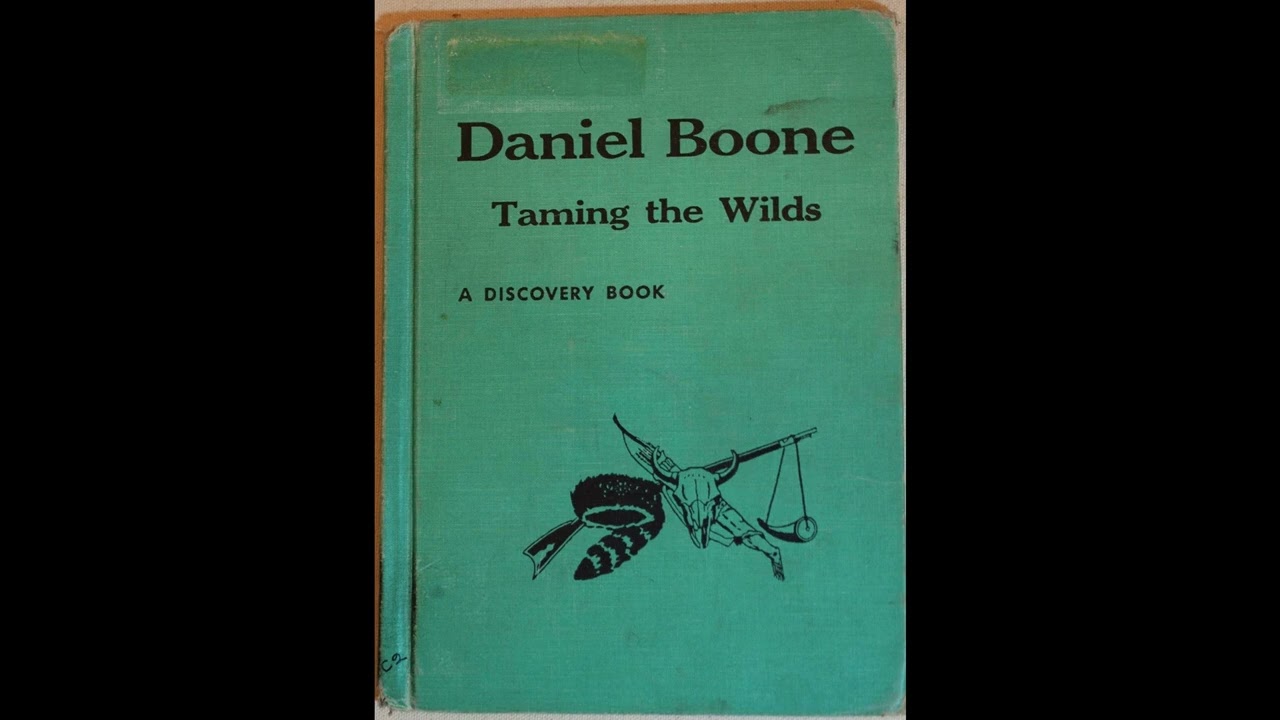
Daniel Boone: Taming the Wilds
Before America's vast network of highways and sprawling cities existed, before even the ink dried on the Declaration of Independence, there was an untamed wilderness stretching west, a vast and mysterious land waiting to be known. In the heart of this formidable frontier stood Daniel Boone, a figure whose very name has become synonymous with American grit and the relentless push into the unknown. Katharine E. Wilkie's "Daniel Boone: Taming the Wilds" offers a foundational account of this iconic frontiersman, presenting his life not just as a series of adventures, but as a defining saga in the making of a nation. For modern listeners, this narrative provides an essential understanding of the challenges, the spirit, and the moral complexities that shaped the early American character, revealing the deep roots of our enduring fascination with independence and the call of the open spaces. Wilkie's story drops listeners directly into the raw, often perilous world of colonial America, specifically in the mid-18th century, as settlers began to cast their eyes beyond the Appalachian mountains. The narrative centers on Daniel Boone, a man born with an insatiable longing for what lay beyond the next ridge – a restlessness that would drive him to become one of history's most renowned woodsmen and pioneers. Raised in a Quaker family in Pennsylvania, Boone soon found the settled life too confining, preferring the solace and challenge of the deep woods. The central conflict of the story quickly emerges: the seemingly insurmountable task of carving out a civilized existence from a land fiercely protected by its indigenous inhabitants and dominated by an unforgiving natural environment. The story follows Boone from his early days as a hunter and trapper, honing the skills that would make him legendary, to his momentous expeditions into the "dark and bloody ground" of Kentucky. He becomes a leading figure in the westward expansion, envisioning settlements in a land he found breathtakingly beautiful yet fraught with danger. Listeners witness his tireless efforts to establish Boonesborough, a crucial early outpost that symbolized the settlers' audacious claims. This endeavor pits Boone and his fellow pioneers against not only the relentless forces of nature—harsh winters, scarce food, wild animals—but also against various Native American tribes, primarily the Shawnee, who viewed these encroaching settlements as a direct threat to their ancestral lands and way of life. The narrative vividly portrays the constant vigilance, the daring escapes, and the profound personal sacrifices required to survive and establish a foothold in this contested territory, leaving the listener with a keen sense of the sheer tenacity demanded of these early American pathfinders. Katharine E. Wilkie, an American author born in 1904 in Kentucky, dedicated much of her literary career to bringing historical figures and events to life for a broad audience. Her upbringing in a state deeply steeped in frontier history undoubtedly fostered her interest in subjects like Daniel Boone and Zachary Taylor, another Kentuckian whom she profiled in "Zack Taylor, Young Rough and Ready." Wilkie published a number of historical biographies and works of fiction aimed primarily at younger readers, a genre in which she excelled at making complex historical narratives accessible and engaging. Her writing is characterized by clear prose and a focus on detail that anchors her stories in verifiable historical context, even while presenting them with a compelling narrative flow. Beyond her works on Boone and Taylor, Wilkie also authored books such as "Kentucky's Covered Bridges" and "Man and the Mountain," further cementing her reputation as a chronicler of American history and culture, particularly that of her home state. Her ability to synthesize extensive research into readable, stimulating accounts secured her a respected place within the tradition of biographical fiction that helps introduce foundational American stories to new generations. "Daniel Boone: Taming the Wilds" masterfully enacts several enduring themes crucial to understanding American identity. Foremost is the frontier spirit, characterized by an unyielding drive toward expansion and the allure of the unknown. Boone's repeated refusal to settle in one place, his constant impulse to see what lay just beyond the next range of hills, perfectly illustrates this national characteristic. For instance, the descriptions of his extended hunting trips, sometimes lasting months or even years, abandoning the relative safety of established communities for the profound solitude of the wilderness, underscore this almost spiritual pull toward the wild. Another significant theme is the clash of cultures between the European settlers and the Native American tribes. Wilkie handles this with sensitivity, depicting the deep-seated grievances and territorial claims of the Shawnee while also showcasing Boone's often complex and sometimes respectful relationship with individual Native Americans, even during periods of intense conflict. The dramatic siege of Boonesborough, a repeated event in the story, powerfully demonstrates the high stakes and brutal realities of this confrontation. Additionally, the book significantly addresses the theme of survival against overwhelming odds, both natural and man-made. Boone's extraordinary woodcraft, his ability to track, hunt, and navigate through dense forests, his resourcefulness in the face of scarcity, and his courage in battle serve as constant examples of human resilience. The narrative consistently shows how Boone and his fellow pioneers relied on their ingenuity and sheer tenacity to overcome the challenges of a harsh environment and constant threats. Furthermore, the narrative subtly presents the formation of a distinct American identity, one shaped by independence, self-reliance, and a rugged individualism forged in the crucible of the wilderness, demonstrating how the frontier experience molded new ways of thinking and living distinct from their European origins. When Katharine E. Wilkie penned "Daniel Boone: Taming the Wilds" in 1960, the United States was experiencing a period of intense reflection on its national character and historical origins. The post-World War II era, coupled with the nascent Cold War, created a cultural desire for narratives that celebrated American heroes, resilience, and the core values of the nation. Biographies and historical fiction for younger readers, in particular, flourished as a means of instilling patriotism and a sense of shared heritage. Wilkie's book fit perfectly into this cultural landscape, offering an accessible, heroic portrayal of a figure whose life embodied the courage and pioneering spirit that many Americans admired. It emerged at a time when simplified yet compelling historical narratives played a vital role in shaping a collective national identity, reinforcing ideals of self-sufficiency and the pursuit of new frontiers, even as the "frontier" itself had long been settled. Listening to "Daniel Boone: Taming the Wilds" as an audiobook offers an especially immersive experience, transporting the listener directly into the dense forests and tense moments of the frontier. The run length, several hours long, allows for a comprehensive and unhurried progression through Boone's life, perfect for long drives, focused listening sessions, or even as a backdrop to quiet activities. A skilled narrator can bring the vastness of the American wilderness to life, painting vivid mental images with subtle shifts in tone and pacing – from the hushed sounds of Boone tracking game to the sudden urgency of a skirmish. Listen for the narrator's ability to differentiate characters through dialogue, giving voice to Boone's quiet determination, the anxieties of the settlers, and the pronouncements of Native American leaders. The atmospheric quality of the narration allows one to truly appreciate the isolation, the beauty, and the profound dangers of Boone's world, making his story feel immediate and deeply personal.
Enjoyed Daniel Boone: Taming the Wilds? A few ways to support us
Audible & Amazon links are affiliate; we may earn a small commission at no extra cost.
About this production
Human narration by a volunteer reader from LibriVox.org, the public-domain audiobook project. LibriVox volunteers record literary works whose copyright has expired in the United States, releasing the resulting recordings into the public domain.
Daniel Boone: Taming the Wilds by Katharine E. Wilkie. The underlying text is in the U.S. public domain. We do not republish any modern copyrighted edition, translation, or commentary.
The 4K cinematic visuals accompanying this audiobook are generated by an AI image model from prompts derived from the source text. No copyrighted photos, paintings, or stock footage are used. AI generation is disclosed on every video on our YouTube channel as required by YouTube's altered/synthetic content policy.
English subtitles are transcribed from the LibriVox recording with OpenAI Whisper. Translations into the 11 other supported languages are produced by Meta's NLLB-200 neural translation model. No human translator's copyrighted translation is used.
Questions about sourcing or rights? See our DMCA & Sourcing policy or contact us.
Enjoyed this audiobook?
If you'd like to own a copy of Daniel Boone: Taming the Wilds or hear a professionally produced edition, the links below help support free audiobook production at no extra cost to you.
As an Amazon Associate we earn from qualifying purchases. Audible / print links are affiliate.
More Audiobooks

The Way to the West And the Lives of Three Early Americans: Boone, Crocket and Carso- Full Audiobook

American Big Game in Its Haunts: The Book of the Boone and Crockett Club
Bucky O'Connor: A Tale Of The Unfenced Border (1910)
Among The Sioux: A Story Of The Twin Cities And The Two Dakotas With Introduction