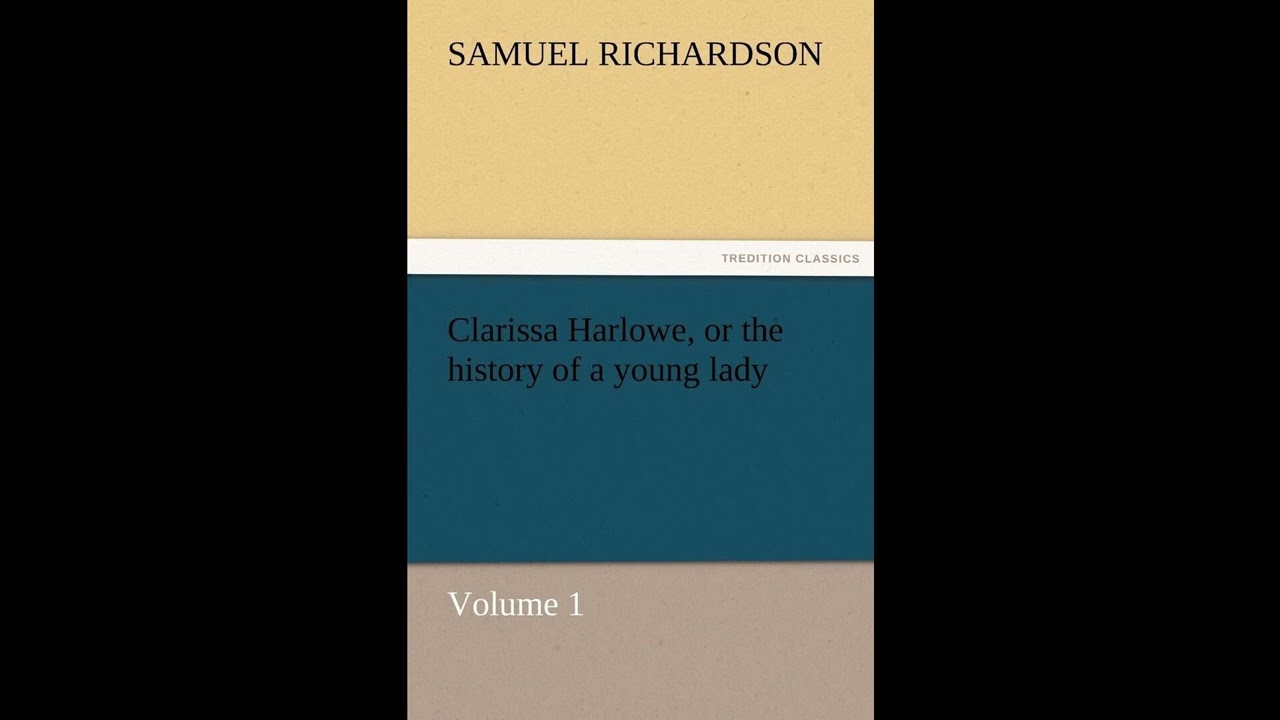
Clarissa Harlowe, or the history of a young lady - Volume 1
Step into the urgent, deeply personal world of Clarissa Harlowe, Samuel Richardson’s monumental novel from the mid-eighteenth century, a work that fundamentally shaped the English literary landscape and continues to resonate with powerful questions about virtue, agency, and social expectation. This first volume introduces us to a young woman of uncommon intelligence and moral strength, caught in a web of family ambition and predatory design. Far from being a relic of the past, Clarissa’s struggle for autonomy against overwhelming societal and personal pressures speaks to enduring human conflicts, making her story as compelling and, at times, as agonizingly relevant today as it was more than two hundred and fifty years ago. It is a story told with searing psychological intensity, demanding not just attention but empathy from its audience. The narrative unfolds in the form of letters, a torrent of correspondence that draws the listener directly into the minds of its characters, set against the backdrop of an English gentry estate. Clarissa Harlowe, a young lady blessed with beauty, wit, and an unyielding sense of moral rectitude, finds herself increasingly isolated within her own family. Her relatives – particularly her hot-headed brother James and spiteful sister Arabella – resent her perceived superiority and her generous inheritance. Driven by social climbing and avarice, the Harlowe family attempts to force Clarissa into an unwanted marriage with Roger Solmes, a man she finds repugnant, solely for his wealth and their desire to consolidate the family’s estate. This tyrannical pressure, coupled with her family’s cruel treatment, corners Clarissa, compelling her to consider desperate measures. Into this fraught domestic scene steps Robert Lovelace, a charming, aristocratic libertine with a notorious reputation. Though initially appearing as a potential rescuer from her family’s harsh dictates, Lovelace is a manipulator of the highest order, driven by a desire to conquer Clarissa’s celebrated virtue and subdue her independent spirit. As Clarissa’s situation at home becomes unbearable, marked by confinement and emotional abuse, she is reluctantly drawn into Lovelace’s orbit, seeing him as the only path to escape her impending forced marriage. This initial volume chronicles the escalating tension within the Harlowe household, Clarissa’s desperate attempts to reason with her unyielding family, and the insidious unfolding of Lovelace’s schemes as he positions himself to exploit her vulnerability, setting the stage for a profound confrontation of wills and principles. The literary world owes a profound debt to Samuel Richardson, a man who, despite his humble beginnings, helped invent the modern English novel. Born in 1689, Richardson’s path to literary renown was unusual; he did not set out to be a novelist. He began his professional life as a printer and bookseller, rising through the London trade to become a highly respected figure in his industry. It was only in his fifties, after a successful career publishing the works of others, that he began to write fiction himself, almost by accident, when asked to provide models for letter writing. His first novel, Pamela; or, Virtue Rewarded, published in 1740, became an overnight sensation, quickly establishing Richardson as a new force in literature. This ground-breaking work, also told through letters, captivated readers with its intimate portrayal of a virtuous servant girl resisting her master’s advances. Richardson followed Clarissa Harlowe with The History of Sir Charles Grandison, another multi-volume epistolary novel. His distinctive focus on domestic life, psychological realism, and the inner lives of his characters, particularly women, carved out a unique space in the burgeoning landscape of English fiction. Richardson’s meticulous attention to moral dilemmas and the nuances of human emotion made him a central figure in the development of the novel as a serious literary form, allowing it to explore the complexities of individual experience with unprecedented depth. He passed away in 1761, leaving behind a legacy that continues to influence writers and thinkers. At its core, Clarissa Harlowe dissects the precarious position of women in eighteenth-century society, particularly through the theme of female agency versus societal constraint. Clarissa’s unwavering refusal to marry Solmes, despite intense familial pressure, exemplifies her profound belief in her right to self-determination and her moral compass. Her eloquent letters reveal her intellectual and emotional resistance to becoming a mere pawn in her family’s social ambitions, illustrating the immense courage it took for a woman of her era to defy patriarchal authority, even at great personal cost. Her every plea and argument for freedom from an odious match showcases her individual will clashing directly with the restrictive expectations placed upon her gender. Another vital theme running through the book is the paramount importance of virtue and reputation, especially for women of the period. Clarissa’s virtue is not simply an abstract concept; it is her very identity, meticulously guarded and continuously reflected upon in her correspondence. Her constant self-scrutiny and moral uprightness in the face of escalating threats highlight the almost unbearable weight placed upon a woman’s honor. This emphasis reveals how a single misstep, or even a perceived lapse in decorum, could irrevocably destroy a woman’s standing, a consequence far more devastating than for men. The novel vividly demonstrates the devastating social and personal ramifications of a reputation compromised, an idea that fuels much of the narrative’s tension and tragedy. When Clarissa Harlowe first appeared in print in 1748, it landed in a rapidly evolving literary and cultural landscape. The mid-eighteenth century was a period of significant intellectual ferment, often referred to as the Age of Enlightenment, where ideas about individual rights, reason, and morality were increasingly debated. While politically still dominated by a relatively narrow elite, the rising middle class was gaining influence, and with it, new forms of entertainment and education, including novels. Marriage, though still largely a social and economic contract, was beginning to be viewed through the lens of personal affection, creating a tension that Richardson skillfully exploited in Clarissa’s plight. The novel itself was a relatively new and still somewhat unrespectable genre, often competing with older forms like romance and epic poetry. Richardson, along with contemporaries such as Henry Fielding, played a crucial role in legitimizing and shaping the novel into a powerful medium for social commentary and psychological inquiry. His choice of the epistolary format, where the story unfolds entirely through letters exchanged between characters, was not entirely new but was perfected by him. This allowed for an unprecedented level of immediacy and intimacy, giving readers direct access to characters' inner thoughts, biases, and the unfolding drama, making Clarissa a revolutionary work that moved fiction towards a greater degree of realism and emotional depth. Listening to Clarissa Harlowe as an audiobook offers a uniquely immersive experience, perfectly suited to the novel’s structure and emotional intensity. The epistolary form, with its constant exchange of letters, truly comes alive when read aloud, creating the sensation of eavesdropping on private correspondence. A skilled narrator can bring distinct voices to each character, differentiating Clarissa’s articulate and earnest reflections from Lovelace’s cynical and manipulative pronouncements, or the harsh, demanding tones of her family. This allows the listener to fully grasp the nuances of their personalities and intentions without needing to pause to identify the sender of each letter. The sheer length of this volume, unfolding over several hours, becomes less a challenge and more an invitation to sink into the eighteenth-century world, absorbing the gradual build-up of tension and the profound emotional weight carried within each word and phrase. The measured pacing allows for the listener to fully appreciate the rhetorical power of the letters, the subtle shifts in character relationships, and the mounting sense of dread that permeates Clarissa’s desperate situation.
Enjoyed Clarissa Harlowe, or the history of a young lady - Volume 1? A few ways to support us
Audible & Amazon links are affiliate; we may earn a small commission at no extra cost.
About this production
Human narration by a volunteer reader from LibriVox.org, the public-domain audiobook project. LibriVox volunteers record literary works whose copyright has expired in the United States, releasing the resulting recordings into the public domain.
Clarissa Harlowe, or the history of a young lady - Volume 1 by Samuel Richardson. The underlying text is in the U.S. public domain. We do not republish any modern copyrighted edition, translation, or commentary.
The 4K cinematic visuals accompanying this audiobook are generated by an AI image model from prompts derived from the source text. No copyrighted photos, paintings, or stock footage are used. AI generation is disclosed on every video on our YouTube channel as required by YouTube's altered/synthetic content policy.
English subtitles are transcribed from the LibriVox recording with OpenAI Whisper. Translations into the 11 other supported languages are produced by Meta's NLLB-200 neural translation model. No human translator's copyrighted translation is used.
Questions about sourcing or rights? See our DMCA & Sourcing policy or contact us.
Enjoyed this audiobook?
If you'd like to own a copy of Clarissa Harlowe, or the history of a young lady - Volume 1 or hear a professionally produced edition, the links below help support free audiobook production at no extra cost to you.
As an Amazon Associate we earn from qualifying purchases. Audible / print links are affiliate.