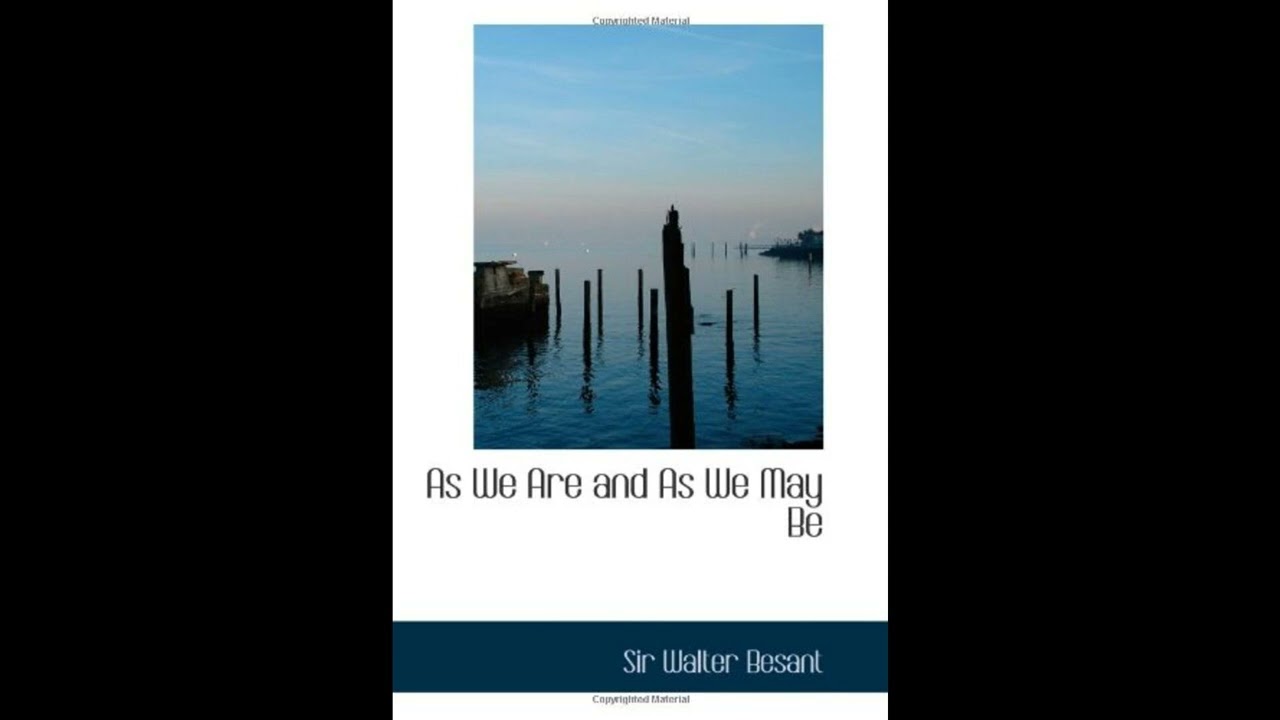
As We Are and As We May Be
Step back into a time of immense social change and profound moral reckoning with Sir Walter Besant’s incisive collection of essays, "As We Are and As We May Be." This isn’t a forgotten relic; it’s a living document that speaks with startling clarity to the enduring questions of human progress, social justice, and the collective imagination. Besant, a keen observer of Victorian England, confronts the stark realities of his present – the crushing poverty, the urban squalor, the profound inequalities – and dares to envision a better future, a society built on principles of dignity, community, and enlightened self-interest. His powerful arguments compel us to look anew at our own societal challenges, urging us to consider not just what society is, but what it has the potential to become. Published in a period rife with economic disparity and rapid urbanization, "As We Are and As We May Be" offers a penetrating examination of late 19th-century British society. Besant meticulously details the condition of England's working classes, the plight of its urban poor, and the challenges faced by the burgeoning middle class. He doesn't invent characters or concoct a fictional world; instead, he presents a meticulously observed panorama of real life, focusing on the structures and institutions that shape people's existence. The "setting" is therefore a vivid, often uncomfortable, portrayal of London and other industrial centers, characterized by their overcrowded tenements, their burgeoning factories, and the stark visual contrast between unimaginable wealth and abject destitution. Besant's central argument establishes a powerful opposition between "as we are" – the current state of affairs, with its inherent flaws and injustices – and "as we may be" – a hopeful, yet practical, vision for societal improvement. He critically assesses various contemporary solutions, from haphazard charity to paternalistic welfare schemes, finding them often insufficient or even counterproductive. Instead, he proposes a blueprint for genuine social advancement, emphasizing education, community-led initiatives, and a more equitable distribution of opportunity. The arc of his argument moves from a sharp diagnosis of the problems to a thoughtful prescription of remedies, encouraging readers to engage actively in the transformation of their own communities and the nation as a whole. He challenges the complacency of the affluent and empowers the dispossessed by articulating a path toward a more humane existence. Sir Walter Besant, born in Portsmouth in 1836, lived a life deeply intertwined with the social and literary currents of the Victorian era. Educated at King's College London and Christ's College, Cambridge, he initially pursued a career in academia, serving as a professor at the Royal College of Mauritius. However, his passion for writing and social commentary soon drew him back to England, where he forged a formidable literary career. He began his writing life in a successful collaboration with James Rice, producing several popular novels that often blended adventure with social observation, such as "Ready-Money Mortiboy." After Rice's untimely death, Besant continued to write prolifically on his own, solidifying his reputation as a novelist and social historian. His solo works frequently focused on the lives of ordinary Londoners and the pressing social issues of the day. Perhaps his most famous novel, "All Sorts and Conditions of Men," vividly depicted life in the East End and famously inspired the creation of the People's Palace, a real-life cultural and recreational center for working-class Londoners. Beyond fiction, Besant was an indefatigable chronicler of London's history, producing comprehensive works like "London" and "South London." He was also a passionate advocate for authors' rights, playing a foundational role in the establishment of the Society of Authors. His place in the literary canon is that of a powerful voice for social justice and a meticulous observer of Victorian life, whose works blended a keen eye for detail with a persistent hope for societal betterment. Several crucial themes resonate throughout "As We Are and As We May Be," each presented with Besant's characteristic clarity and conviction. One primary concern is Social Reform and Progress, where Besant argues forcefully against piecemeal charity and instead advocates for systemic changes that address the root causes of poverty and inequality. For example, he dissects the inadequacy of prevailing poor laws and charitable institutions, proposing instead comprehensive strategies for housing improvement, public health, and industrial training that aim to foster self-reliance and dignity, rather than mere temporary relief. He saw social betterment not as an act of grace but as a societal imperative. Another significant theme is the tension between The Ideal and The Real. The very title encapsulates this dynamic: Besant unflinchingly portrays the harsh realities of "as we are"—the squalid conditions of urban slums, the precariousness of working-class existence—and juxtaposes them with his vision of "as we may be"—a future where citizens are empowered, communities thrive, and beauty is accessible to all. He offers concrete examples, such as comparing the crowded, disease-ridden alleyways of his present to imagined, well-planned residential areas with green spaces and cultural amenities. This contrast serves not to despair, but to energize, illustrating the tangible possibilities for improvement. Besant also champions the idea of Community and Civic Responsibility, stressing that collective action and local engagement are essential for true social progress. He believed in the power of ordinary citizens to shape their environment and future, moving beyond passive acceptance of hardship to active participation in reform. He calls upon the more fortunate to recognize their shared humanity with the less privileged, promoting a sense of collective purpose in forging a better nation. The historical backdrop against which "As We Are and As We May Be" was written is critical to understanding its urgency and relevance. The late Victorian period was a time of unprecedented industrial expansion and imperial dominance for Britain, yet it was also a society grappling with profound internal contradictions. Rapid urbanization had led to massive population shifts, concentrating poverty and disease in sprawling cities, fueling debates about public health and moral decay. This was the era of detailed social surveys, like those conducted by Charles Booth, which exposed the shocking extent of urban poverty and fueled calls for reform. Besant's essays emerged from this crucible of social awareness and burgeoning activism, at a moment when traditional philanthropic models were being questioned and new ideas about state intervention and collective welfare were gaining traction. His work reflects the growing intellectual ferment that would eventually lead to the establishment of the welfare state, positioning him as a prescient voice anticipating the needs of the coming century. He wrote not just as a commentator, but as a fervent participant in the ongoing conversation about Britain's future. Listening to "As We Are and As We May Be" as an audiobook offers a unique opportunity to immerse oneself in Besant's thoughtful prose and persuasive arguments. A skilled narrator brings a vital dimension to the text, allowing the listener to fully absorb the nuances of Besant's observations and the passion behind his calls for reform. Over several hours, you are granted the space to truly engage with his detailed depictions of Victorian life and his optimistic visions for change, free from the distractions of the page. The pacing of the narration can highlight the logical progression of Besant's essays, from his sharp critiques of existing conditions to his detailed proposals for a better future. A good voice actor captures the blend of critical analysis and earnest advocacy in Besant's writing, lending an authoritative yet empathetic tone to his "dialogue" with the listener. The atmosphere created is one of thoughtful intellectual engagement, as if you are privy to a direct conversation with a brilliant mind wrestling with the most pressing societal issues of his day, issues that, surprisingly, continue to echo in our own modern world.
Enjoyed As We Are and As We May Be? A few ways to support us
Audible & Amazon links are affiliate; we may earn a small commission at no extra cost.
About this production
Human narration by a volunteer reader from LibriVox.org, the public-domain audiobook project. LibriVox volunteers record literary works whose copyright has expired in the United States, releasing the resulting recordings into the public domain.
As We Are and As We May Be by Sir Walter Besant. The underlying text is in the U.S. public domain. We do not republish any modern copyrighted edition, translation, or commentary.
The 4K cinematic visuals accompanying this audiobook are generated by an AI image model from prompts derived from the source text. No copyrighted photos, paintings, or stock footage are used. AI generation is disclosed on every video on our YouTube channel as required by YouTube's altered/synthetic content policy.
English subtitles are transcribed from the LibriVox recording with OpenAI Whisper. Translations into the 11 other supported languages are produced by Meta's NLLB-200 neural translation model. No human translator's copyrighted translation is used.
Questions about sourcing or rights? See our DMCA & Sourcing policy or contact us.
Enjoyed this audiobook?
If you'd like to own a copy of As We Are and As We May Be or hear a professionally produced edition, the links below help support free audiobook production at no extra cost to you.
As an Amazon Associate we earn from qualifying purchases. Audible / print links are affiliate.