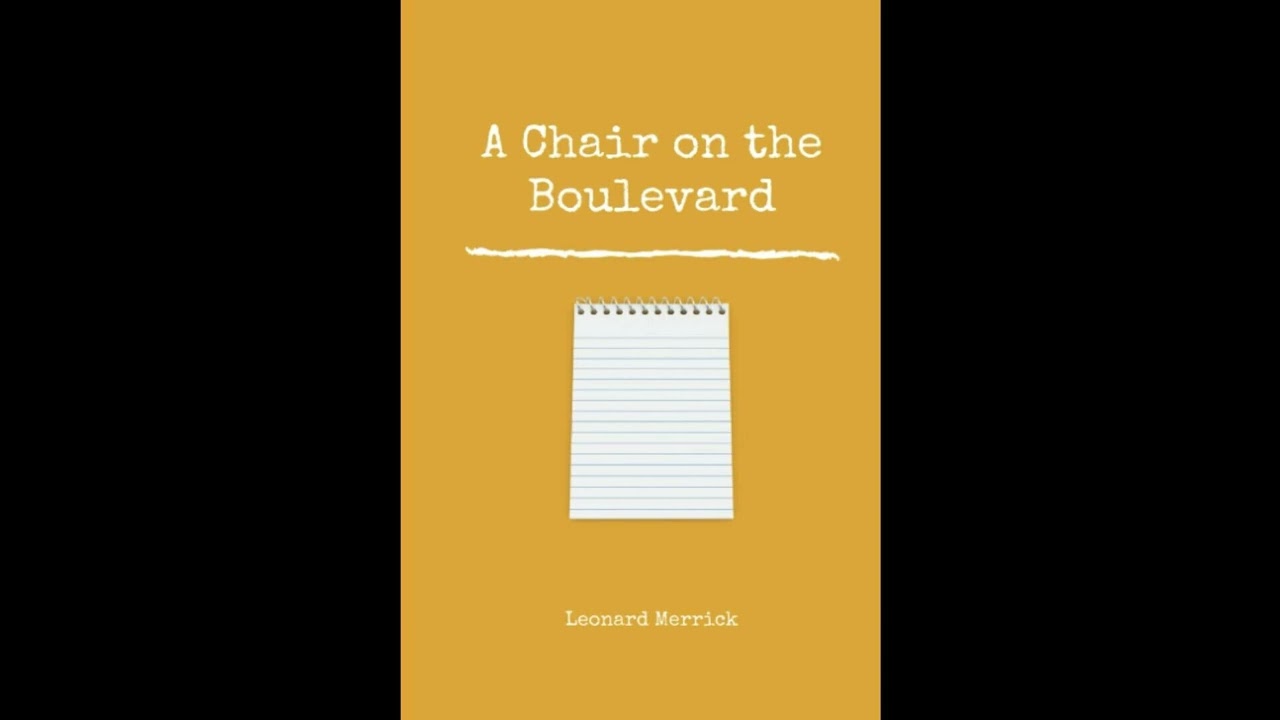
A Chair on the Boulevard
A simple chair, strategically placed on a bustling Parisian boulevard, offers an unusual vantage point for understanding life's grand theatre. This is the premise of Leonard Merrick's charming and insightful volume, a collection of connected vignettes and stories that invite listeners to slow down, observe, and ponder the human comedy unfolding before their eyes. Far from a mere travelogue, A Chair on the Boulevard presents a gallery of character studies, brief romances, and poignant moments, all filtered through the keen eye of an unseen narrator or perhaps the accumulated wisdom of the chair itself. It's a book about perspective, about finding meaning in the fleeting encounters of urban existence, and about the quiet dignity and enduring foibles that define us. For anyone who has ever found solace or inspiration in people-watching, or who appreciates the subtle craft of a well-told story focused on character over spectacle, Merrick's work remains as engaging today as it was upon its original appearance. The setting is undeniably Paris, specifically the tree-lined boulevards and side streets that hum with activity. Our narrative loosely follows Pierre Lachance, a young, aspiring writer, new to the city, who often finds himself occupying a particular café chair, sketching notes in his small notebook. From this modest perch, he witnesses the comings and goings of a diverse cast of Parisians. There is Madame Dubois, the perpetually optimistic flower vendor; Monsieur Armand, the melancholic retired academic who reads newspapers with an air of profound disappointment; and a host of struggling artists, grand dames, and transient lovers. The central threads that weave through these observations often revolve around Pierre's own quiet quest for inspiration and connection. He dreams of writing a novel that captures the true spirit of Paris, but first, he must truly see and understand its inhabitants. His observations frequently draw him into brief, yet impactful, interactions. He might offer a kind word to a disheartened street musician, or find himself unexpectedly drawn into a conversation with a young woman, Mademoiselle Elise, a seamstress who harbors her own artistic ambitions. The gentle arc of the story involves Pierre's gradual shift from a passive observer to a more engaged participant in the lives he chronicles. He begins to understand that the stories he seeks are not merely for his notebook, but are found in the shared laughter, unspoken heartbreaks, and everyday struggles that bind people together. His initial detached curiosity slowly transforms into a deeper empathy, prompting him to occasionally step away from his chair and offer a gesture of kindness or a word of encouragement, without ever fully abandoning his beloved vantage point. This gradual opening of the heart forms the quiet, unfolding drama of the collection. Leonard Merrick, born Leonard Miller in 1864 in London, lived a life as varied and interesting as many of his fictional characters. His early years were marked by a youthful wanderlust that saw him run away to sea at the age of sixteen. He spent time in America, working in various capacities, before returning to Europe. This breadth of experience—from actor to journalist, from stage manager to private secretary—provided him with a unique understanding of human nature and the many different paths people take. He absorbed the nuances of social classes and the aspirations that drove individuals, especially those in creative or precarious professions. Merrick settled in Paris for a period, developing a profound familiarity with the city that would inform many of his stories. Though his output was not prolific compared to some of his contemporaries, his novels and short stories garnered immense respect from fellow authors. Works like Conrad in Quest of His Youth, The Actor-Manager, and the collection While Paris Laughed solidified his reputation for elegant prose, psychological insight, and a delicate touch of irony. Esteemed writers such as J.M. Barrie and H.G. Wells championed his work, recognizing his craftsmanship and his ability to depict life's bittersweet realities with clarity and wit. Merrick, who passed away in 1938, carved out a distinct place for himself as a master of character-driven fiction, often focusing on the struggles and triumphs of artists and ordinary people navigating the complexities of their worlds. The central themes woven into A Chair on the Boulevard resonate deeply with the human condition. One prominent idea is the art of observation versus the necessity of participation. Pierre's reliance on his chair symbolizes the detached observer, initially content to merely chronicle the lives around him. However, as the narrative progresses, he discovers that true understanding, and indeed true artistry, requires stepping beyond mere watching and engaging with the world. For example, when he shares a quiet moment with the often-overlooked street musician, offering genuine praise, he realizes the profound connection that even a small act of kindness can forge. Another theme is the pursuit of artistic integrity and inspiration. Pierre's own struggles as a writer mirror those of the other artists and dreamers he encounters. He grapples with the challenge of transforming observed life into authentic art, learning that inspiration often arises not from grand events, but from the simple, honest moments shared between people on a busy street. This is evident when he abandons a preconceived plot for his novel, finding instead that the genuine interactions he has witnessed hold far greater narrative power. Further, the book subtly addresses the theme of solitude and connection in an urban landscape. Paris, for all its bustling activity, can be a lonely place. Pierre's chair offers both a shield and a window, allowing him to be alone in the crowd, yet constantly surrounded by the potential for human contact. The unexpected friendships and fleeting romances that emerge from his daily vigil demonstrate how easily people can drift through life in close proximity without truly seeing each other, and how small gestures can bridge vast distances. The final, quiet thread is the beauty in the mundane. Merrick elevates the everyday interactions of shopkeepers, lovers, and passers-by into moments of profound significance, suggesting that heroism and drama are not reserved for grand stages, but play out daily on the ordinary boulevard. Merrick's active years, primarily spanning the late 19th and early 20th centuries, placed him squarely in the Edwardian era, a period of significant social and literary transition. This was a time when the ornate idealism of Victorian literature was giving way to the grittier realism that would define much of 20th-century fiction. Culturally, cities like Paris were at the heart of the Belle Époque, a vibrant period of artistic and scientific flourishing, but also one marked by growing social anxieties and class distinctions. Writers like Merrick, often compared to French masters of the short story such as Guy de Maupassant, sought to capture the complexities of modern urban life with precision and psychological depth. His work emerged from a desire to portray characters not as archetypes, but as flawed, aspiring individuals navigating a rapidly changing world, often with a keen eye for irony and the absurdities of social conventions. It was a time when literature was increasingly concerned with the inner lives of ordinary people, reflecting a broader societal shift towards introspection and a more nuanced understanding of human motivation. Listening to A Chair on the Boulevard as an audiobook offers a singular opportunity to immerse oneself in Merrick's exquisite prose and the rich atmosphere of turn-of-the-century Paris. The run length of several hours is perfectly suited for a collection of interconnected stories, allowing for a leisurely absorption of each vignette without feeling rushed. A skilled narrator can bring to life the diverse voices of the Parisian street—the jaunty optimism of a young artist, the weary wisdom of a shopkeeper, the lilting accents of lovers—making each character distinct and memorable. Listen for the subtle pacing, which often mirrors the gentle rhythm of boulevard life, sometimes quickening with a sudden encounter, then slowing to allow a moment of introspection. The dialogue, often witty and naturalistic, comes alive through vocal performance, enhancing the charm and gentle humor that pervades the collection. It is an experience that invites listeners to find their own quiet chair, whether in a park, on a commute, or in the comfort of their home, and simply allow the city's sounds and stories to wash over them.
Enjoyed A Chair on the Boulevard? A few ways to support us
Audible & Amazon links are affiliate; we may earn a small commission at no extra cost.
About this production
Human narration by a volunteer reader from LibriVox.org, the public-domain audiobook project. LibriVox volunteers record literary works whose copyright has expired in the United States, releasing the resulting recordings into the public domain.
A Chair on the Boulevard by Leonard Merrick. The underlying text is in the U.S. public domain. We do not republish any modern copyrighted edition, translation, or commentary.
The 4K cinematic visuals accompanying this audiobook are generated by an AI image model from prompts derived from the source text. No copyrighted photos, paintings, or stock footage are used. AI generation is disclosed on every video on our YouTube channel as required by YouTube's altered/synthetic content policy.
English subtitles are transcribed from the LibriVox recording with OpenAI Whisper. Translations into the 11 other supported languages are produced by Meta's NLLB-200 neural translation model. No human translator's copyrighted translation is used.
Questions about sourcing or rights? See our DMCA & Sourcing policy or contact us.
Enjoyed this audiobook?
If you'd like to own a copy of A Chair on the Boulevard or hear a professionally produced edition, the links below help support free audiobook production at no extra cost to you.
As an Amazon Associate we earn from qualifying purchases. Audible / print links are affiliate.