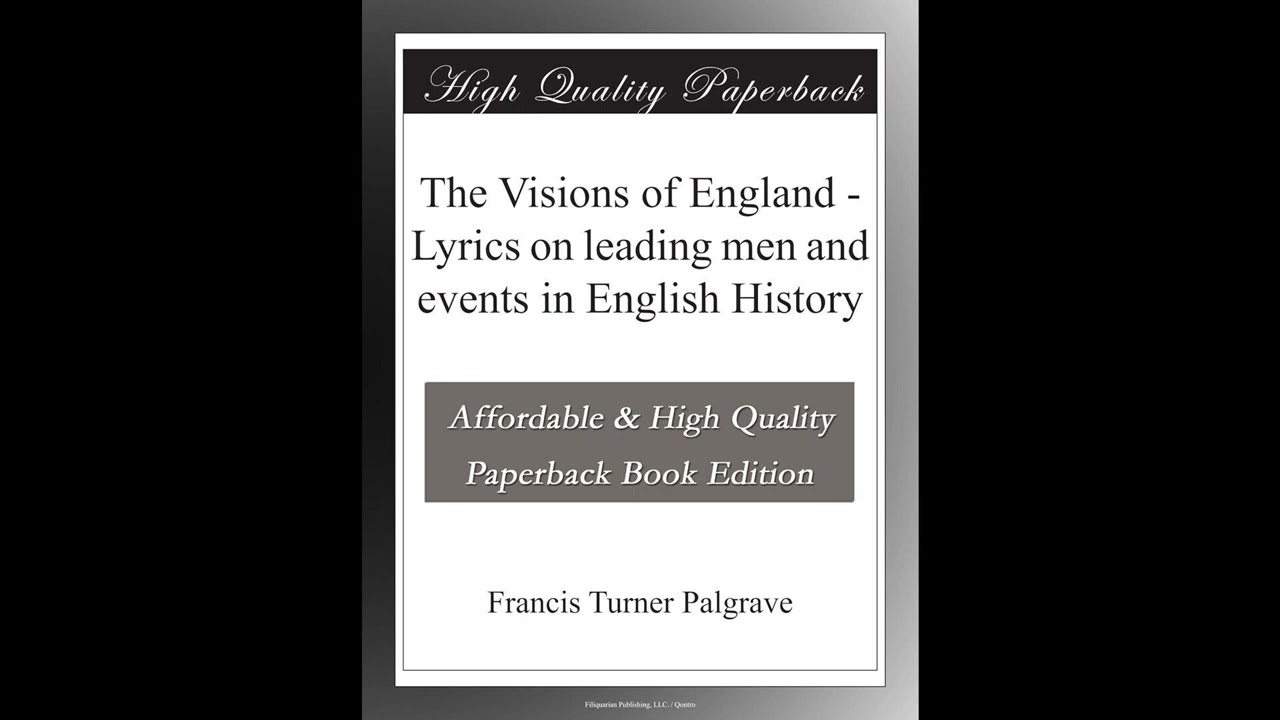
The Visions of England - Lyrics on leading men and events in English History- Full Audiobook
To understand a nation is to understand its stories—the legends it tells itself, the heroes it exalts, and the pivotal moments it remembers. "The Visions of England" offers precisely that: a lyrical panorama of English history, told through verse that celebrates leading men and defining events. This collection of poems is more than just a chronological recitation; it’s an interpretive lens, a poetic monument to the spirit of a people, presenting the past not merely as fact but as inspiration. For listeners today, these verses provide a unique insight into how national identity is forged and sustained, revealing the enduring power of myth and memory in shaping our understanding of who we are and where we come from. The overarching narrative of "The Visions of England" unfurls like a grand historical pageant, beginning with the earliest echoes of England’s formation and continuing through centuries of transformation. The setting moves across battlefields, royal courts, and quiet landscapes, each poem acting as a spotlight on a distinct epoch or figure. Main characters emerge not as individuals with developing internal lives, but as archetypes—the brave monarch, the sagacious statesman, the valorous soldier—embodying specific virtues or historical roles. From the Roman legions landing on British shores to the establishment of the Anglo-Saxon kingdoms, the collection paints initial pictures of a nascent nation grappling with invasion and the first stirrings of unified identity. The central conflict that runs through these verses is the enduring struggle for nationhood, the ongoing contest between internal divisions and external threats, always pushing England toward its perceived destiny. As the collection progresses, the listener is guided through the medieval period, witnessing the Norman Conquest and its profound impact on language and culture, the signing of the Magna Carta as a cornerstone of liberty, and the Hundred Years' War, which solidified England’s martial prowess and distinctive identity apart from continental Europe. Later lyrics illuminate the dynamic Tudor era, with its religious upheavals and voyages of discovery under figures like Queen Elizabeth I, and the subsequent Stuart dynasty, leading to the dramatic confrontations of the English Civil War. Each lyrical piece acts as a concise, evocative painting, capturing the essence of an event or personality, framing it within a larger, unfolding narrative of national character and progress. The arc of the story is thus the sweeping trajectory of a nation’s development, seen through a series of focused, poetic vignettes. "The Visions of England" comes to us as an anonymous creation, its precise author and publication date lost to the mists of time, hence its classification as a "classic literature" of unknown origin. Such works are not uncommon in the literary heritage of nations, especially those aiming to compile and distill popular or educational verse. They often represent a collective spirit, a distillation of shared cultural memory rather than the singular vision of one individual. It is highly probable that this collection emerged during a period when national pride was paramount, perhaps the late nineteenth or early twentieth century, when anthologies of patriotic and historical verse were widely popular, serving both as entertainment and as tools for fostering a sense of shared heritage among the populace. The very anonymity of the author lends the work a sense of timelessness and broad appeal, suggesting that these "visions" are perhaps not of one person, but of the collective English consciousness itself. This work stands within a long and revered tradition of national poetic chronicles, akin to sagas or epic poems designed to mythologize a people's past. Unlike a lengthy epic, however, "The Visions of England" employs a lyrical format, presenting a series of concise, emotionally charged poems. This structure made such collections highly accessible, suitable for recitation, memorization in schools, or inclusion in popular miscellanies. The enduring appeal of these verses speaks to their success in capturing the public imagination, presenting historical figures and events in a memorable and often inspiring manner, ensuring that the narratives of England’s past remained vivid and influential for generations. Several prominent themes resonate through the lyrical verses of "The Visions of England." One central idea is the theme of National Identity and Destiny. Many poems articulate a belief in England’s unique character and its ordained path towards greatness. A lyric recounting Alfred the Great’s defense against the Vikings, for instance, often depicts him not just as a king but as the very embodiment of English resilience, laying the groundwork for a unified nation against seemingly insurmountable odds. Another pervasive theme is Heroism and Sacrifice. The collection frequently celebrates individuals who exhibited extraordinary courage or made ultimate sacrifices for the common good. A poem describing the Battle of Agincourt might focus on the valor of Henry V and his soldiers, portraying their victory as a testament to English fighting spirit and a willingness to face overwhelming forces for the sake of their homeland. Another significant theme is The Weight of History and Tradition. The poems often revere foundational moments and enduring institutions, underscoring their importance in shaping the present. A lyric about the signing of the Magna Carta, for example, would likely emphasize the document as a bedrock of English law and individual liberty, framing it as a sacred covenant passed down through generations. Finally, the collection highlights The Poetic Rendering of History itself. The verses demonstrate how meter, rhyme, and vivid imagery are employed to transform dry historical facts into emotionally resonant narratives. A poem describing the launch of Sir Francis Drake’s ships against the Spanish Armada uses evocative language to conjure images of towering masts, billowing sails, and the resolve of the English sailors, turning a military confrontation into an epic clash of titans, demonstrating how poetry can elevate history to the realm of myth. The cultural and political landscape at the probable time of "The Visions of England's" creation — likely the late 19th or early 20th century — provides significant context for its emergence. This was an era marked by the zenith of the British Empire, a period of immense national confidence, and a widespread belief in Britain’s global supremacy. Education systems heavily emphasized national history and literature, often through patriotic verse, to instill a strong sense of identity and civic duty in young citizens. There was a popular appetite for narratives that reinforced a heroic vision of England's past, celebrating its military triumphs, its cultural achievements, and its perceived moral superiority. Literary trends of the period also contributed to the form and content of such works. While realism and naturalism were gaining ground in prose, a strong current of Victorian and Edwardian poetry remained committed to traditional forms, often serving didactic or commemorative purposes. Collections like "The Visions of England" found a receptive audience in a public that valued verse that was both accessible and uplifting, poetry that could inform as much as it entertained, and that explicitly connected the present generation to the glories and trials of their ancestors. Such works were instrumental in shaping a collective historical consciousness, solidifying a particular narrative of national progress and exceptionalism. Listening to "The Visions of England" as an audiobook offers a uniquely immersive experience, allowing the inherent musicality and rhythm of the lyrics to fully blossom. A skilled narrator can bring these historical verses to life, allowing the listener to absorb the nuances of each poem without the silent effort of reading. With several hours of content, this collection becomes a companion for extended listening sessions—perfect for long commutes, walks, or moments of quiet reflection. Pay attention to the narrator's pacing: how they might quicken their delivery during accounts of battle and slow it for more reflective moments of triumph or sorrow. Notice the subtle shifts in voice, perhaps adopting a different tone for a regal proclamation versus a lament for a fallen hero. The spoken word enhances the inherent atmosphere of each piece, transforming historical accounts into vivid auditory landscapes where the echoes of ancient deeds and the grandeur of a nation's story unfold directly to the ear.
Enjoyed The Visions of England - Lyrics on leading men and events in English History- Full Audiobook? A few ways to support us
Audible & Amazon links are affiliate; we may earn a small commission at no extra cost.
About this production
Human narration by a volunteer reader from LibriVox.org, the public-domain audiobook project. LibriVox volunteers record literary works whose copyright has expired in the United States, releasing the resulting recordings into the public domain.
The Visions of England - Lyrics on leading men and events in English History- Full Audiobook by Francis Turner Palgrave. The underlying text is in the U.S. public domain. We do not republish any modern copyrighted edition, translation, or commentary.
The 4K cinematic visuals accompanying this audiobook are generated by an AI image model from prompts derived from the source text. No copyrighted photos, paintings, or stock footage are used. AI generation is disclosed on every video on our YouTube channel as required by YouTube's altered/synthetic content policy.
English subtitles are transcribed from the LibriVox recording with OpenAI Whisper. Translations into the 11 other supported languages are produced by Meta's NLLB-200 neural translation model. No human translator's copyrighted translation is used.
Questions about sourcing or rights? See our DMCA & Sourcing policy or contact us.
Enjoyed this audiobook?
If you'd like to own a copy of The Visions of England - Lyrics on leading men and events in English History- Full Audiobook or hear a professionally produced edition, the links below help support free audiobook production at no extra cost to you.
As an Amazon Associate we earn from qualifying purchases. Audible / print links are affiliate.