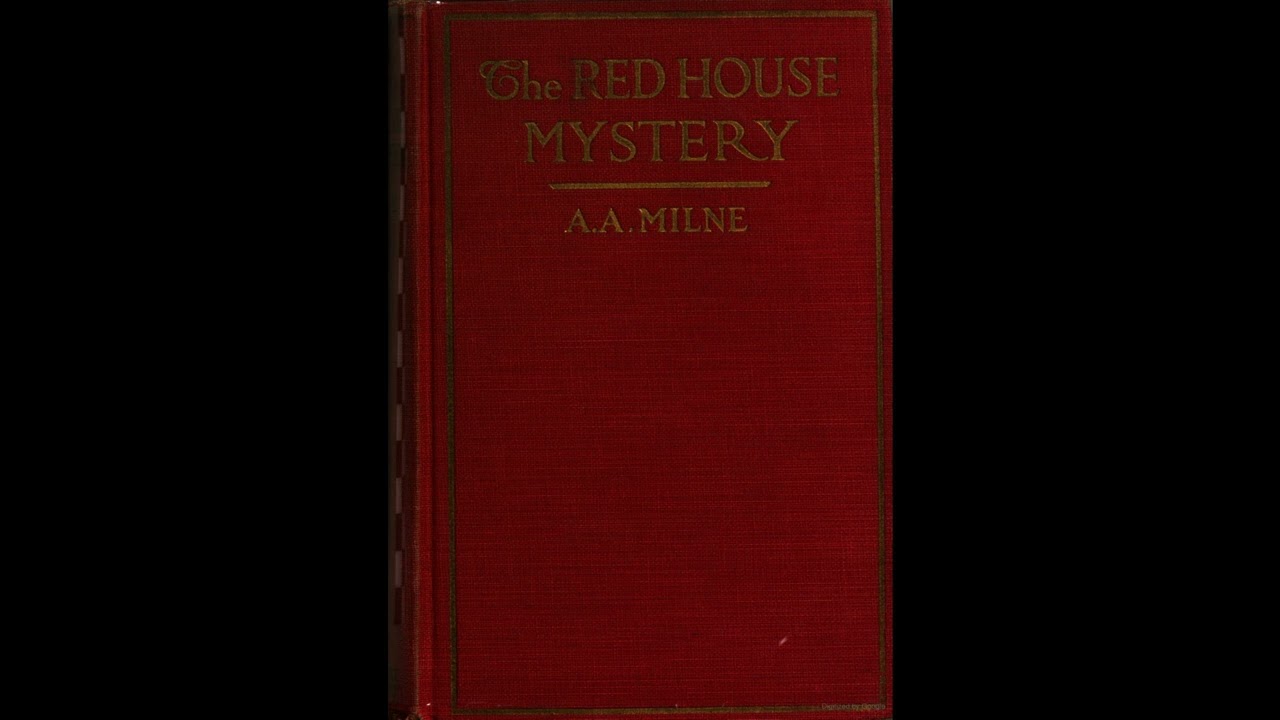
The Red House Mystery
Stepping far from the Hundred Acre Wood, A. A. Milne, the beloved creator of Winnie-the-Pooh, presents a delightful and surprisingly sophisticated diversion with The Red House Mystery. This novel, published in 1922, offers a fascinating glimpse into the sharp intellect of a writer celebrated for gentler tales, proving his versatility and wit beyond the realm of children's literature. It stands as an early cornerstone of the Golden Age of Detective Fiction, a period marked by intricate plots, intellectual puzzles, and a charming British sensibility. For listeners today, it’s not just a clever whodunit from a bygone era; it’s an invitation to experience Milne’s elegant prose and keen observation applied to a genre that demands precision, offering a chance to discover a different facet of a literary giant. It’s a chance to pit your own deductive skills against one of the genre’s foundational puzzles, presented by a master storyteller. The quiet, predictable routine of the Red House, a comfortable English country estate, is shattered when its owner, Mark Ablett, receives an unexpected visitor: his long-lost brother, Robert, who has returned from years spent abroad. The arrival of this prodigal sibling injects an immediate tension into the household, a palpable discomfort that precedes the grim events to come. Shortly after Robert Ablett makes his appearance, a gunshot rings out. When the house is roused, Robert is found dead in the study, a pistol by his side. The initial assumption leans towards suicide, a tragic end to a troubled return, but inconsistencies quickly surface, casting a shadow of doubt over the scene. Adding to the baffling situation, Mark Ablett, the master of the house, inexplicably disappears. Was he connected to his brother's death? Did he flee in shock, or is his absence a more sinister indicator? Enter Anthony Gillingham, a genial and quick-witted friend of the family, who happens to be visiting. Accompanied by his loyal and somewhat bemused friend, Bill Beverley, who also serves as the story's narrator, Anthony finds himself drawn into the investigation. With the police, led by the methodical Superintendent Battle, making their steady inquiries, Anthony and Bill begin their own informal examination, interviewing the assorted members of the household and staff, piecing together fragments of conversations, motives, and alibis. The trail of clues leads through secret passages, deciphered messages, and a web of complex family dynamics, as Anthony—with a remarkable blend of intuition and logical deduction—works to uncover the truth hidden beneath the surface of the seemingly respectable household. Alan Alexander Milne was born in London in 1882, the youngest of three sons. His early education at Westminster School and later at Trinity College, Cambridge, provided a foundation for his literary ambitions. He would go on to edit the student magazine Granta, where he crossed paths with the likes of G. K. Chesterton, whose own Father Brown mysteries would later help define the Golden Age of detective fiction. After university, Milne served for a time on the staff of Punch magazine, a famed British humor publication, where he honed his distinctive style and wit through numerous essays and light verses. His experiences during the First World War, serving in the Royal Warwickshire Regiment, had a profound impact, shaping some of his later perspectives on pacifism. Milne’s prolific career spanned plays, essays, and novels before he achieved enduring global fame with his children's books. His collection of children's verse, When We Were Very Young (1924), and the subsequent tales of Christopher Robin and his beloved toy bear, beginning with Winnie-the-Pooh (1926) and The House at Pooh Corner (1928), cemented his legacy as one of the most cherished authors for young readers. Yet, these heartwarming stories often overshadow the breadth of his other literary contributions. Works like the popular play Mr. Pim Passes By (1919) showcased his talent for drawing-room comedy, while The Red House Mystery stands as his sole full-length foray into the detective genre, a testament to his intellectual curiosity and range, positioning him as a unique figure whose work touched many corners of the early 20th-century literary landscape. One of the central themes that The Red House Mystery enacts is the classic confrontation between the amateur and professional detective. Anthony Gillingham, with his affable demeanor and sharp intellect, represents the intuitive, personable amateur who often sees what the more constrained, procedural police officer misses. For example, Anthony’s casual conversations with servants or houseguests often reveal subtle inconsistencies or overlooked details that Superintendent Battle's more formal questioning fails to elicit. He’s less interested in protocol than in human nature, allowing him to connect seemingly disparate clues through a logical yet empathetic lens. The contrast highlights the strengths and limitations of both approaches to crime-solving, celebrating the power of individual insight. Another significant theme is the pervasive idea of order disrupted and restored. The peaceful, predictable life of the English country house is shattered by the shocking discovery of a body. Milne meticulously constructs a world where rules of civility and social decorum are paramount, only to brutally break them. The entire arc of the story then becomes a quest to re-establish that order, not through brute force or emotional outbursts, but through rigorous, intellectual deduction. The crime is a puzzle, and the satisfaction lies in seeing the scattered pieces—the alibis, the physical evidence, the psychological insights—fall back into their rightful, logical places, much like a perfectly solved crossword. This reflects a broader cultural yearning for resolution and understanding in a changing world. Furthermore, the novel cleverly plays with the theme of identity and appearance, showing that individuals, especially in the context of a murder investigation, are rarely what they first seem. Characters present carefully constructed facades, and it is through the unraveling of these layers—piecing together past actions, hidden motives, and secret relationships—that the true nature of the crime, and the people involved, is ultimately revealed. The story’s central mystery hinges on misdirection and mistaken assumptions about who certain individuals truly are. The Red House Mystery emerged during a fascinating period in English history and literature. Published in 1922, it landed squarely in the aftermath of the First World War. This post-war era, often dubbed the "Roaring Twenties," saw a yearning for stability, reason, and perhaps a degree of escapism after the trauma of the conflict. The burgeoning genre of detective fiction perfectly fit this societal need. It offered a kind of intellectual comfort, presenting the chaos of murder as a solvable puzzle, a world where logic could triumph over disorder. It was a time when mass literacy was on the rise, and a growing middle class demanded accessible, engaging entertainment. Authors like Agatha Christie, Dorothy L. Sayers, and G. K. Chesterton were actively shaping the "Golden Age" of the genre, establishing conventions such as the "fair play" mystery, where all the clues are theoretically available to the reader. Milne's contribution, while unique for him, aligns perfectly with this trend, presenting a meticulously constructed puzzle that allows the reader to engage their intellect alongside the detective, finding satisfaction in the elegant unraveling of a complex truth within the seemingly secure confines of the English country house. Listening to The Red House Mystery as an audiobook offers a particularly immersive and enjoyable experience. The narrator's performance breathes life into Milne's crisp prose and the distinct personalities of characters like the wry, observant Bill Beverley and the charmingly astute Anthony Gillingham. The pacing of the story, with its gradual accumulation of clues and subtle character interactions, is perfectly suited to the spoken word, allowing listeners to absorb the nuances of the dialogue and the unfolding mystery at an unhurried, thoughtful pace. A skilled voice actor can bring out the inherent wit and gentle humor that Milne weaves into the narrative, making the interplay between the friends and their observations of the peculiar household truly shine. The atmosphere of a slightly unsettling but ultimately cozy English country house, the rustle of hidden letters, the hushed conversations—all are enhanced, transforming the process of deduction into an intimate, auditory journey, much like having a clever friend recount a fascinating and perplexing tale.
Enjoyed The Red House Mystery? A few ways to support us
Audible & Amazon links are affiliate; we may earn a small commission at no extra cost.
About this production
Human narration by a volunteer reader from LibriVox.org, the public-domain audiobook project. LibriVox volunteers record literary works whose copyright has expired in the United States, releasing the resulting recordings into the public domain.
The Red House Mystery by A. A. Milne. The underlying text is in the U.S. public domain. We do not republish any modern copyrighted edition, translation, or commentary.
The 4K cinematic visuals accompanying this audiobook are generated by an AI image model from prompts derived from the source text. No copyrighted photos, paintings, or stock footage are used. AI generation is disclosed on every video on our YouTube channel as required by YouTube's altered/synthetic content policy.
English subtitles are transcribed from the LibriVox recording with OpenAI Whisper. Translations into the 11 other supported languages are produced by Meta's NLLB-200 neural translation model. No human translator's copyrighted translation is used.
Questions about sourcing or rights? See our DMCA & Sourcing policy or contact us.
Enjoyed this audiobook?
If you'd like to own a copy of The Red House Mystery or hear a professionally produced edition, the links below help support free audiobook production at no extra cost to you.
As an Amazon Associate we earn from qualifying purchases. Audible / print links are affiliate.