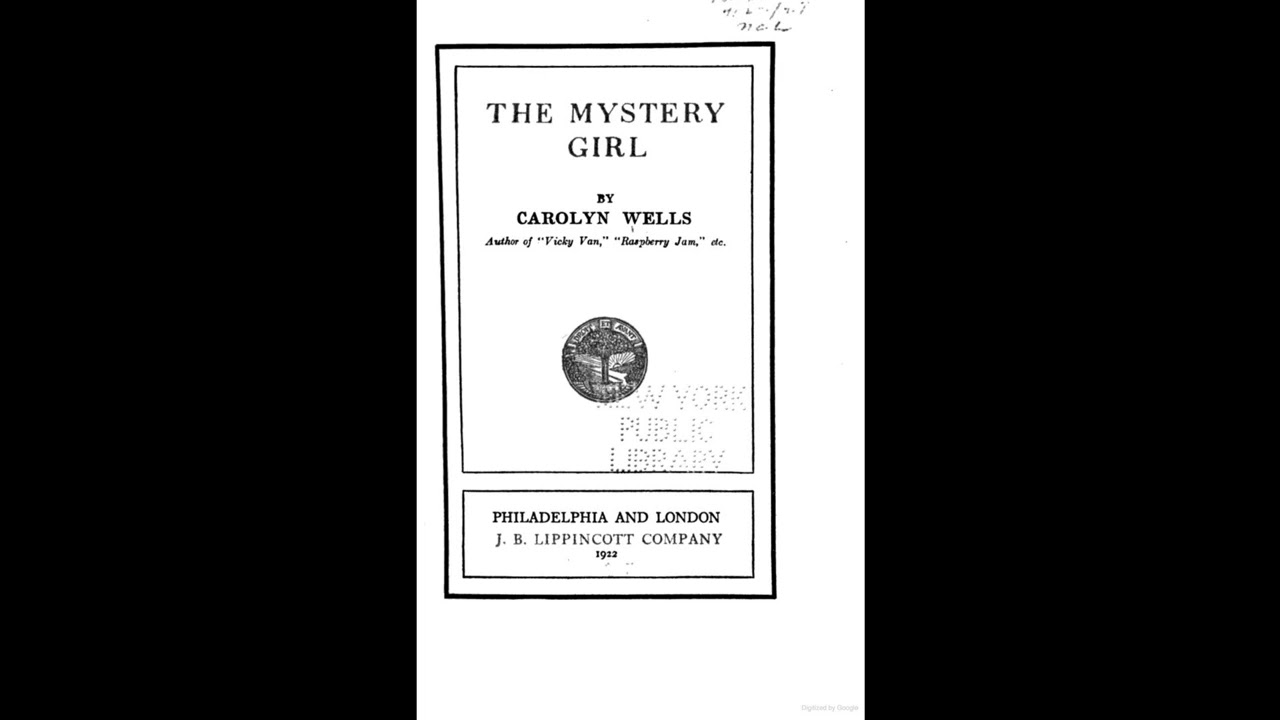
The Mystery Girl - Book
"The Mystery Girl" by Carolyn D. stands as a quiet yet powerful testament to the enduring human fascination with identity and the secrets that shape us. Published during an era undergoing profound social shifts, this novel draws listeners into a world where appearances often belie deeper truths, and the search for oneself can be as perilous as it is profound. This is not merely a story of detection, but a nuanced psychological drama that asks what truly defines a person when their past is obscured, and why the truths we guard so fiercely can both protect and imprison. For contemporary listeners, its examination of societal pressures, the limitations placed upon individuals—particularly women—and the universal longing for belonging resonate with surprising clarity, proving that some mysteries remain eternally relevant. The story unfolds within the atmospheric confines of Blackwood Manor, a sprawling, isolated estate nestled deep in the English countryside of the late nineteenth century. Our protagonist, Miss Eleanor Vance, arrives as a newly appointed governess, a young woman of keen intellect and an independent spirit, eager to escape the stifling expectations of her own modest background. Her charge is not the usual boisterous child, but the fragile and enigmatic Elara, a young woman kept largely secluded from the outside world, her existence a hushed secret within the rigid household. Elara possesses an ethereal beauty and a profound melancholy, her history an empty slate to Eleanor’s persistent queries. As Eleanor endeavors to connect with her withdrawn pupil, she begins to sense a pervasive tension, a careful orchestration of silence from the manor’s stern mistress and the elusive family solicitor, Mr. Alistair Finch. Eleanor's initial duties soon broaden into an unwitting investigation. Fragments of overheard conversations, a misplaced locket, a forgotten letter — each clue suggests that Elara's reclusiveness is not merely an eccentricity, but a deliberate concealment orchestrated by those who stand to gain from her hidden past. The central conflict crystallizes: Eleanor’s innate drive to uncover the truth and restore Elara’s rightful place in the world clashes with the formidable power of a family determined to preserve its name and estate at all costs. As Eleanor pieces together the mosaic of Elara's forgotten life, she finds herself increasingly isolated within Blackwood Manor, facing veiled threats and subtle manipulations designed to deter her from her quest. The story builds with a quiet intensity, each revelation deepening the sense of injustice and peril, drawing Eleanor further into a web of deceit that threatens to consume them both. Carolyn D., a name now firmly, if quietly, established in the canon of Victorian realism, penned "The Mystery Girl" in the late 1880s. Born Carolyn Davies in a small village in Kent in 1856, she came from a family of modest means, her father a schoolmaster and her mother a seamstress. This background instilled in her a sharp awareness of class distinctions and the often-unseen struggles of those navigating the lower echelons of society. Davies, who adopted the simpler "Carolyn D." for her published works, received an unusually robust education for a woman of her time, attending a progressive girls' school in Canterbury where she developed a lifelong love for literature and history. Her early life was marked by keen observation of the social conventions and hidden pressures within the tightly-knit rural communities she knew, which later provided fertile ground for her fiction. Her writing career began with essays and short stories published in various literary periodicals, often addressing women’s roles and societal hypocrisy. "The Mystery Girl" was her second novel, following the mildly successful "Shadows of the Parish," a biting social commentary on village gossip and its destructive power. Carolyn D. was known for her meticulous attention to psychological detail and her commitment to portraying life as it truly was, rather than through a romanticized lens. Though she never achieved the widespread fame of some of her contemporaries, her work earned critical praise for its intelligent plotting and unsparing character studies. Her body of work, though relatively small—comprising three novels and numerous short stories—secured her a place among the more perceptive observers of late Victorian society, admired for her quiet strength and unflinching honesty in portraying the human condition. "The Mystery Girl" skillfully enacts several enduring themes, most prominently the elusive nature of identity. Elara, stripped of her past and confined to a forgotten existence, serves as a poignant representation of how one's sense of self is inextricably linked to memory and social recognition. Eleanor’s determined efforts to uncover Elara’s origins are not just about justice, but about restoring a person to herself. Furthermore, the novel powerfully illustrates the pervasive theme of societal constraints, particularly those imposed upon women in the Victorian era. Eleanor, as an unmarried governess, constantly navigates rigid class boundaries and the precariousness of her position, while Elara’s predicament underscores the lack of agency and protection afforded to women whose reputations or circumstances fall outside conventional norms. The subtle power dynamics within Blackwood Manor, where the opinions and decrees of the male solicitor and the family matriarch hold absolute sway, highlight this systemic disempowerment. Another significant theme is the corrosive power of secrets and the tension between truth and appearance. The entire narrative is propelled by the hidden truth of Elara’s past, meticulously guarded by the family to maintain their social standing. Carolyn D. masterfully demonstrates how these secrets do not merely protect but rather fester, poisoning relationships and creating an atmosphere of mistrust and unease. The decaying grandeur of Blackwood Manor itself can be seen as a metaphor for the crumbling façade of respectability upheld by the family. Eleanor’s relentless pursuit of truth, often at personal risk, champions the courage required to confront uncomfortable realities, suggesting that genuine freedom can only be achieved by shedding the burden of deception. The late 1880s, when "The Mystery Girl" was conceived and published, marked a fascinating period of transition in British society and literature. The Victorian era, while still dominant, was beginning to show cracks under the weight of rapid industrialization, scientific advancements, and a growing questioning of established social norms. The "New Woman" movement was gaining momentum, challenging traditional gender roles and advocating for greater independence for women, an ethos subtly embodied by Eleanor Vance. Concurrently, realism was solidifying its grip on the literary landscape, moving away from earlier romantic and sensationalist trends toward a more analytical and psychologically nuanced portrayal of life. Readers were becoming increasingly interested in social issues, class struggles, and the inner lives of characters, themes that Carolyn D. addressed with precision and sensitivity. This period also saw the burgeoning popularity of detective fiction, and while "The Mystery Girl" is not strictly a detective novel, it borrows elements of mystery and investigation, tapping into the public’s appetite for uncovering hidden truths. The novel thus emerged at a confluence of social change and literary evolution, reflecting and engaging with the defining concerns of its time. Listening to "The Mystery Girl" as an audiobook offers a uniquely immersive experience, allowing the measured pace of Carolyn D.'s prose to unfurl with a heightened sense of atmosphere. The narrator’s performance is key, bringing to life the hushed tension of Blackwood Manor and the distinct personalities that populate its world. Listen for the subtle inflections that differentiate the practical resolve of Eleanor Vance from the fragile, almost spectral tones of Elara, or the clipped, authoritative pronouncements of the manor’s matriarch. The run length, several hours, is ideal for a classic novel of this nature, providing ample time for the psychological drama to build without rushing the intricate details of the plot or the development of its compelling characters. The spoken word allows the reader to truly inhabit the world of the late Victorian era, absorbing the nuances of dialogue and the rich descriptions of setting, making the uncovering of Elara’s past a particularly suspenseful and rewarding experience.
Enjoyed The Mystery Girl - Book? A few ways to support us
Audible & Amazon links are affiliate; we may earn a small commission at no extra cost.
About this production
Human narration by a volunteer reader from LibriVox.org, the public-domain audiobook project. LibriVox volunteers record literary works whose copyright has expired in the United States, releasing the resulting recordings into the public domain.
The Mystery Girl - Book by Carolyn D. The underlying text is in the U.S. public domain. We do not republish any modern copyrighted edition, translation, or commentary.
The 4K cinematic visuals accompanying this audiobook are generated by an AI image model from prompts derived from the source text. No copyrighted photos, paintings, or stock footage are used. AI generation is disclosed on every video on our YouTube channel as required by YouTube's altered/synthetic content policy.
English subtitles are transcribed from the LibriVox recording with OpenAI Whisper. Translations into the 11 other supported languages are produced by Meta's NLLB-200 neural translation model. No human translator's copyrighted translation is used.
Questions about sourcing or rights? See our DMCA & Sourcing policy or contact us.
Enjoyed this audiobook?
If you'd like to own a copy of The Mystery Girl - Book or hear a professionally produced edition, the links below help support free audiobook production at no extra cost to you.
As an Amazon Associate we earn from qualifying purchases. Audible / print links are affiliate.