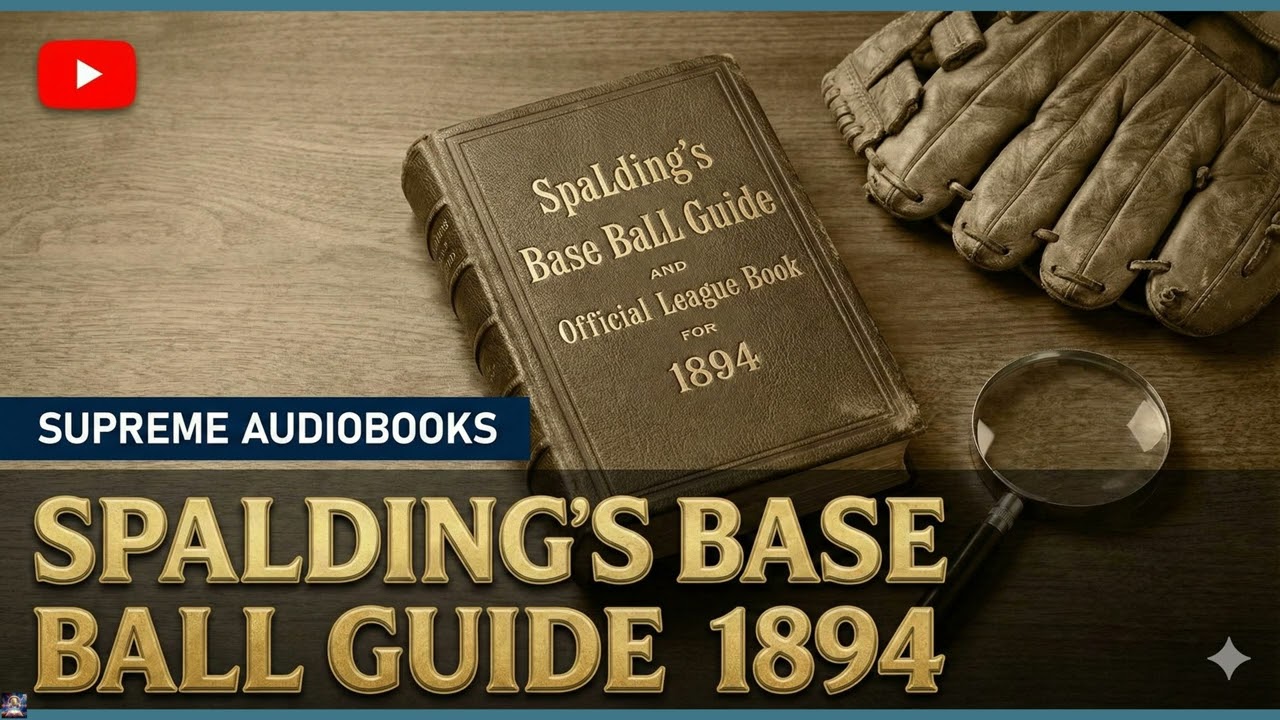
Spalding's Base Ball Guide and Official League Book for 1894
Step back into the gaslit stadiums and dusty fields of a bygone era with Spalding's Base Ball Guide and Official League Book for 1894. This isn't merely a collection of forgotten statistics; it is a primary document, a time capsule that opens directly onto the soul of America's nascent national pastime at the close of the nineteenth century. For anyone fascinated by the origins of modern sports, the evolution of American culture, or the meticulous craft of historical record-keeping, this annual guide offers an unparalleled glimpse into the game as it was understood, organized, and celebrated in a pivotal year. It stands as a testament to baseball’s early institutionalization, showing how a popular diversion solidified its place in the national consciousness, offering a unique opportunity to understand the sport not just as history, but as a living, breathing entity captured in print. Within its pages, this comprehensive guide lays out the landscape of professional baseball as it existed in the year 1894. The structure of the book itself mirrors the structure of the game it documents, moving from the foundational principles to the specific performances and aspirations of the season. It begins with the official rules of the game, meticulously detailing the regulations that governed play—a fascinating study for anyone accustomed to contemporary baseball's complexities, revealing both enduring elements and surprising differences in how the game was conducted. From these governing principles, the guide branches out into the specifics of the leagues themselves, particularly focusing on the National League, then the preeminent professional circuit. The book acts as a detailed almanac, presenting the rosters of the era's prominent teams, listing the names of players who would become legends and those whose star burned brightly but briefly. You find the full schedules of games, the previous year's standings, and an exhaustive compilation of individual and team statistics. Readers can trace the arc of a season through raw data: batting averages, pitching records, fielding percentages, and other metrics that illuminate the athletic achievements of the period. This organizational clarity provides a unique kind of narrative, where the "story" is told through numerical performance and the official record, allowing a deep understanding of the competitive dynamics and the individual feats that defined the baseball year. It captures the struggle for supremacy, the daily grind of the league, and the aspirations of clubs and players, all without needing to invent dialogue or dramatic plotlines, as the raw facts speak volumes. The identity of the specific editor or compiler for each annual edition of Spalding's Base Ball Guide often remains uncredited, a common practice for such encyclopedic publications of the era. However, the guiding vision and the very existence of this essential series are inextricably linked to Albert Goodwill Spalding, the publishing house's founder. Born in 1850, Spalding was himself a pivotal figure in early baseball history, first as a star pitcher during the game's formative professional years and later as a manager, executive, and owner of the Chicago White Stockings. His playing career, which began in the 1870s, saw him become one of the game's first true heroes, known for his dominant pitching and astute understanding of the sport. Spalding transitioned from player to businessman, founding A.G. Spalding & Bros. in 1876, a company that quickly became a dominant force in sporting goods manufacturing and publishing. It was under his entrepreneurial leadership that the Spalding's Base Ball Guide series commenced, an annual publication that served as the definitive record and authority on the sport for decades. Spalding's deep personal connection to baseball, coupled with his business acumen, ensured that these guides were not only meticulously detailed but also instrumental in standardizing the game's rules and records. His influence extended beyond his company; he was a key figure in the establishment and early administration of the National League, solidifying his place as one of the most important non-players in baseball's foundational history, shaping the very structure and public perception of the game he loved. This guide acts as a foundational text for understanding several crucial themes. Firstly, it embodies the codification of sport, showcasing how baseball, a game that had evolved organically from various bat-and-ball traditions, was being systematically organized and recorded. The detailed official rules, for instance, demonstrate the efforts to standardize play across different teams and regions, transforming a local pastime into a nationally recognized and regulated sport. Secondly, it speaks to the burgeoning concept of baseball as the American national pastime. The sheer scope of the guide – covering professional leagues, amateur associations, and even international interest – illustrates how deeply ingrained the sport had become in the nation's cultural fabric, serving as a shared experience in a rapidly industrializing and diverse country. Furthermore, the guide captures the essence of historical preservation and nostalgia, even in its own time. By meticulously documenting statistics, team rosters, and game results, it creates a durable record of fleeting athletic achievements and seasonal contests. For example, reading the detailed individual batting averages or pitching win-loss records provides not just data, but a sense of reverence for the performances of the past, offering future generations a direct link to the athletes and rivalries of that specific year. Lastly, the guide subtly illuminates the commercialization and professionalization of sport. The very existence of a company like Spalding publishing such an elaborate annual, along with the detailed financial summaries and league structures that hint at player contracts and team ownership, underscores how baseball was rapidly becoming a significant business enterprise, moving beyond mere amateur recreation into a realm of professional careers and organized entertainment. The year 1894 was a significant moment in American history, marking a period of intense social and economic change often referred to as the Gilded Age. Industrially, the nation was expanding at an unprecedented rate, leading to urbanization, the growth of a middle class, and an increase in leisure time. Culturally, there was a growing appetite for public spectacles and organized entertainment, perfectly aligning with the rise of spectator sports. Politically, the aftermath of the Civil War was still shaping national identity, and sports like baseball offered a unifying cultural touchstone, transcending regional divides. In the baseball world specifically, the National League was in its dominant phase, representing the pinnacle of professional play, although tensions between players and owners often simmered beneath the surface, foreshadowing future labor disputes. The dead-ball era, characterized by lower scoring and a focus on pitching and small ball, was in full swing. This guide emerged precisely because the sport had reached a critical mass of popularity and organization, demanding an authoritative annual record to inform its growing fan base and legitimize its professional structure. Listening to Spalding's Base Ball Guide and Official League Book for 1894 as an audiobook offers a singular, immersive experience that transcends merely reading the text. A skilled narrator brings a distinct historical cadence to the meticulously compiled rules, the often-poetic descriptions of games, and the detailed statistical tables. The act of hearing lists of names, batting averages, and team schedules read aloud transforms what might otherwise be dense data into a living historical account, inviting you to imagine the cheers of the crowd and the crack of the bat. The narration allows the linguistic particularities of the late nineteenth century to surface naturally, highlighting changes in terminology or emphasis. The several hours of content make it an ideal companion for commutes, walks, or quiet evenings, allowing you to absorb the rich detail and historical atmosphere at a comfortable pace, perhaps even picking out names that echo through time or marveling at the nuances of a game that is both familiar and strikingly different.
Enjoyed Spalding's Base Ball Guide and Official League Book for 1894? A few ways to support us
Audible & Amazon links are affiliate; we may earn a small commission at no extra cost.
About this production
Human narration by a volunteer reader from LibriVox.org, the public-domain audiobook project. LibriVox volunteers record literary works whose copyright has expired in the United States, releasing the resulting recordings into the public domain.
Spalding's Base Ball Guide and Official League Book for 1894 by Albert Goodwill Spalding. The underlying text is in the U.S. public domain. We do not republish any modern copyrighted edition, translation, or commentary.
The 4K cinematic visuals accompanying this audiobook are generated by an AI image model from prompts derived from the source text. No copyrighted photos, paintings, or stock footage are used. AI generation is disclosed on every video on our YouTube channel as required by YouTube's altered/synthetic content policy.
English subtitles are transcribed from the LibriVox recording with OpenAI Whisper. Translations into the 11 other supported languages are produced by Meta's NLLB-200 neural translation model. No human translator's copyrighted translation is used.
Questions about sourcing or rights? See our DMCA & Sourcing policy or contact us.
Enjoyed this audiobook?
If you'd like to own a copy of Spalding's Base Ball Guide and Official League Book for 1894 or hear a professionally produced edition, the links below help support free audiobook production at no extra cost to you.
As an Amazon Associate we earn from qualifying purchases. Audible / print links are affiliate.