Royalty Restored Or London under Charles II
Imagine a moment when an entire nation holds its breath, then erupts in a cacophony of joy and relief as a long-exiled king steps once more onto English soil. This is the dramatic hinge upon which J. Fitzgerald Molloy's Royalty Restored Or London under Charles II swings – a vivid chronicle of the English Restoration, a period as turbulent and transformational as any in British history. What began as a desperate hope for stability after years of civil war and republican rule blossomed into an era of unprecedented cultural liberation, scientific discovery, and social upheaval. Molloy takes us by the hand and leads us directly into the bustling streets and gilded halls of London during the 1660s, offering not just a factual account, but a deeply human portrait of a society reborn. This book matters today because it reminds us how quickly a nation can change direction, how profoundly politics can shape daily life, and how the pursuit of pleasure and freedom can sometimes coexist with profound instability. Molloy's narrative opens in May of 1660, with the triumphant return of King Charles II from his long exile. London, having endured the austere strictures of Puritan rule under the Commonwealth, bursts forth in a spontaneous outpouring of celebration. The air hums with anticipation and an almost delirious sense of freedom as the monarchy, parliament, and the Anglican Church are reinstated. Charles, a man renowned for his wit, charm, and love of luxury, sets about transforming his court into a vibrant center of art, fashion, and scientific inquiry, attracting playwrights like Dryden, architects like Wren, and intellectuals forming the Royal Society. The narrative follows this initial honeymoon period, painting a detailed picture of the new court's excesses and the king's often-strained relationship with a populace eager for peace but wary of absolutism. As the years progress, Molloy unflinchingly presents the challenges that confront the restored monarch and his capital. He depicts the uneasy peace between former Royalists and Parliamentarians, the simmering religious tensions, and the financial pressures on the Crown. London itself becomes a central character, grappling with the sudden shift in social norms and the physical realities of rapid growth. The book details the monumental events that test the very fabric of society: the devastating Great Plague of 1665, which empties the city streets and claims thousands of lives, followed closely by the catastrophic Great Fire of 1666, which razes much of the old city to the ground. Molloy illustrates how these twin disasters, while harrowing, also provide an unlikely catalyst for rebuilding and modernizing London, reshaping its very skyline under the guidance of men like Christopher Wren. The story is an intimate look at the resilience of a people and the complexities of leadership during a time of both profound joy and immense suffering, leaving the reader to ponder how such a volatile era ultimately set the stage for England's future. J. Fitzgerald Molloy, born in Ireland in 1858, dedicated his literary career to illuminating historical figures and periods for a broad readership. He was a prolific writer, known for his ability to synthesize vast amounts of historical material into accessible and engaging prose. Molloy possessed a keen eye for anecdotal detail and a flair for dramatic storytelling, qualities that made his biographies and historical accounts popular in his day. He often focused on colorful, sometimes controversial, personalities and pivotal moments in British and European history, bringing them to life with a narrative style that blended factual rigor with a novelist's touch. His work offered a refreshing counterpoint to more academic historical writing, making the past feel immediate and relevant to the Victorian public. Among Molloy's other widely read books are The Most Gorgeous Lady Blessington, a biography of the celebrated Irish author and literary hostess, and The Life and Adventures of Peg Woffington, a vivid account of the famous eighteenth-century actress. These titles, much like Royalty Restored, demonstrate his consistent interest in the social histories of eras defined by charismatic individuals and significant cultural shifts. Molloy’s method involved extensive research, but his ultimate goal was to entertain and inform, drawing readers into the human drama of history rather than merely presenting a dry chronology of events. His place in the literary canon is that of a popular historian who, through his accessible style, played a significant role in fostering public interest in the lives of historical figures and the texture of bygone times, cementing history’s appeal as a form of popular entertainment. He passed away in 1908, leaving behind a substantial body of work that continues to offer insights into the past. Royalty Restored enacts several significant themes, central among them being the concept of restoration not just of a monarchy, but of a nation’s spirit. After the somber years of the Commonwealth, Molloy shows us a society desperately longing for pleasure, evident in the sudden explosion of theater, music, and fashion. For example, the detailed descriptions of court balls and the elaborate new styles of dress highlight a deliberate rejection of Puritan austerity, symbolizing a collective embrace of hedonism and public spectacle. Another potent theme is the persistent tension between individual liberty and state authority. While the return of the king was widely celebrated, Molloy illustrates how Charles II often struggled to balance his own desires for absolute rule with the expectations of a Parliament that had only recently overthrown his father. The king’s private treaty with France, for instance, created deep suspicion, revealing the ongoing struggle for power and the fragility of trust. Furthermore, the book powerfully illustrates the theme of resilience in the face of catastrophe. London's experiences with the Plague and the Great Fire are presented not merely as calamities, but as crucible moments that forge a new sense of communal identity and lead to groundbreaking urban planning and architectural innovation. Molloy shows how the widespread destruction of the old, timber-framed city paved the way for modern brick structures, sewers, and wider streets, quite literally rebuilding London from its ashes. A final theme that resonates throughout is the shaping power of personality in leadership. Charles II’s distinctive blend of political astuteness, personal charm, and occasional indolence is constantly at play, influencing not only political decisions but also the very moral and cultural tone of his court and, by extension, the nation. His often scandalous private life, as presented by Molloy, becomes intertwined with the public image of the monarchy, demonstrating how personal character can indelibly mark an entire age. When Molloy was writing in the late nineteenth century, there was a widespread public appetite for historical accounts that were both informative and entertaining. The Victorian era, marked by its own dramatic industrial and social transformations, frequently looked back to earlier periods of significant change, perhaps seeking parallels or lessons from the past. Molloy’s accessible style fit perfectly within this cultural context, contrasting with the more academic, often dense historical works emerging from universities. His focus on the human element, the personalities, and the everyday lives within his historical narratives resonated strongly with a public that was increasingly literate and eager to engage with history not just as a dry academic subject, but as a compelling drama. Royalty Restored emerged from this demand, offering a vibrant, character-driven account of a pivotal English period that had much to say to a changing Victorian world. To experience Royalty Restored as an audiobook is to gain direct entry into the past, as if a learned guide were personally recounting these momentous events. A skilled narrator brings Molloy’s evocative prose to life, allowing the listener to absorb the intricate details of Charles II’s court and the chaos of London’s streets with greater immediacy. The sustained run length of several hours is ideal for listeners who appreciate the unfolding of a comprehensive historical narrative, allowing for a deep immersion without interruption. Listen for the narrator’s careful pacing, which can emphasize the grandeur of a royal procession or the hushed terror of the plague-stricken city. The vocal performance can imbue historical figures with distinct, memorable qualities, making Charles II, his mistresses, and his ministers feel like living, breathing individuals rather than distant historical entries. The atmospheric quality of a well-produced audiobook heightens the sense of time and place, transporting the listener directly into the heart of London in the 1660s, making the past feel remarkably present.
Enjoyed Royalty Restored Or London under Charles II? A few ways to support us
Audible & Amazon links are affiliate; we may earn a small commission at no extra cost.
About this production
Human narration by a volunteer reader from LibriVox.org, the public-domain audiobook project. LibriVox volunteers record literary works whose copyright has expired in the United States, releasing the resulting recordings into the public domain.
Royalty Restored Or London under Charles II by J. Fitzgerald Molloy. The underlying text is in the U.S. public domain. We do not republish any modern copyrighted edition, translation, or commentary.
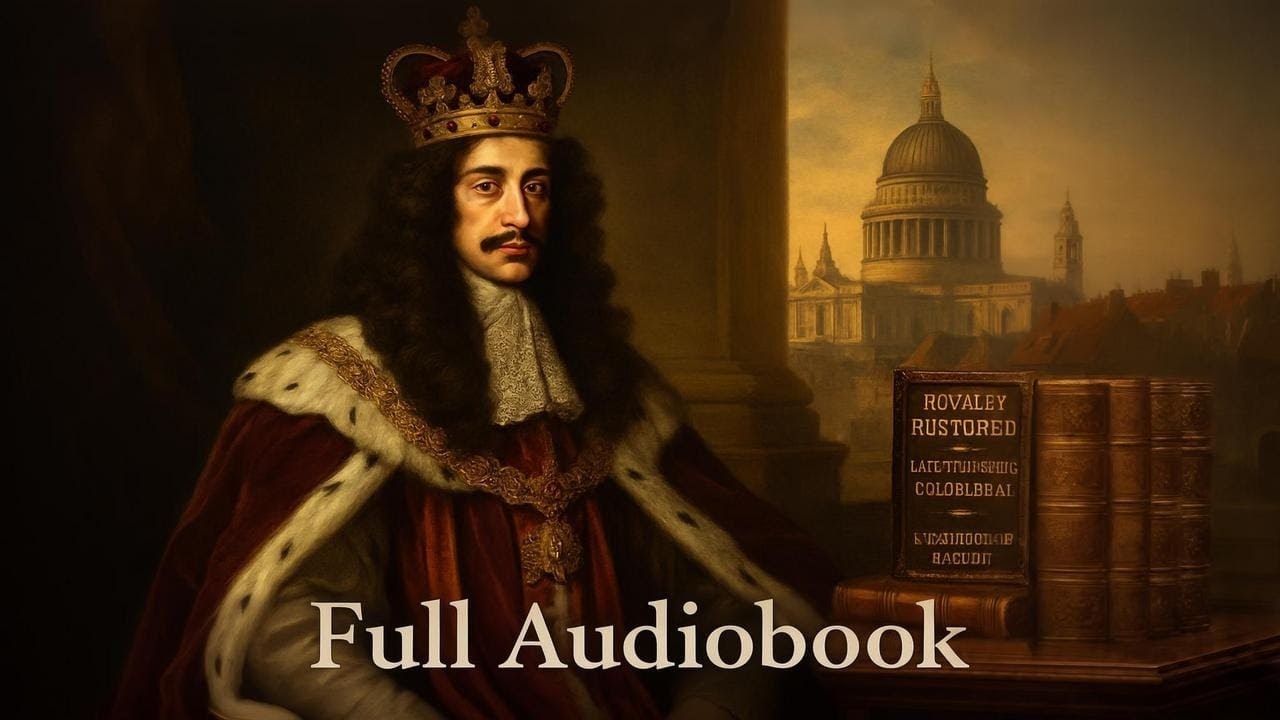
The 4K cinematic visuals accompanying this audiobook are generated by an AI image model from prompts derived from the source text. No copyrighted photos, paintings, or stock footage are used. AI generation is disclosed on every video on our YouTube channel as required by YouTube's altered/synthetic content policy.
English subtitles are transcribed from the LibriVox recording with OpenAI Whisper. Translations into the 11 other supported languages are produced by Meta's NLLB-200 neural translation model. No human translator's copyrighted translation is used.
Questions about sourcing or rights? See our DMCA & Sourcing policy or contact us.
Enjoyed this audiobook?
If you'd like to own a copy of Royalty Restored Or London under Charles II or hear a professionally produced edition, the links below help support free audiobook production at no extra cost to you.
As an Amazon Associate we earn from qualifying purchases. Audible / print links are affiliate.