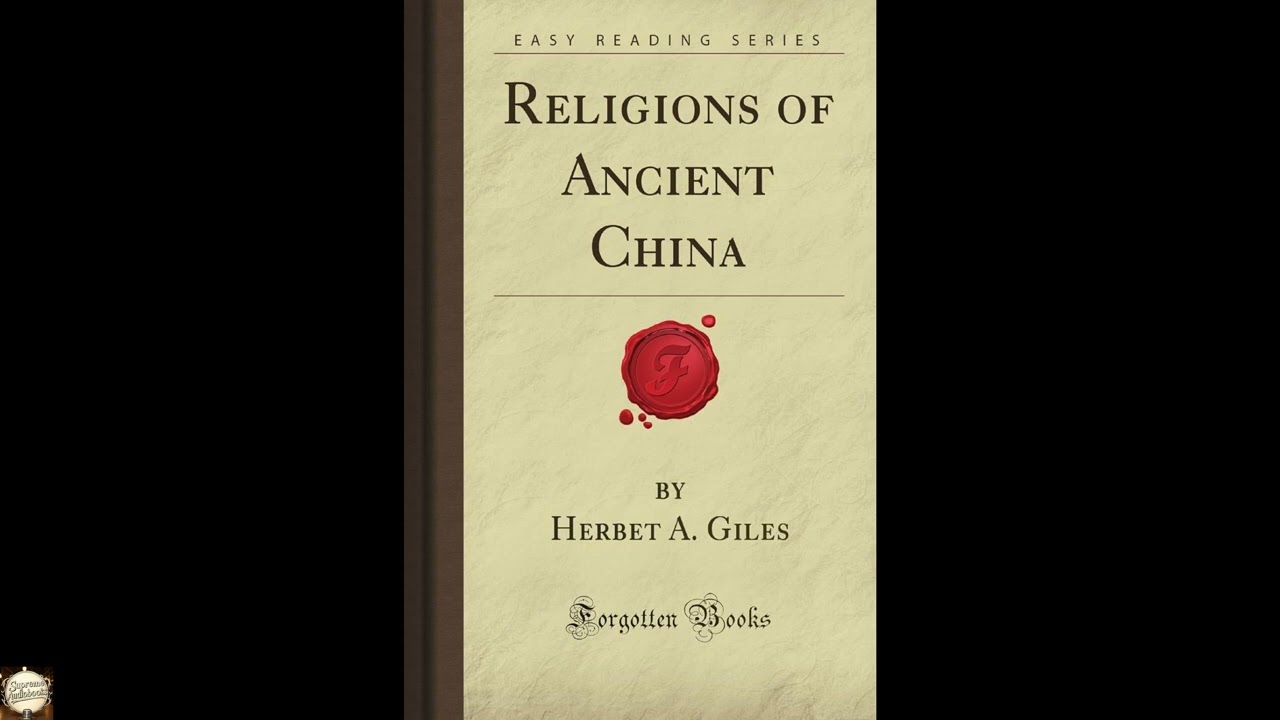
Religions of Ancient Chin
To understand the deepest currents of Chinese civilization, one must look to its spiritual and philosophical bedrock. For millennia, China has cultivated belief systems that are not merely doctrines, but the very framework of society, governance, and individual identity. Herbert A. Giles’s Religions of Ancient Chin offers a foundational gateway into this profound intellectual landscape, distilling centuries of thought into an accessible and illuminating account. Listeners today will discover how these ancient philosophies continue to shape China's modern outlook, influencing everything from social etiquette to political thought, offering a vital key to grasping one of the world's most enduring and influential cultures. Giles’s work sets out to present the spiritual and ethical development of ancient China, beginning not with formal religions but with the earliest discernible beliefs of its people. He takes us back to the primordial veneration of Heaven and Earth, the significance of ancestor worship, and the animistic reverence for spirits inhabiting natural forces. From this foundational substratum, the book traces the emergence of the major philosophical schools that would come to define Chinese thought. The initial focus centers on Confucianism, presented not as a religion in the Western sense, but as a system of ethics, social harmony, and virtuous governance, championed by Confucius himself—a philosopher whose teachings became integral to the imperial administration and personal conduct. Following this, the narrative shifts to Taoism, a school of thought starkly contrasted with the practicalities of Confucianism, yet equally fundamental. Giles illuminates Taoism through the teachings of Lao Tzu, emphasizing its quest for harmony with the natural order, its concept of the Tao or "the Way," and its embrace of simplicity and spontaneity. He discusses the philosophical Taoism that advocated for a life in accord with cosmic forces, distinct from later, more formalized Taoist religious practices involving alchemy and immortal seeking. Finally, the book introduces Buddhism, detailing its arrival in China from India and its eventual adaptation into a distinctly Chinese form, often merging with existing Taoist and Confucian ideas. Giles highlights how these seemingly disparate systems did not always conflict but often coexisted, forming a pragmatic and syncretic spiritual environment. The author, Herbert Allen Giles (1845-1935), was a preeminent British diplomat and scholar who dedicated his life to Sinology. Born in England, the son of a prominent Anglican priest, Giles received a classical education before joining the British Consular Service in China in 1867. For over two decades, he served in various capacities across different Chinese cities, gaining an unparalleled direct experience of the language, culture, and social fabric of the nation. This immersion provided the empirical foundation for his later academic contributions, making him one of the most authoritative voices on Chinese studies in the Western world during his era. Upon his return to England, Giles transitioned into academia, accepting the prestigious position as the first professor of Chinese at Cambridge University in 1897, a role he held until his retirement in 1932. His influence extended far beyond his lectures; he was a prolific writer whose works were instrumental in shaping Western understanding of China. Among his many notable publications are A Chinese-English Dictionary (1892), a monumental achievement that remained a standard for decades, and his evocative translation, Strange Stories from a Chinese Studio (1880), which introduced traditional Chinese folk tales to English readers. He also penned A History of Chinese Literature (1901), another pioneering work. Giles is also remembered for co-developing the Wade-Giles romanization system, a method for transliterating Chinese characters into the Latin alphabet that was widely used before the advent of Pinyin. His work fundamentally established the field of Chinese studies in the English-speaking academic world. One of the central themes Giles enacts throughout Religions of Ancient Chin is the remarkable syncretism and pragmatic coexistence of diverse belief systems. Rather than a zero-sum game, ancient Chinese thought allowed for multiple philosophies to operate simultaneously, each serving different aspects of life. For instance, Giles illustrates how an individual might adhere to Confucian principles for public service and social ethics, drawing upon its emphasis on filial piety and respect for hierarchy, while simultaneously embracing Taoist practices for personal spiritual cultivation, seeking harmony with nature in a quiet retreat. This ability to integrate seemingly disparate doctrines into a coherent cultural whole is a distinctive feature of Chinese spirituality, meticulously presented through Giles's examples of everyday customs and intellectual debates. Another key theme is the enduring power of primordial beliefs, particularly ancestor worship and the reverence for natural forces. Even with the rise of sophisticated philosophical schools and the introduction of Buddhism, the older, more elemental forms of spirituality never truly faded. Giles details the elaborate rituals surrounding ancestral veneration, underscoring its role in family cohesion and continuity. He also touches upon the persistent belief in the efficacy of divination, the importance of geomancy (feng shui) in architectural placement, and the pervasive respect for spirits of mountains, rivers, and celestial bodies. These practices formed a persistent, foundational layer beneath the more formalized systems, demonstrating a deep historical continuity in Chinese religious life. When Religions of Ancient Chin was published in 1905, the world was entering a new century marked by increasing globalization and imperial expansion. Western powers, including Britain, were deeply entangled with China, often through colonial interests and diplomatic missions. This period saw a surge in academic and public interest in non-Western cultures, though often viewed through a lens of Western cultural supremacy. Works like Giles's emerged from a desire to systematically document and understand these societies, moving beyond anecdotal accounts or purely missionary perspectives. Giles’s book represented a significant scholarly contribution during a time when much of the Western understanding of China was either superficial or skewed. As a scholar who had spent decades living and working in China and who subsequently held a prestigious academic chair, Giles provided an authoritative voice. His work was part of a broader intellectual movement to translate, interpret, and disseminate knowledge about Chinese history, language, and culture to a Western audience, helping to establish the academic discipline of Sinology itself. It offered an accessible yet rigorous overview that aimed to educate rather than proselytize, contributing to a more nuanced, though still era-bound, comprehension of China’s spiritual heritage. Listening to Religions of Ancient Chin as an audiobook offers a singular experience of intellectual engagement. The narration will guide you through complex philosophical ideas with a clear, measured pace, allowing time for reflection and absorption. Imagine a seasoned scholar, with a voice both authoritative and approachable, leading you through the labyrinthine yet logical progressions of Chinese thought. The "several hours" run length is perfectly suited for extended listening, perhaps over multiple commutes or during quiet evenings, transforming otherwise mundane moments into periods of profound learning. Without visual distractions, the listener can focus entirely on the flow of Giles's arguments, appreciating the careful construction of his historical narrative and the depth of his insights into the traditions that shaped—and continue to shape—the soul of a civilization.
Enjoyed Religions of Ancient Chin? A few ways to support us
Audible & Amazon links are affiliate; we may earn a small commission at no extra cost.
About this production
Human narration by a volunteer reader from LibriVox.org, the public-domain audiobook project. LibriVox volunteers record literary works whose copyright has expired in the United States, releasing the resulting recordings into the public domain.
Religions of Ancient Chin by Herbert A. Giles. The underlying text is in the U.S. public domain. We do not republish any modern copyrighted edition, translation, or commentary.
The 4K cinematic visuals accompanying this audiobook are generated by an AI image model from prompts derived from the source text. No copyrighted photos, paintings, or stock footage are used. AI generation is disclosed on every video on our YouTube channel as required by YouTube's altered/synthetic content policy.
English subtitles are transcribed from the LibriVox recording with OpenAI Whisper. Translations into the 11 other supported languages are produced by Meta's NLLB-200 neural translation model. No human translator's copyrighted translation is used.
Questions about sourcing or rights? See our DMCA & Sourcing policy or contact us.
Enjoyed this audiobook?
If you'd like to own a copy of Religions of Ancient Chin or hear a professionally produced edition, the links below help support free audiobook production at no extra cost to you.
As an Amazon Associate we earn from qualifying purchases. Audible / print links are affiliate.