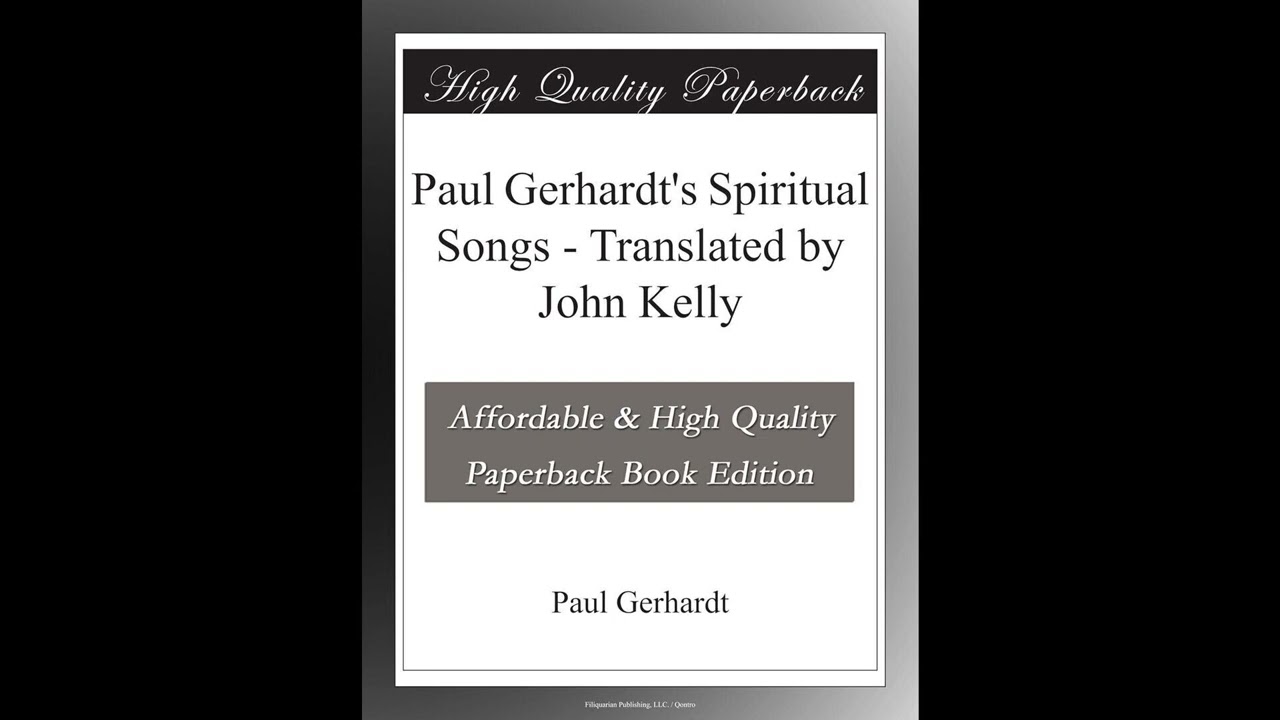
Paul Gerhardt's Spiritual Songs
Paul Gerhardt’s Spiritual Songs represents a cornerstone of sacred poetry, a collection that has provided comfort, inspiration, and profound theological insight for centuries. Far from being a relic of a bygone era, these hymns speak to universal human experiences—joy and sorrow, doubt and conviction, loss and hope—with an eloquence that transcends their original context. For anyone seeking solace, wrestling with life’s enduring questions, or simply appreciating the enduring power of language shaped by deep personal experience, this body of work offers a spiritual sustenance that remains remarkably potent and relevant, a testament to the human spirit’s capacity for endurance and belief even in the darkest times. While not a narrative in the conventional sense of plot and characters, Paul Gerhardt's Spiritual Songs presents a powerful emotional and spiritual arc, guiding the listener through the spectrum of human devotion. Each song, or hymn, acts as a self-contained lyrical moment, yet together they chart the journey of a believing soul through the world's trials and triumphs. Listeners find themselves immersed in the reflections of a devout "I" who communes directly with the divine, expressing profound anxieties, earnest petitions, and soaring praise. The setting shifts from the quiet intimacy of personal prayer to the communal celebration of church seasons, from the desolation of war-torn landscapes to the hopeful vision of heaven. The central conflict within these songs is the timeless struggle of faith against adversity: the human heart grappling with suffering, doubt, temptation, and the ever-present shadow of mortality. Gerhardt gives voice to the rawest expressions of grief and fear, but always turns them toward an unwavering trust in God's providence and mercy. The arc moves consistently from despair to hope, from introspection to outward-looking gratitude, portraying a spiritual resilience born from adversity. This collection offers not a resolution to earthly struggles, but a pathway to enduring them with grace, finding strength in conviction, and ultimately discovering profound joy even amidst hardship. Paul Gerhardt, born in Gräfenhainichen, Germany, in 1607, became one of the most influential German hymn writers after Martin Luther himself. His life spanned a period of immense upheaval and suffering, most notably the Thirty Years' War (1618-1648), a conflict that ravaged Central Europe and deeply affected his personal circumstances. He studied theology at the University of Wittenberg and served various pastorates, including an important tenure in Berlin. Throughout his life, Gerhardt experienced significant personal loss—the deaths of his parents, several children, and his wife, Anna Maria. These profound sorrows undeniably shaped the empathetic and often poignant tone of his hymns, lending them an authenticity born from lived experience. Gerhardt’s steadfast faith was tested not only by war and personal tragedy but also by religious controversies. As a devout Lutheran, he became entangled in disputes regarding syncretism in Brandenburg, which ultimately led to his dismissal from his pastoral post in Berlin. He spent his final years as an archdeacon in Lübben, where he continued to compose. He authored over 130 hymns, many of which are still sung today across denominations and have been translated into numerous languages. Hymns like "O Sacred Head, Now Wounded" (O Haupt voll Blut und Wunden) and "A Lamb Goes Uncomplaining Forth" (Ein Lämmlein geht und trägt die Schuld) are not merely religious songs; they are towering achievements in world literature, celebrated for their poetic beauty and theological depth. The collection enacts several enduring themes, often intertwining them with powerful imagery. One prominent theme is the resilience of faith amidst profound suffering. Gerhardt lived through unimaginable hardships, yet his hymns consistently demonstrate an unwavering trust in God. For example, in "Commit Thy Way, O Weary Soul" (Befiehl du deine Wege), the speaker acknowledges despair but ultimately surrenders to divine care, depicting the act of casting burdens upon a higher power as the only true source of peace. This hymn, born from the anguish of a war-torn landscape and personal loss, offers a blueprint for navigating life's darkest valleys with hope. Another key theme is the affirmation of joy and gratitude, even in modest blessings. Despite his trials, Gerhardt frequently turns to praise, finding beauty and comfort in the natural world and the simple mercies of daily existence. Hymns like "Go Forth, My Heart, and Seek Delight" (Geh aus, mein Herz, und suche Freud) use vivid descriptions of blooming flowers, singing birds, and the warmth of the sun to illustrate God's constant care and the beauty of creation. These lyrical depictions serve as concrete reminders that even amidst a world of pain, reasons for thankfulness abound, and the divine presence can be found in the mundane. Gerhardt’s work emerged directly from the turbulent cultural and political landscape of 17th-century Central Europe. The Thirty Years' War, a brutal confessional conflict, had ravaged the Holy Roman Empire, leaving widespread destruction, famine, and disease. This era was marked by an acute awareness of human fragility and the fleeting nature of life, which often found expression in the Baroque artistic and literary movements. Baroque art and music often featured dramatic contrasts, emotional intensity, and a focus on themes of death and resurrection, earthly vanity, and eternal salvation. Gerhardt's hymns, with their rich emotional range—from deep lament to soaring praise—and their often elaborate poetic structure, fit perfectly within this broader cultural framework. Moreover, the period was shaped by the ongoing legacy of the Protestant Reformation. While Lutheranism was firmly established, there were internal theological debates, such as the Syncretistic Controversy, which sought to bridge divides between various Protestant factions. Gerhardt, a staunch orthodox Lutheran, nonetheless infused his theology with a deep, heartfelt piety, moving away from purely intellectual dogma towards an experiential faith. His hymns, therefore, provided not just theological instruction but also a vehicle for personal devotion, allowing individuals to connect with their faith on an emotional and spiritual level that transcended the intellectual arguments of the time. Listening to Paul Gerhardt’s Spiritual Songs as an audiobook provides an intimate and reflective experience, allowing the poetic and theological depth to unfold naturally. These are not merely texts to be read; they are words intended to be heard, to resonate with the cadence of human speech, and to carry the weight of their profound meaning through spoken rhythm. The narrator's voice, pacing, and emotional nuance become crucial elements, bringing to life the subtle shifts from lament to comfort, from petition to exuberant praise. Without the visual distraction of a page, listeners can fully immerse themselves in Gerhardt's evocative imagery and the timeless truths his language conveys, encountering the hymns in a way that aligns with their original purpose—as expressions of heartfelt devotion meant to be internalized and cherished. The several hours of listening time allow for a gradual assimilation of this enduring literary legacy, making it an ideal companion for moments of quiet contemplation or sustained reflection.
Enjoyed Paul Gerhardt's Spiritual Songs? A few ways to support us
Audible & Amazon links are affiliate; we may earn a small commission at no extra cost.
About this production
Human narration by a volunteer reader from LibriVox.org, the public-domain audiobook project. LibriVox volunteers record literary works whose copyright has expired in the United States, releasing the resulting recordings into the public domain.
Paul Gerhardt's Spiritual Songs by Paul Gerhardt. The underlying text is in the U.S. public domain. We do not republish any modern copyrighted edition, translation, or commentary.
The 4K cinematic visuals accompanying this audiobook are generated by an AI image model from prompts derived from the source text. No copyrighted photos, paintings, or stock footage are used. AI generation is disclosed on every video on our YouTube channel as required by YouTube's altered/synthetic content policy.
English subtitles are transcribed from the LibriVox recording with OpenAI Whisper. Translations into the 11 other supported languages are produced by Meta's NLLB-200 neural translation model. No human translator's copyrighted translation is used.
Questions about sourcing or rights? See our DMCA & Sourcing policy or contact us.
Enjoyed this audiobook?
If you'd like to own a copy of Paul Gerhardt's Spiritual Songs or hear a professionally produced edition, the links below help support free audiobook production at no extra cost to you.
As an Amazon Associate we earn from qualifying purchases. Audible / print links are affiliate.
More Audiobooks
English Songs and Ballads
Ballads Of Mystery And Miracle And Fyttes Of Mirth; Popular Ballads Of The Olden Tim- Full Audiobook
A Medieval Mystic: A Short Account of the Life and Writings of Blessed John Ruysbroe- Full Audiobook
Religious Poems, Part 2.. Part 6 From Volume II of The Works of John Greenleaf Whit