Out of the Air (Classic Books)
Step back into an era when women's voices were rising, demanding recognition and new futures. Inez Haynes Gillmore's “Out of the Air” is a compelling literary artifact, a testament to the societal shifts and personal awakenings that defined the early 20th century. This novel offers a unique window into the minds and struggles of individuals grappling with profound change, making its observations startlingly relevant to our own moment of redefinition. It challenges perceptions of reality and self, revealing how seemingly intangible forces can reshape a life, inviting us to reconsider the origins of our deepest convictions and the paths we choose. Within this milieu, “Out of the Air” introduces us to Eleanor Vance, a young woman living in a bustling turn-of-the-century American city. She leads a seemingly conventional existence, engaged to a respectable, if somewhat staid, young man, and anticipates a future centered on home and social engagements. Yet, Eleanor possesses a keen, questioning mind that quietly chafes against the unspoken limitations placed upon her. Her world begins to shift when she encounters Professor Alistair Finch, a charismatic and unconventional scholar who speaks of unseen forces, of ideas that seem to coalesce from the ether and profoundly shape human destiny. Finch’s concepts—initially dismissed as eccentric—begin to manifest in subtle, unsettling ways within Eleanor’s own life. A series of strange coincidences, unexpected encounters, and whispers of forgotten knowledge appear to arise from nowhere, challenging her logical understanding of the world. She finds herself drawn into conversations about intuition, the collective unconscious, and the power of individual will to shape reality. As she navigates these new currents, Eleanor recognizes a growing discrepancy between the life she is expected to lead and the vibrant, intellectual existence she secretly yearns for. This awakening pulls her away from her fiancé and established social circle, compelling her toward a burgeoning sense of self and purpose that truly emerges "out of the air," forcing her to confront deep-seated fears about stepping beyond convention. The mind behind this compelling narrative, Inez Haynes Gillmore, later known as Inez Haynes Irwin, was a formidable literary and political figure of the early 20th century. Born in Rio de Janeiro in 1873 to American parents, she grew up in Massachusetts and graduated from Vassar College in 1897. Gillmore’s education and early experiences instilled in her a fervent commitment to social justice, particularly the cause of women’s suffrage. She became a prolific journalist and author, using her pen to advocate for women’s rights during an era of profound societal transformation. Her influence extended far beyond fiction; Gillmore notably co-founded the National Woman’s Party with Alice Paul and authored the authoritative "The Story of the Woman's Party." Beyond her activism, she was a versatile fiction writer, penning children's stories, mysteries, and serious social novels. Her most acclaimed novel, "Angel Island" (1914), stands as a striking example of allegorical feminist science fiction, showcasing her imaginative breadth. Gillmore stood at the vanguard of a generation of women writers who sought not just to document their times but to actively shape them, her work offering a vital perspective on womanhood and societal roles in a rapidly changing world. At its heart, "Out of the Air" grapples with the profound questions of female identity and autonomy that were particularly resonant in the early 20th century. The story acutely portrays protagonist Eleanor Vance’s internal struggle as she navigates the chasm between societal expectations and her own burgeoning intellectual and personal aspirations. We witness her conventional engagement, a symbol of the prescribed path for women of her era, contrasting sharply with the stirrings of a deeper, more independent self that begins to assert itself. This tension is vividly dramatized as Eleanor finds herself increasingly at odds with her fiancé’s predictable worldview, driven instead by a hunger for knowledge and self-determination that seems to materialize from previously unimagined sources. Another compelling theme woven through the narrative is the interplay between intuition and rationality, or perhaps, the seen versus the unseen forces that shape human experience. The mysterious occurrences and profound philosophical discussions that challenge Eleanor’s logical understanding serve to highlight this. Gillmore masterfully illustrates how what we perceive as "out of the air"—be it an idea, an insight, or a compelling urge—can fundamentally alter one’s reality. The novel suggests that profound truths and personal revolutions often originate not from explicit instruction, but from a more ethereal, intuitive realm, questioning the limits of purely rational thought. This notion of an emergent, almost mystical truth empowers Eleanor to reconsider her entire future, ultimately making a strong case for individual freedom over the constraints of social convention. Inez Haynes Gillmore penned "Out of the Air" during a period of immense upheaval and transformation in American society, roughly corresponding to the Progressive Era and the years immediately surrounding World War I. This was an epoch defined by rapid industrialization, burgeoning urban centers, and a profound questioning of established social norms, particularly those concerning women. The women's suffrage movement was reaching its zenith, with suffragists like Gillmore tirelessly campaigning for the right to vote, a struggle that symbolized a broader demand for economic, social, and intellectual equality. The novel arises directly from this ferment, reflecting the cultural shifts that saw women increasingly entering public life, pursuing higher education, and challenging the Victorian ideal of the domestic sphere as their sole domain. The literary landscape of the time also reflected these changes. Writers were moving beyond the strictures of Victorian sentimentality, embracing realism and naturalism, and beginning to experiment with modernism. Gillmore’s work, while maintaining a clear narrative, resonates with this spirit of questioning and newness. Her ability to weave contemporary social commentary with elements of psychological introspection and a sense of the unforeseen speaks to a generation grappling with a future that felt both uncertain and exhilarating. "Out of the Air" therefore stands as a vivid literary artifact, not only reflecting the anxieties and aspirations of its time but also actively participating in the ongoing dialogue about what it meant to be a modern woman in a rapidly evolving world. Listening to "Out of the Air" as an audiobook offers a singular opportunity to immerse oneself in Gillmore’s distinctive voice and the nuanced world she creates. The length, spanning several hours, makes it an ideal companion for a series of commutes, quiet evenings, or moments of focused escape. A skilled narrator brings Eleanor Vance’s internal struggles and the shifting atmospheres of her world vividly to life, allowing the listener to truly experience her awakening. Pay close attention to the pacing, which might subtly build tension as Eleanor confronts new ideas, or linger reflectively on moments of profound insight. The dialogue, delivered by an adept voice artist, will reveal the subtle power dynamics and evolving relationships, making the conversations between characters feel immediate and impactful. This auditory format underscores the subtle psychological shifts and the almost ethereal quality of ideas manifesting "out of the air," transforming a written narrative into a direct, intimate encounter with a powerful story and a vital historical perspective.
Enjoyed Out of the Air (Classic Books)? A few ways to support us
Audible & Amazon links are affiliate; we may earn a small commission at no extra cost.
About this production
Human narration by a volunteer reader from LibriVox.org, the public-domain audiobook project. LibriVox volunteers record literary works whose copyright has expired in the United States, releasing the resulting recordings into the public domain.
Out of the Air (Classic Books) by Inez Haynes Gillmore. The underlying text is in the U.S. public domain. We do not republish any modern copyrighted edition, translation, or commentary.
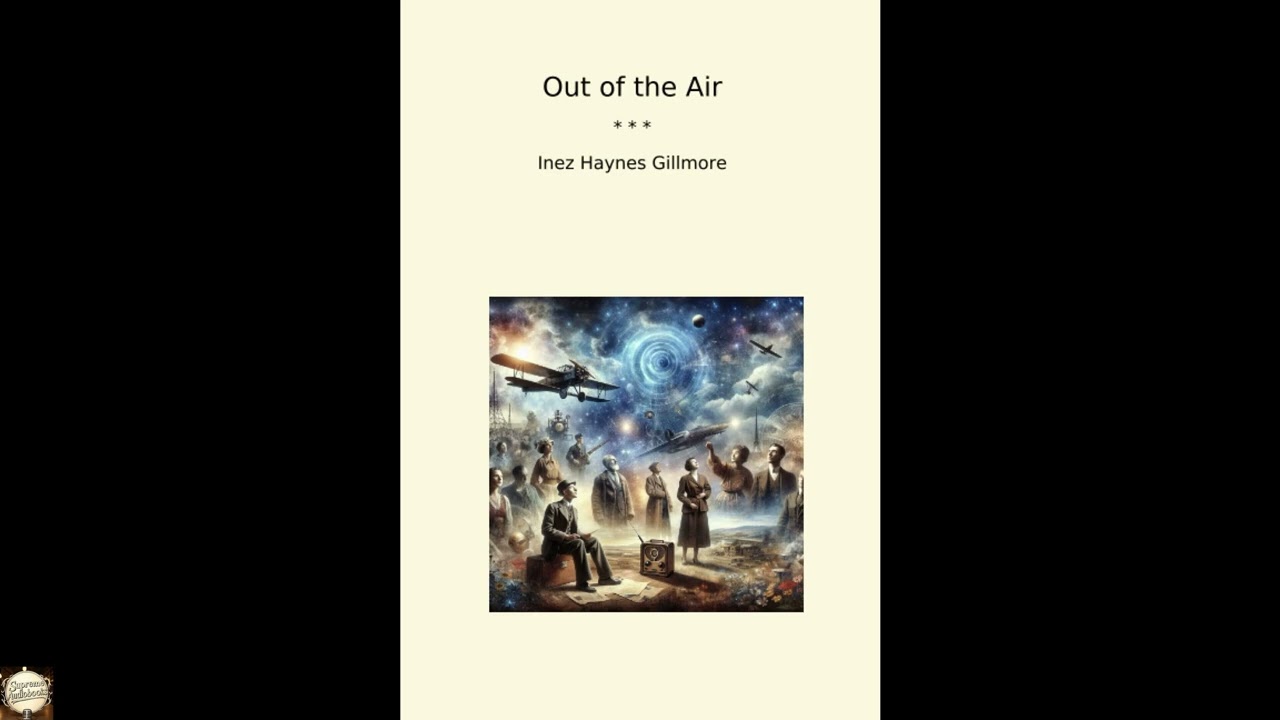
The 4K cinematic visuals accompanying this audiobook are generated by an AI image model from prompts derived from the source text. No copyrighted photos, paintings, or stock footage are used. AI generation is disclosed on every video on our YouTube channel as required by YouTube's altered/synthetic content policy.
English subtitles are transcribed from the LibriVox recording with OpenAI Whisper. Translations into the 11 other supported languages are produced by Meta's NLLB-200 neural translation model. No human translator's copyrighted translation is used.
Questions about sourcing or rights? See our DMCA & Sourcing policy or contact us.
Enjoyed this audiobook?
If you'd like to own a copy of Out of the Air (Classic Books) or hear a professionally produced edition, the links below help support free audiobook production at no extra cost to you.
As an Amazon Associate we earn from qualifying purchases. Audible / print links are affiliate.