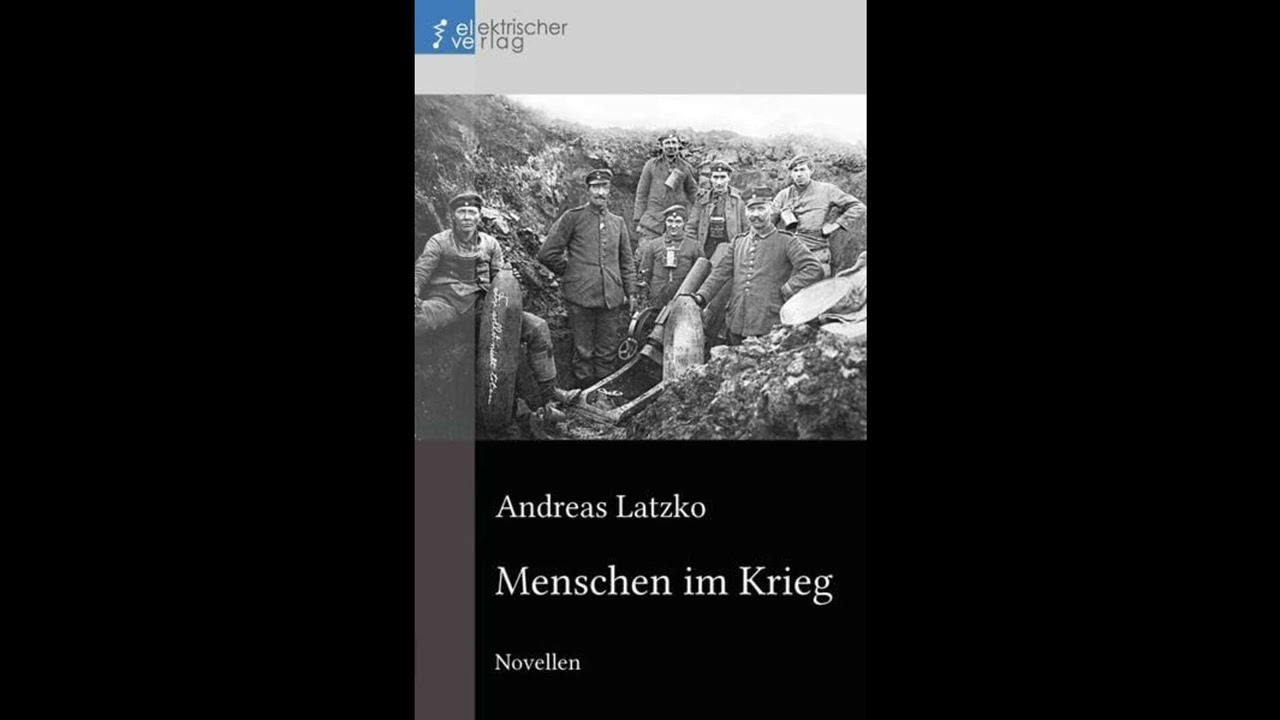
Menschen im Krieg
The roar of cannons, the stench of mud, the despair of a generation—these realities burst forth from Andreas Latzko's "Menschen im Krieg." Published during the First World War, this powerful collection excavates the human soul under industrialized conflict. It confronts how war distorts perception, erodes humanity, and poisons heroism. Though historically set, Latzko’s unflinching portrayal of suffering and disillusionment resonates with chilling familiarity, urging us to consider war's echoes today and the eternal cost of turning humans into cogs. "Menschen im Krieg," or "Men in War," unfolds not as a single narrative, but as interconnected glimpses into lives caught in the brutal machinery of the First World War. Set on the Eastern Front, in desolate trenches, the stories immerse the listener in the harrowing experiences of soldiers and officers. We meet Captain Bartenstein, whose spirit breaks under command’s absurdity, and Lieutenant Wlast, whose integrity offers a counterpoint to the madness, alongside countless anonymous privates, their hopes crushed by battle. The central conflict is less about military engagements than the internal struggle against dehumanization and despair. Latzko renders war's psychological toll: eroded empathy, trauma from horrors, and desperate attempts to cling to sanity. We see subtle shifts in human behavior under duress—moments of compassion, flashes of cruelty, and pervasive dread. The story arc is a collective descent into war’s abyss, revealing how conflict systematically strips away identity, leaving behind a scarred humanity. Andreas Latzko, an Austrian writer born in Budapest in 1876, led a cosmopolitan life as a journalist and dramatist before the First World War. His direct service in the Austro-Hungarian army on the Eastern Front, enduring malaria and horrors, profoundly shaped his artistic vision. Invalided out in 1917, this visceral engagement fueled his powerful anti-war writing and transformed him into an impassioned voice for pacifism. "Menschen im Krieg," published in 1918, became his searing response. Its raw honesty garnered international attention, despite being banned in Austria-Hungary. The work placed him within the Expressionist literary movement, prioritizing emotional reality and highlighting social injustice. Latzko continued his critical examination of war in works like "Friedensgericht" (1919), "Der wilde Mann" (1921), and "Auguste 1914" (1927). In exile in Switzerland due to his anti-militarist convictions, he remained a prominent figure in the interwar peace movement. His unwavering commitment established him as a significant voice in war literature, mentioned alongside contemporaries like Erich Maria Remarque and Henri Barbusse, for depicting war's grim truth. He passed away in Amsterdam in 1943, leaving a legacy of unflinching honesty and a profound call for peace. At its core, "Menschen im Krieg" dissects potent themes, starting with the futility of war. Latzko demonstrates this through mundane, repetitive trench horrors and senseless human waste. Soldiers die for insignificant patches of land, immediately lost or retaken—a constant cycle of sacrifice. The narrative exposes the disconnect between patriotic rhetoric and the stark suffering endured by men, revealing war as a machine consuming lives for its own sake. Another profound theme is the dehumanization of the individual within the military apparatus. Latzko illustrates how soldiers are reduced to mere cogs, their identities stripped by uniforms, regulations, and constant death threats. A scene depicts a soldier finding more solace in cleaning his rifle than in his own dwindling self. Furthermore, the book portrays psychological trauma inflicted by sustained violence. Characters grapple with nightmares, shell shock, and creeping madness, showing that war's wounds extend far beyond the physical, scarring mind and spirit. "Menschen im Krieg" emerged from the unprecedented global upheaval of the First World War. Published in 1918, the year fighting concluded, it offered a stark counter-narrative to nationalistic fervor and romanticized combat. As the conflict dragged on, costing millions of lives, disillusionment swept society. Latzko’s work joined a crucial outpouring of anti-war literature refusing to glorify suffering. It belonged to a literary moment grappling with old certainties and the horrifying spectacle of industrialized warfare. This literary response was deeply entwined with the rise of Expressionism, an artistic movement conveying subjective emotions and realities through distortion and disturbing imagery. Latzko's raw depictions of degradation aligned with Expressionist ideals, rejecting traditional narrative forms to confront uncomfortable truths. The book's publication at that juncture—when the public was weary of propaganda and hungry for authentic accounts—achieved immediate impact, serving as a powerful testament to war's human cost and a desperate plea for sanity. Its timing made it a vital historical document. Listening to "Menschen im Krieg" as an audiobook offers a unique, deeply affecting way to connect with its powerful message. Its several-hour run length allows these interconnected stories to unfold at a deliberate pace, immersing the listener in Latzko’s vivid, disturbing world. A skilled narrator can convey quiet desperation in a soldier's monologue, weary resignation in an officer's command, and stark horror in battlefield descriptions. Nuanced vocal performances, with subtle shifts in tone, underscore the narrative’s psychological weight and the pervasive atmosphere of dread. Listen for how the narration delineates character voices and handles the grim, realistic dialogue. This auditory presentation transforms a powerful collection into an immediate, resonant experience, ensuring Latzko's urgent plea against war echoes directly into your consciousness.
Enjoyed Menschen im Krieg? A few ways to support us
Audible & Amazon links are affiliate; we may earn a small commission at no extra cost.
About this production
Human narration by a volunteer reader from LibriVox.org, the public-domain audiobook project. LibriVox volunteers record literary works whose copyright has expired in the United States, releasing the resulting recordings into the public domain.
Menschen im Krieg by Andreas Latzko. The underlying text is in the U.S. public domain. We do not republish any modern copyrighted edition, translation, or commentary.
The 4K cinematic visuals accompanying this audiobook are generated by an AI image model from prompts derived from the source text. No copyrighted photos, paintings, or stock footage are used. AI generation is disclosed on every video on our YouTube channel as required by YouTube's altered/synthetic content policy.
English subtitles are transcribed from the LibriVox recording with OpenAI Whisper. Translations into the 11 other supported languages are produced by Meta's NLLB-200 neural translation model. No human translator's copyrighted translation is used.
Questions about sourcing or rights? See our DMCA & Sourcing policy or contact us.
Enjoyed this audiobook?
If you'd like to own a copy of Menschen im Krieg or hear a professionally produced edition, the links below help support free audiobook production at no extra cost to you.
As an Amazon Associate we earn from qualifying purchases. Audible / print links are affiliate.