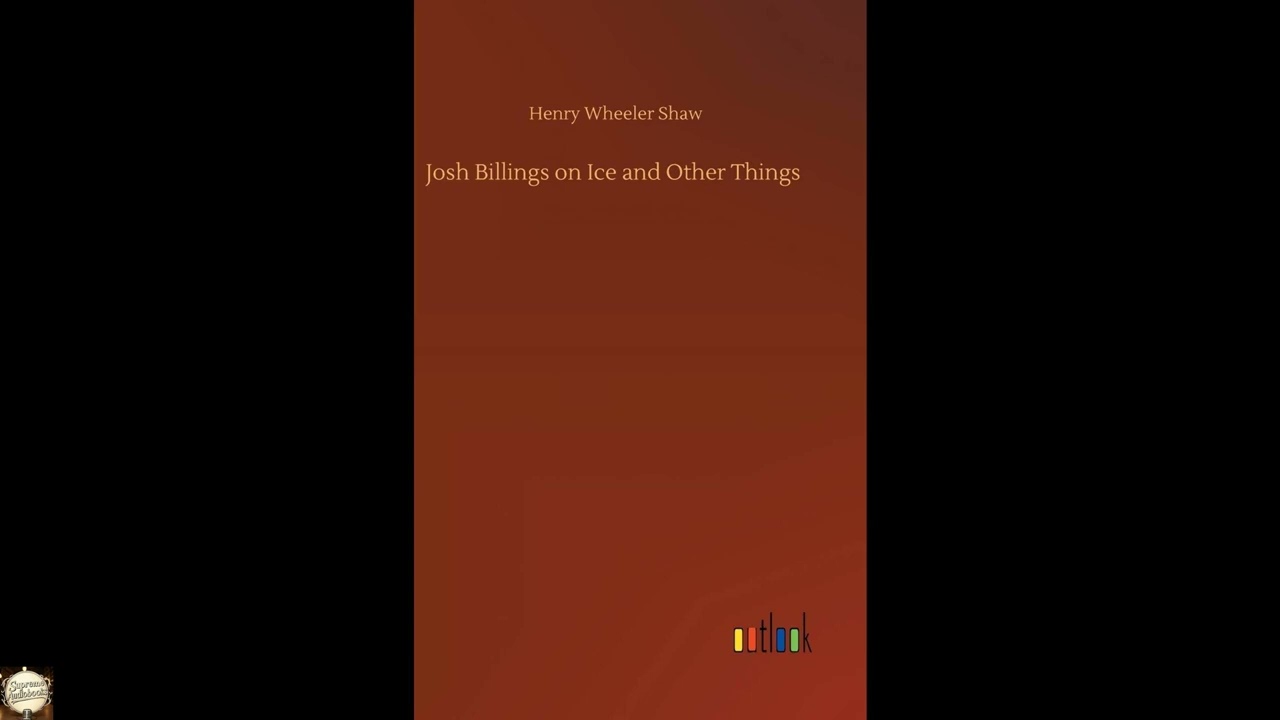
Josh Billings on Ice and Other Things
Step into the singular world of Josh Billings, the homespun philosopher whose wry observations and unique turn of phrase charmed post-Civil War America. In Josh Billings on Ice and Other Things, Henry Wheeler Shaw, writing under his famous nom de plume, collects a treasury of his most beloved humorous essays and aphorisms, offering listeners a delightful window into 19th-century American wit. This is more than just a collection of jokes; it’s a shrewd, often surprisingly poignant, look at human nature, society’s quirks, and the eternal struggle between common sense and sheer folly. What makes Billings’s voice so enduring today is its authenticity—a folksy wisdom delivered with a generous helping of intentional misspellings and phonetic renderings, which only heighten the comedic effect and underscore his unique, unfiltered perspective on the world. Unlike a traditional novel, Josh Billings on Ice and Other Things doesn't unfold with a linear plot or a single cast of characters. Instead, it invites the listener into a sprawling conversation with its central "character," Josh Billings himself—a persona crafted as the quintessential cracker-barrel philosopher. The setting is loosely defined as 19th-century small-town and rural America, a landscape of farms, general stores, and simple living, yet Billings’s observations extend far beyond, touching on universal truths. Each short piece, be it a short essay, a witty maxim, or a brief anecdote, acts as a vignette, painting a picture of everyday life and the eccentricities of its inhabitants. The "arc" of this collection isn't a narrative progression but rather the cumulative effect of experiencing Billings’s distinctive worldview. He tackles subjects as diverse as animals, marriage, money, medicine, and the weather, all filtered through his idiosyncratic language and droll delivery. The central "conflict," if one can call it that, is the gentle clash between genuine human experience and the pretenses people adopt, between simple wisdom and educated foolishness. Billings champions the former, often using his deliberately ungrammatical style to highlight the artificiality of formal language and thought. Listeners will encounter a parade of human types—the self-important, the naive, the overly dramatic—all subjected to Billings’s good-natured but incisive scrutiny, leading to moments of both hearty laughter and quiet reflection. The man behind the curtain, Henry Wheeler Shaw, was born in Lanesborough, Massachusetts, in 1818. His early life was a patchwork of varied—and often unsuccessful—occupations, far removed from the literary world. He briefly attended Hamilton College, but soon left to try his hand at farming, auctioneering, operating a coal business, and even captaining a steamboat on the Ohio and Mississippi Rivers. It wasn't until his late 40s, after years of struggle and moving between different states, that Shaw discovered his true calling as a humorist. He began writing short, satirical pieces for newspapers, adopting the persona of "Josh Billings" and employing the phonetic spellings that would become his trademark. Shaw’s unique blend of down-to-earth wisdom and linguistic play quickly resonated with a wide audience. His first major collection, Josh Billings: His Sayings, published in 1865, cemented his fame. He went on to author other popular books such as Everybody's Friend in 1874 and, most notably, the immensely successful Josh Billings' Farmer's Allminax, an annual publication that mixed humorous advice, meteorological predictions, and satirical observations, published from 1870 until his death. Shaw passed away in Monterey, California, in 1885, leaving behind a legacy as one of America's most beloved humorists, often considered a precursor to—and contemporary of—such giants as Mark Twain in shaping a uniquely American comedic voice. At its heart, Josh Billings on Ice and Other Things playfully dissects the universal themes of human folly versus common sense. Billings frequently lampoons pomposity and intellectual pretension, as exemplified by his famous observation, "It is better to kno a fiew things well, than to kno a good many things bi halves." He consistently elevates the practical, often rustic, wisdom of the common person over the often-absurd pronouncements of the supposedly learned. Another recurring theme is the satirical commentary on societal norms and expectations. Billings often uses exaggeration and witty reversals to expose the hypocrisies and absurdities of everyday life, whether he is talking about the peculiarities of house cats or the complexities of married life, always with a keen eye for human nature’s inconsistencies. Furthermore, Shaw uses his Billings persona to highlight the power and limitations of language itself. The deliberate misspellings, like "fiew" for "few" or "kno" for "know," are not merely a gimmick; they are integral to the character’s voice, suggesting that true insight doesn’t always conform to grammatical rules. This phonetic style allows him to subtly comment on the arbitrary nature of "correct" English, implying that an authentic, unvarnished truth can emerge from non-standard expressions. His seemingly simple statements often carry a surprising philosophical weight, offering a gentle yet profound critique of human behavior, making his work a significant contribution to 19th-century American humor and its enduring appeal. The period when Henry Wheeler Shaw gained prominence and published these works was a tumultuous yet fertile time in American history. The decades following the Civil War saw rapid industrialization, significant social change, and a growing sense of national identity. This era, often called the Gilded Age, was ripe for humor that could both entertain and gently critique the country’s evolving values and often ostentatious new wealth. There was a burgeoning demand for distinctly American voices in literature, moving away from European traditions towards something homegrown and relatable. Humorists like Billings, Artemus Ward, and Petroleum V. Nasby found a wide audience through newspapers and magazines, providing a form of popular entertainment that spoke directly to the everyday concerns of Americans. Shaw’s "cracker-barrel philosopher" persona, with its folksy dialect and common-sense wisdom, offered a comforting and familiar voice amidst rapid modernization. His humor served as a way to process the anxieties and absurdities of a changing nation, creating a shared cultural touchstone through laughter and shrewd observation. To hear Josh Billings on Ice and Other Things as an audiobook is to genuinely experience the artistry of Henry Wheeler Shaw. His work, designed to be read aloud with its phonetic spellings and distinct cadence, truly comes alive when narrated. The run length, several hours, makes it perfect for relaxed listening—perhaps during a commute, while tackling household chores, or simply unwinding with a cup of coffee. A skilled narrator can bring out the dry wit and the underlying warmth of Billings's persona, lending proper weight to his aphorisms and making the deliberate misspellings sound like charming quirks rather than textual impediments. The pacing is naturally episodic, allowing listeners to absorb each observation or anecdote before moving on. The very atmosphere of the work—a quiet, intimate conversation with a shrewd observer—is perfectly suited to the spoken word, creating an immersive sense of stepping back in time to share a laugh with a genuinely original American voice.
Enjoyed Josh Billings on Ice and Other Things? A few ways to support us
Audible & Amazon links are affiliate; we may earn a small commission at no extra cost.
About this production
Human narration by a volunteer reader from LibriVox.org, the public-domain audiobook project. LibriVox volunteers record literary works whose copyright has expired in the United States, releasing the resulting recordings into the public domain.
Josh Billings on Ice and Other Things by Henry Wheeler Shaw. The underlying text is in the U.S. public domain. We do not republish any modern copyrighted edition, translation, or commentary.
The 4K cinematic visuals accompanying this audiobook are generated by an AI image model from prompts derived from the source text. No copyrighted photos, paintings, or stock footage are used. AI generation is disclosed on every video on our YouTube channel as required by YouTube's altered/synthetic content policy.
English subtitles are transcribed from the LibriVox recording with OpenAI Whisper. Translations into the 11 other supported languages are produced by Meta's NLLB-200 neural translation model. No human translator's copyrighted translation is used.
Questions about sourcing or rights? See our DMCA & Sourcing policy or contact us.
Enjoyed this audiobook?
If you'd like to own a copy of Josh Billings on Ice and Other Things or hear a professionally produced edition, the links below help support free audiobook production at no extra cost to you.
As an Amazon Associate we earn from qualifying purchases. Audible / print links are affiliate.