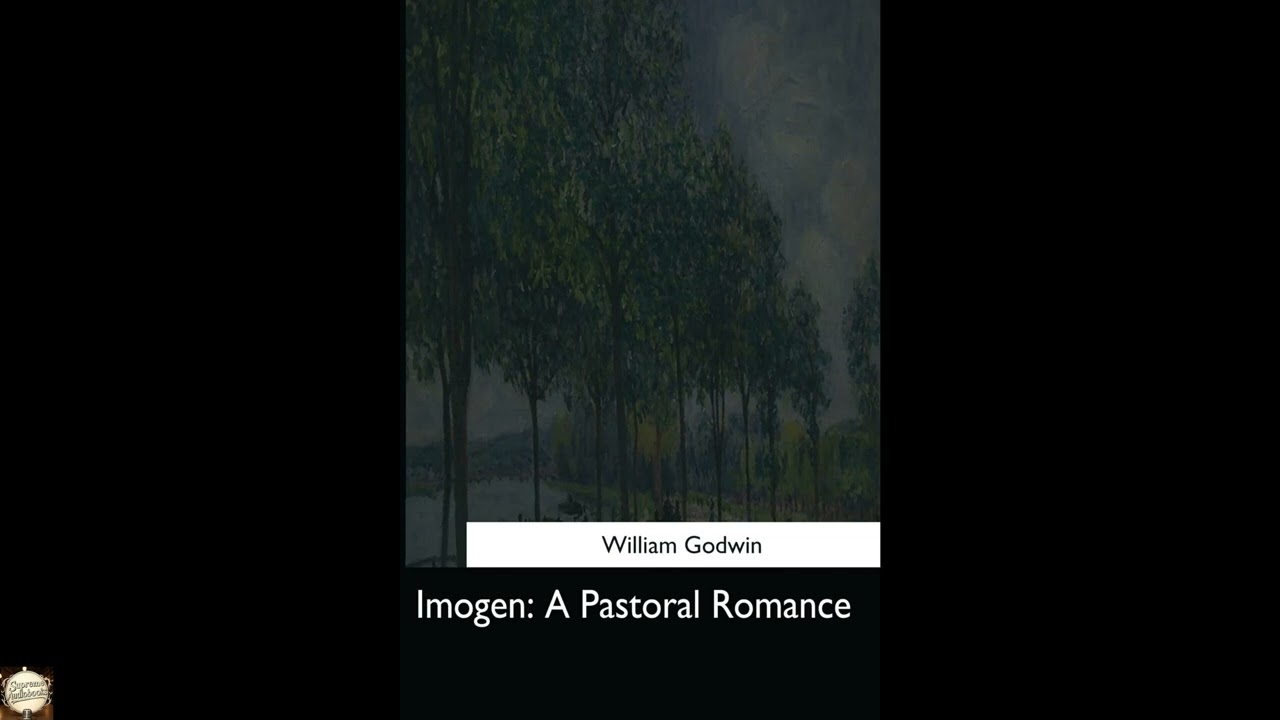
Imogen: A Pastoral Romance
Amidst the vast and often stormy landscape of William Godwin's literary output—a terrain usually marked by radical philosophy, stark social critique, and the deep shadows of gothic suspense—lies a serene, yet ultimately poignant, anomaly: "Imogen: A Pastoral Romance." This beautiful, unfinished fragment, discovered and published long after its author's death, offers listeners a unique entry point into the imaginative world of one of British Romanticism's most influential and unconventional minds. It is a tale that, despite its brevity, resonates powerfully with enduring questions about innocence, the lure of an idealized past, and the inevitable, sometimes sorrowful, collision between the untainted heart and the complexities of the world. Far from his more overtly political works, "Imogen" reveals Godwin's capacity for delicate sentiment and pastoral charm, providing a fresh perspective on a writer whose ideas continue to shape discussions of individual liberty and societal structure even today. The narrative transports us to a secluded, almost mythical valley, a verdant haven untouched by the corrupting influences of civilization. Here lives Imogen, a young woman of breathtaking beauty and unparalleled purity, raised in blissful ignorance of society's artifice and its often-harsh realities. Her days are spent in harmony with nature, her spirit untroubled by ambition or deceit. This tranquil existence is profoundly altered by the arrival of Rodolph, a sophisticated and worldly traveler who, by chance, stumbles upon Imogen's Eden. He is instantly captivated by her natural grace and unblemished spirit, a striking contrast to the artificiality he knows. As Rodolph slowly integrates himself into Imogen's secluded world, a tender connection begins to form between them. He, weary of the superficiality of the polite society he has left behind, finds in Imogen a profound truth and an idealized simplicity he never imagined possible. Imogen, for her part, is drawn to Rodolph's knowledge and charm, encountering for the first time a mind that reflects the wider world beyond her valley. Their budding romance blossoms against the backdrop of this idyllic setting, but the very nature of their backgrounds—her pristine innocence versus his worldly experience—introduces an inherent fragility. The story gently, but firmly, establishes the delicate balance of their relationship, hinting at the profound challenges that will inevitably arise as the boundaries of Imogen's sheltered world begin to blur, and the complexities Rodolph carries with him threaten to intrude upon their pastoral dream. The unfolding of their initial encounters and the slow dawning of mutual affection lays the groundwork for a romance that, even in its incomplete state, raises fundamental questions about the sustainability of such pure happiness when confronted with the forces of human nature and external reality. The author of this intriguing romance, William Godwin (1756-1836), was a towering figure in English intellectual life, a novelist, philosopher, and political theorist whose ideas profoundly impacted his contemporaries and subsequent generations. Born in Wisbech, Cambridgeshire, and initially educated to follow his father into the dissenting ministry, Godwin ultimately abandoned the pulpit for the pen, dedicating his life to literature and radical philosophy. His seminal work, "An Enquiry Concerning Political Justice" (1793), was a revolutionary treatise advocating for individual liberty and reason, challenging established institutions of government, property, and even marriage, effectively laying some of the groundwork for anarchist thought. Godwin's personal life was as unconventional and influential as his ideas. He formed a celebrated, though tragically brief, marriage with the pioneering feminist Mary Wollstonecraft, whose own work "A Vindication of the Rights of Woman" remains a cornerstone of feminist philosophy. Their daughter, Mary Shelley, would go on to write the enduring classic "Frankenstein." Godwin’s circle included some of the most prominent writers and thinkers of the age, including Percy Bysshe Shelley, Lord Byron, and Samuel Taylor Coleridge, all of whom were influenced by his radical viewpoints. His novels, such as "Caleb Williams" (1794), are often considered early examples of the detective novel and psychological thriller, using gripping narratives to critique social injustice and the oppressive power of the state. Godwin's place in the canon is secure as a central figure of British radicalism and a bridge between Enlightenment rationalism and Romantic idealism. "Imogen: A Pastoral Romance" enacts several profound themes, illustrating them through the delicate interactions and descriptions it presents. Central to the story is the classic tension between innocence and experience. Imogen herself is the very embodiment of untouched purity; her lack of exposure to societal norms and vices renders her guileless and trusting. Rodolph, on the other hand, carries the weight of the sophisticated world, his observations colored by disillusionment and knowledge. Their encounter highlights the fragility of Imogen's innocent state, suggesting that such purity, once exposed, can never truly be recovered. For example, Rodolph's initial admiration of Imogen's unselfconscious beauty subtly shifts as he contemplates the challenges she would face if introduced to the judging eyes of society, a clear instance of his worldly wisdom contrasting with her naive self-assurance. Another significant theme is the allure and ultimate limitations of nature versus civilization. The pastoral setting of Imogen's valley functions as a utopian ideal, a retreat from the corruption Godwin often critiqued in his other works. It represents a state of being where humanity is in harmony with its environment, free from the artificial constraints and moral decay of urban life. However, Rodolph's very presence, an intrusion from the outside world, serves as a poignant reminder that even the most secluded paradise is not impermeable. The text subtly poses the question of whether true happiness can exist in such an isolated, uninformed state, or if the challenges of society, for all their drawbacks, are ultimately an inescapable part of the human condition. This work was likely conceived by Godwin during his most prolific period in the late eighteenth or early nineteenth century, a time of immense intellectual and political upheaval in Europe. The French Revolution had irrevocably altered the landscape of political thought, sparking both fervent idealism and profound fear across Britain. Enlightenment ideals, emphasizing reason and individual rights, were clashing with traditional institutions, and the Romantic movement was beginning to flourish, placing new emphasis on emotion, nature, and the individual spirit. It was a period ripe for questioning societal structures and exploring alternative modes of living. Godwin, ever a man of his age, was deeply engaged with these currents. While much of his work directly addressed political philosophy and social critique, "Imogen" reflects a different, yet related, facet of contemporary thought: a fascination with the "noble savage" concept and the possibility of a purer, more natural existence, echoing philosophers like Jean-Jacques Rousseau. The pastoral romance genre itself was enjoying a revival, often serving as a literary vehicle to comment on contemporary societal ills by presenting an idealized counterpoint. Godwin's fragment, despite its posthumous publication in 1884, speaks to the intellectual climate of his active years, showcasing his engagement with questions of human nature, societal influence, and the pursuit of happiness—even through the gentler lens of an idealized love story rather than overt revolutionary discourse. Listening to "Imogen: A Pastoral Romance" as an audiobook offers a unique opportunity to immerse oneself in Godwin's distinctive prose and the delicate atmosphere of the story. A skilled narrator breathes life into the lyrical descriptions of the secluded valley and the nuanced characterizations of Imogen and Rodolph. The measured pace allows the listener to savor each carefully chosen word, appreciating the elegance and reflective quality of the writing. The narrator's voice becomes a conduit for the subtle shifts in emotion, from the initial wonder and tranquility to the underlying tension that begins to gather as the narrative progresses. The careful articulation of dialogue, however sparse, allows the distinct personalities of the characters to emerge, conveying Imogen's innocent directness and Rodolph's more contemplative nature. Through this auditory experience, the listener is transported directly into the heart of Godwin's pastoral vision, experiencing the beauty and the melancholic undertones of this compelling, unfinished tale as if it were being recounted by a thoughtful companion.
Enjoyed Imogen: A Pastoral Romance? A few ways to support us
Audible & Amazon links are affiliate; we may earn a small commission at no extra cost.
About this production
Human narration by a volunteer reader from LibriVox.org, the public-domain audiobook project. LibriVox volunteers record literary works whose copyright has expired in the United States, releasing the resulting recordings into the public domain.
Imogen: A Pastoral Romance by William Godwin. The underlying text is in the U.S. public domain. We do not republish any modern copyrighted edition, translation, or commentary.
The 4K cinematic visuals accompanying this audiobook are generated by an AI image model from prompts derived from the source text. No copyrighted photos, paintings, or stock footage are used. AI generation is disclosed on every video on our YouTube channel as required by YouTube's altered/synthetic content policy.
English subtitles are transcribed from the LibriVox recording with OpenAI Whisper. Translations into the 11 other supported languages are produced by Meta's NLLB-200 neural translation model. No human translator's copyrighted translation is used.
Questions about sourcing or rights? See our DMCA & Sourcing policy or contact us.
Enjoyed this audiobook?
If you'd like to own a copy of Imogen: A Pastoral Romance or hear a professionally produced edition, the links below help support free audiobook production at no extra cost to you.
As an Amazon Associate we earn from qualifying purchases. Audible / print links are affiliate.