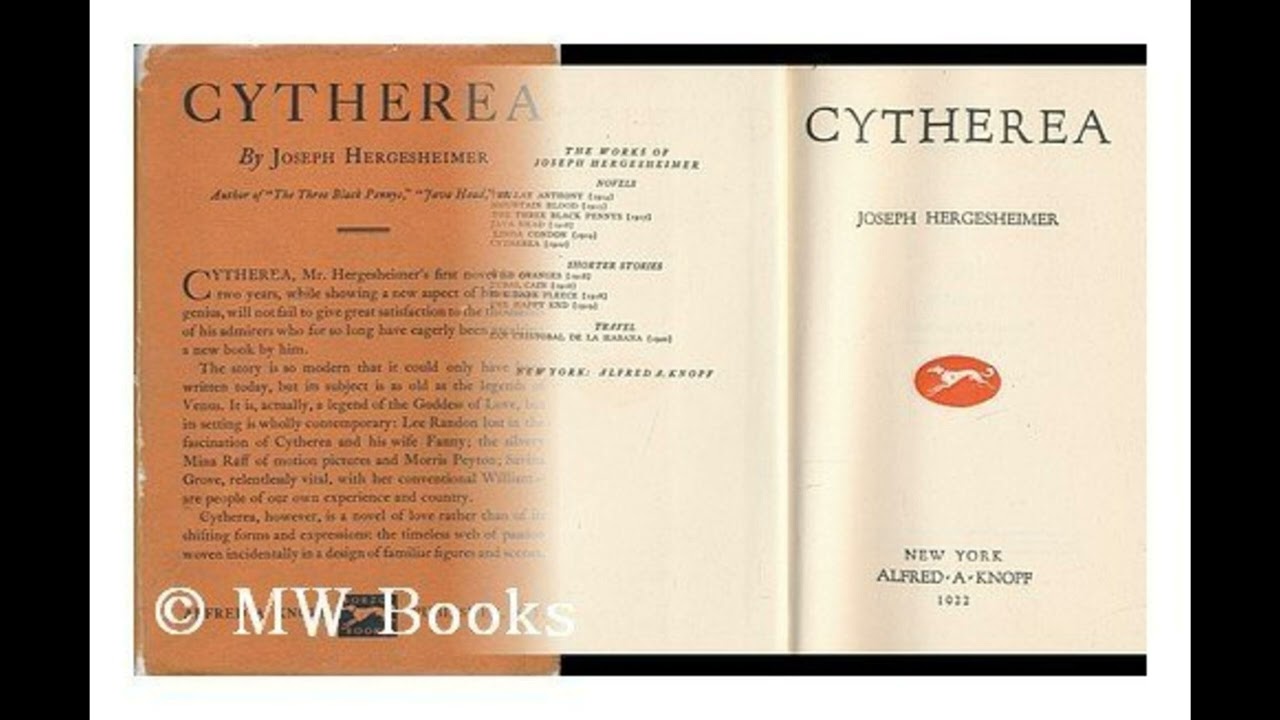
Cytherea 1st edition
Joseph Hergesheimer’s 1922 novel, Cytherea, presents a penetrating portrait of American upper-class life in a period of immense societal flux, a work that asks enduring questions about the nature of desire, fidelity, and the elusive quest for happiness. It emerges from the crucible of the early 20th century, a time when the certainties of the Victorian age had crumbled, leaving individuals to grapple with new freedoms and their profound consequences. This story, with its keen psychological insights and sumptuous prose, remains remarkably relevant today, speaking to anyone who has ever felt the subtle, corrosive dissatisfaction beneath an outwardly perfect existence or been tempted by the siren call of an imagined alternative life. It is a novel that doesn't merely tell a story; it holds a mirror to the soul's secret longings and the often-painful choices that define us. The narrative centers on Lee Randon, a successful businessman living in a comfortable Philadelphia suburb, whose life appears to be the epitome of domestic bliss. He has a devoted and socially adept wife, Fanny, two charming children, and a well-ordered home filled with the trappings of respectability. Yet, beneath this veneer of contentment, a quiet unease stirs within Lee. He finds himself increasingly detached from the predictable routines and emotional flatness of his marriage, longing for something more—a vitality, a sense of passionate engagement he feels is missing. This growing internal restlessness sets the stage for a profound disruption. Into Lee’s carefully constructed world steps Savina Grove, a woman of striking beauty and an enigmatic allure who represents everything Fanny is not. Savina is worldly, sophisticated, and possesses a magnetic charm that immediately captivates Lee. Their connection is not one of mere acquaintance; it is an undeniable, visceral attraction that quickly spirals beyond the bounds of polite society. As Lee finds himself increasingly drawn into Savina’s orbit, he begins to question every aspect of his life, his marriage, and the very foundations of his moral compass. The novel meticulously documents his internal struggle, the push and pull between duty and an intoxicating, dangerous freedom, building a powerful sense of impending crisis as Lee confronts the potential wreckage of his choices. Joseph Hergesheimer was a highly celebrated American novelist and short story writer, born in Philadelphia in 1880. His early life was marked by an artistic temperament and a struggle to find his path, initially pursuing painting before turning to writing at the age of 28. This late start, however, was quickly overcome by a period of intense productivity and critical acclaim. Hergesheimer was a meticulous craftsman, known for his refined, almost sensuous prose style and his commitment to literary artifice. His rise to prominence coincided with the height of American literary modernism, and he was published by the prestigious Alfred A. Knopf, becoming a significant figure in the literary landscape of the 1910s and 20s. Among his other notable works are "The Three Black Pennys" (1917), a multi-generational historical novel about a Pennsylvania iron-working family, and "Java Head" (1919), which explored cultural clashes and exoticism. Hergesheimer cultivated a public persona that reflected his literary style: a dandyish, somewhat detached observer of human nature, dedicated to aesthetic beauty. While his popularity waned in later decades, eclipsed by authors with starker, more experimental styles, Hergesheimer remains an important transitional figure in American literature, bridging the ornate, detailed prose of the late 19th century with the emerging psychological realism of the 20th. He passed away in 1954 in West Chester, Pennsylvania, leaving behind a body of work that captures the unique spirit of his era. Cytherea grapples with several powerful themes that resonate deeply with modern sensibilities. Foremost among these is the pervasive theme of disillusionment and the search for authentic selfhood. Lee Randon, despite his material success and stable family, feels a profound emptiness, a sense that he is merely performing a role rather than living genuinely. This is poignantly enacted in scenes describing his routine evenings, where the quiet order of his home only amplifies his inner restlessness, pushing him to question whether this outwardly perfect life is truly his life. The novel suggests that societal expectations, while offering security, can stifle individual spirit. Another central theme is the conflict between societal expectation and individual desire. Lee’s respectable marriage to Fanny represents duty and convention, while his yearning for Savina embodies forbidden passion and a radical break from his established world. The tension is palpable as Lee weighs the comfort and familiarity of his domestic life against the intoxicating promise of intense, albeit potentially destructive, romance. For instance, the clandestine meetings and the charged conversations with Savina highlight this internal war, demonstrating how a single glance or whispered word can challenge years of established norms and ignite a revolution within. The novel also addresses the destructive nature of idealized love or fantasy. Savina, in many ways, functions as a projection of Lee’s unfulfilled desires, a symbol of an idealized freedom. The pursuit of this fantasy, however, is shown to carry profound risks, threatening to unravel not only Lee’s personal life but also to expose the fragility of the very ideals he thought he was pursuing. Published in 1922, Cytherea stands squarely in the heart of the "Roaring Twenties," a decade that saw America grappling with the seismic shifts brought about by World War I, rapid industrialization, and the burgeoning Jazz Age. This was a period of profound cultural and social upheaval: women were gaining new freedoms, Prohibition was challenging traditional moral codes, and an economic boom was creating unprecedented wealth and leisure for many, alongside growing anxieties. Young people, often labeled the "Lost Generation," questioned the values of their parents, leading to a palpable tension between the old order and the new. Hergesheimer's novel emerges directly from this crucible, reflecting the era's fascination with psychological complexity and its challenge to established social mores. It captures the sense of a society teetering on the edge, where the outward display of success often masked deep-seated anxieties about identity, purpose, and the true cost of liberation. The work’s frank depiction of marital dissatisfaction and extramarital desire was particularly resonant—and controversial—at a time when traditional notions of fidelity and family were being re-examined in both literature and everyday life. It offers a window into the dilemmas of individuals navigating a world that was suddenly less certain, more exciting, and considerably more dangerous than it had been a generation before. Listening to Cytherea as an audiobook transforms Hergesheimer's distinctive prose into a truly immersive experience. The deliberate pacing and detailed descriptions, which might feel dense on the page, come alive through a skilled narrator's voice, allowing the listener to sink into Lee Randon’s inner world with ease. A good performance can convey the simmering discontent beneath the surface of his life, the delicate dance of forbidden attraction, and the atmosphere of a privileged but often emotionally stifling world. The run length, several hours in total, is perfectly suited for extended periods of focused listening, whether during commutes, leisurely walks, or quiet evenings at home. The nuances in dialogue, the subtle inflections in character voices, and the overall rhythm of Hergesheimer’s writing are all enhanced, allowing the intricate psychological unfolding of the story to feel immediate and intensely personal. This allows the subtle shifts in mood and the undercurrents of emotion to be fully appreciated, making the story's dramatic tensions all the more compelling.
Enjoyed Cytherea 1st edition? A few ways to support us
Audible & Amazon links are affiliate; we may earn a small commission at no extra cost.
About this production
Human narration by a volunteer reader from LibriVox.org, the public-domain audiobook project. LibriVox volunteers record literary works whose copyright has expired in the United States, releasing the resulting recordings into the public domain.
Cytherea 1st edition by Hergesheimer, Joseph published by Alfred A. Knopf. The underlying text is in the U.S. public domain. We do not republish any modern copyrighted edition, translation, or commentary.
The 4K cinematic visuals accompanying this audiobook are generated by an AI image model from prompts derived from the source text. No copyrighted photos, paintings, or stock footage are used. AI generation is disclosed on every video on our YouTube channel as required by YouTube's altered/synthetic content policy.
English subtitles are transcribed from the LibriVox recording with OpenAI Whisper. Translations into the 11 other supported languages are produced by Meta's NLLB-200 neural translation model. No human translator's copyrighted translation is used.
Questions about sourcing or rights? See our DMCA & Sourcing policy or contact us.
Enjoyed this audiobook?
If you'd like to own a copy of Cytherea 1st edition or hear a professionally produced edition, the links below help support free audiobook production at no extra cost to you.
As an Amazon Associate we earn from qualifying purchases. Audible / print links are affiliate.