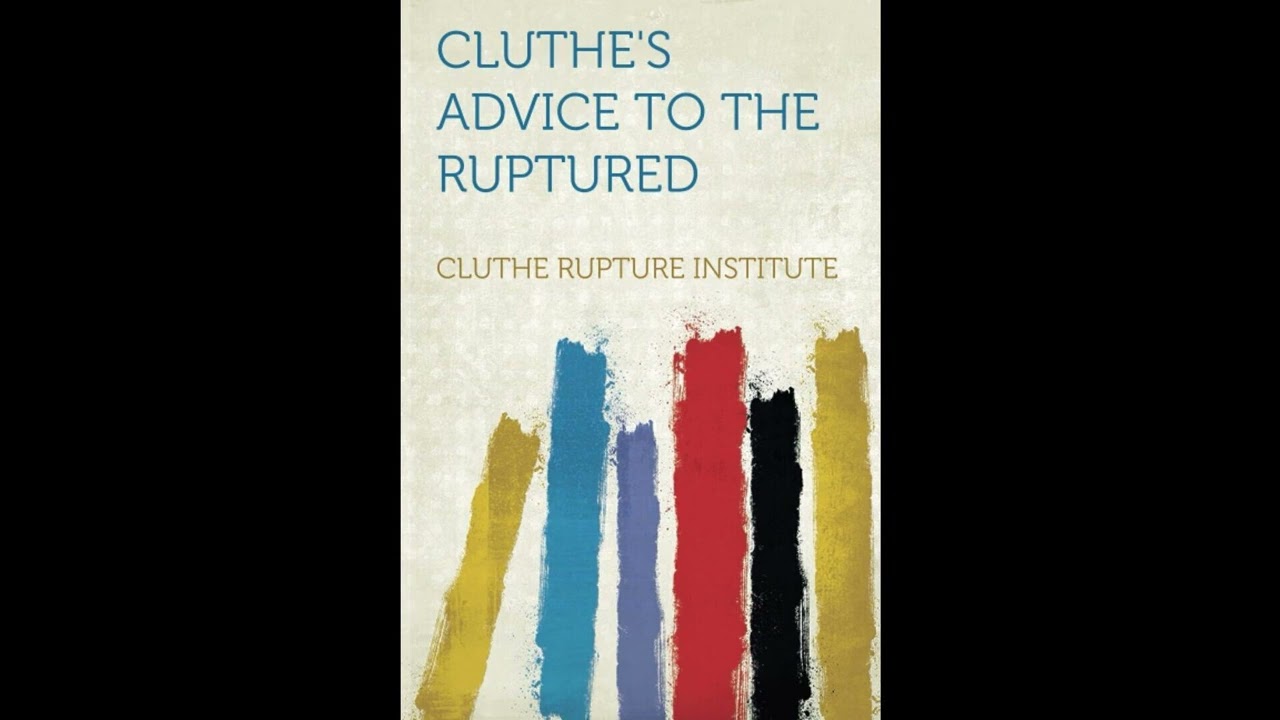
Cluthe's Advice to the Ruptured
"Cluthe's Advice to the Ruptured" stands as a remarkable artifact, a testament to an earlier era's approach to human ailments and the enduring quest for comfort and healing. Far from a dry medical textbook, this classic text offers a deeply human perspective on a pervasive and often debilitating condition, revealing not just the specific treatments advocated by the Cluthe Rupture Institute but also the underlying anxieties, hopes, and belief systems surrounding health in a world before modern surgical interventions became commonplace. For listeners today, it provides a unique window into the history of medicine, the evolution of patient care, and the perennial human need for authoritative guidance when faced with physical vulnerability, resonating with anyone who has ever sought relief from a persistent ailment. The narrative arc of "Cluthe's Advice to the Ruptured" unfolds as a methodical yet compassionate guide for those afflicted with rupture, a condition that, in its time, carried significant social stigma and physical discomfort. The text establishes its setting implicitly: a world where medical understanding was still developing, where surgical options were risky and often a last resort, and where self-management and specialized mechanical aids were paramount. The central "character" is arguably the ruptured individual themselves – anonymous, suffering, and seeking a definitive solution. The conflict is clear: the unrelenting physical symptoms, the constant fear of worsening the condition, and the psychological burden of living with a chronic ailment. Cluthe’s approach begins with a comprehensive explanation of rupture – its various forms, causes, and the often-misunderstood mechanisms of its occurrence. The institute's voice, authoritative yet empathetic, seeks to demystify the condition, empowering the reader with knowledge. It then systematically introduces its proprietary methods for support and amelioration, focusing on non-invasive techniques and the careful application of specially designed trusses. The story, if we can call it that, progresses from initial diagnosis and understanding, through the careful selection and fitting of these devices, to the disciplined adherence to specific routines and lifestyle adjustments. The text guides the afflicted through a process of self-care and perseverance, emphasizing the possibility of management and even a return to a more active life, without ever resorting to the final, drastic steps of surgery that many feared. The arc is one of informed hope and practical application, meticulously detailing a path toward relief. The "author" of this singular work, the Cluthe Rupture Institute, represents a fascinating phenomenon within medical history: the rise of specialized clinics and self-help systems dedicated to particular ailments. Though specific dates for its founding are lost to common record, the institute likely emerged during a period—perhaps the late nineteenth or early twentieth century—when medical knowledge was becoming more specialized, yet access to comprehensive, affordable healthcare remained a challenge for many. Such institutes often filled a void, offering focused expertise and proprietary methods to conditions that conventional doctors might have overlooked or treated in a less specialized manner. The Cluthe Rupture Institute, through its published advice, sought to establish itself as the foremost authority on rupture management. It was less a single individual and more a collective of practitioners, innovators, and perhaps even skilled artisans dedicated to the design and fitting of supportive appliances. Their "literary movement," if one considers it such, aligned with the burgeoning era of health manuals and direct-to-public medical advice, a time when the general public actively sought practical solutions for their physical complaints. This volume stands as the institute's primary, if not sole, lasting contribution to a broader literary canon, elevating what might otherwise be purely technical instruction into a document reflecting both the medical understanding and the commercial enterprise of its time. It secured its place not through groundbreaking scientific discovery, but through its persistent, organized efforts to communicate its specialized knowledge directly to those in need. One prominent theme woven throughout "Cluthe's Advice to the Ruptured" is the vulnerability of the human body and the relentless search for its restoration. The text frequently describes the insidious onset of rupture, the sudden strain, the discomfort of an emerging protrusion, and the chronic pain that can follow. For example, it details how a simple cough or a lift of a heavy object could precipitate the condition, underscoring how fragile the body's integrity can be. This physical vulnerability isn't merely a medical fact; it acts as a silent character, constantly challenging the afflicted and demanding vigilance. Another significant theme is self-reliance and agency in health. While offering expert guidance, Cluthe's institute consistently places the responsibility for healing and management firmly in the hands of the individual. The descriptions of truss application, the need for careful measurement, the discipline required for daily wear, and the warnings against neglecting one's condition all underscore this. It’s not a passive reception of treatment; it’s an active partnership, a commitment by the patient to their own well-being. A passage detailing the importance of consistently wearing the truss, even during sleep, concretely illustrates the level of personal discipline advocated. A third theme is the democratization of knowledge and care. By publishing this extensive guide, the institute aimed to make its specialized knowledge accessible beyond the confines of its physical location, reaching a wider audience who might not have had access to such specific expertise or who preferred a non-surgical option. This effort to disseminate information widely shows a belief in the power of public education to empower individuals in their own healthcare, a forward-thinking concept for its era. "Cluthe's Advice to the Ruptured" emerged from a fascinating juncture in medical and societal history, likely during the transitional period spanning the late 19th and early 20th centuries. This was an era characterized by significant advancements in surgical techniques, yet also by widespread apprehension regarding surgery, which still carried high risks of infection and mortality. Anesthesia was improving, but post-operative care remained rudimentary by modern standards. Consequently, non-surgical management of conditions like rupture held considerable appeal and was often the preferred route for both patients and practitioners. Culturally, this period also witnessed the rise of widespread advertising and the proliferation of self-help manuals, driven by increasing literacy rates and a public eager for practical advice on everything from household management to personal health. Medical charlatans coexisted with legitimate, albeit specialized, institutes like Cluthe’s, all vying for public attention and trust. The demand for remedies that promised relief without the trauma or expense of surgery created a fertile ground for such publications. Politically, there was little regulation of medical practice compared to today, allowing various approaches to flourish. "Cluthe's Advice" therefore reflects not just a particular medical philosophy but also the broader societal landscape of personal responsibility for health, the developing market for medical products, and the ongoing public negotiation between traditional remedies and emerging scientific understanding. Listening to "Cluthe's Advice to the Ruptured" as an audiobook transforms what might appear as a historical medical manual into an intimate and remarkably engaging experience. Over its several hours, a skilled narrator can lend an authoritative yet comforting voice to the institute's counsel, allowing the listener to absorb the detailed explanations and recommendations with a sustained focus that might be harder to maintain when reading a text of this nature. The pacing of the narration can highlight critical sections, emphasizing the precision required for understanding the condition and applying the advice. One can almost picture a thoughtful practitioner dictating his wisdom. The absence of traditional dialogue means the narrator's voice becomes the primary conduit for the institute's collected knowledge, shaping the atmosphere with its tone – a blend of earnest instruction, empathetic understanding, and unwavering confidence in its methods. It allows for a deeper appreciation of the work as a historical document, transporting the listener back to a time when such direct, reassuring instruction was a vital lifeline for countless individuals navigating discomfort and uncertainty.
Enjoyed Cluthe's Advice to the Ruptured? A few ways to support us
Audible & Amazon links are affiliate; we may earn a small commission at no extra cost.
About this production
Human narration by a volunteer reader from LibriVox.org, the public-domain audiobook project. LibriVox volunteers record literary works whose copyright has expired in the United States, releasing the resulting recordings into the public domain.
Cluthe's Advice to the Ruptured by Cluthe Rupture Institute. The underlying text is in the U.S. public domain. We do not republish any modern copyrighted edition, translation, or commentary.
The 4K cinematic visuals accompanying this audiobook are generated by an AI image model from prompts derived from the source text. No copyrighted photos, paintings, or stock footage are used. AI generation is disclosed on every video on our YouTube channel as required by YouTube's altered/synthetic content policy.
English subtitles are transcribed from the LibriVox recording with OpenAI Whisper. Translations into the 11 other supported languages are produced by Meta's NLLB-200 neural translation model. No human translator's copyrighted translation is used.
Questions about sourcing or rights? See our DMCA & Sourcing policy or contact us.
Enjoyed this audiobook?
If you'd like to own a copy of Cluthe's Advice to the Ruptured or hear a professionally produced edition, the links below help support free audiobook production at no extra cost to you.
As an Amazon Associate we earn from qualifying purchases. Audible / print links are affiliate.