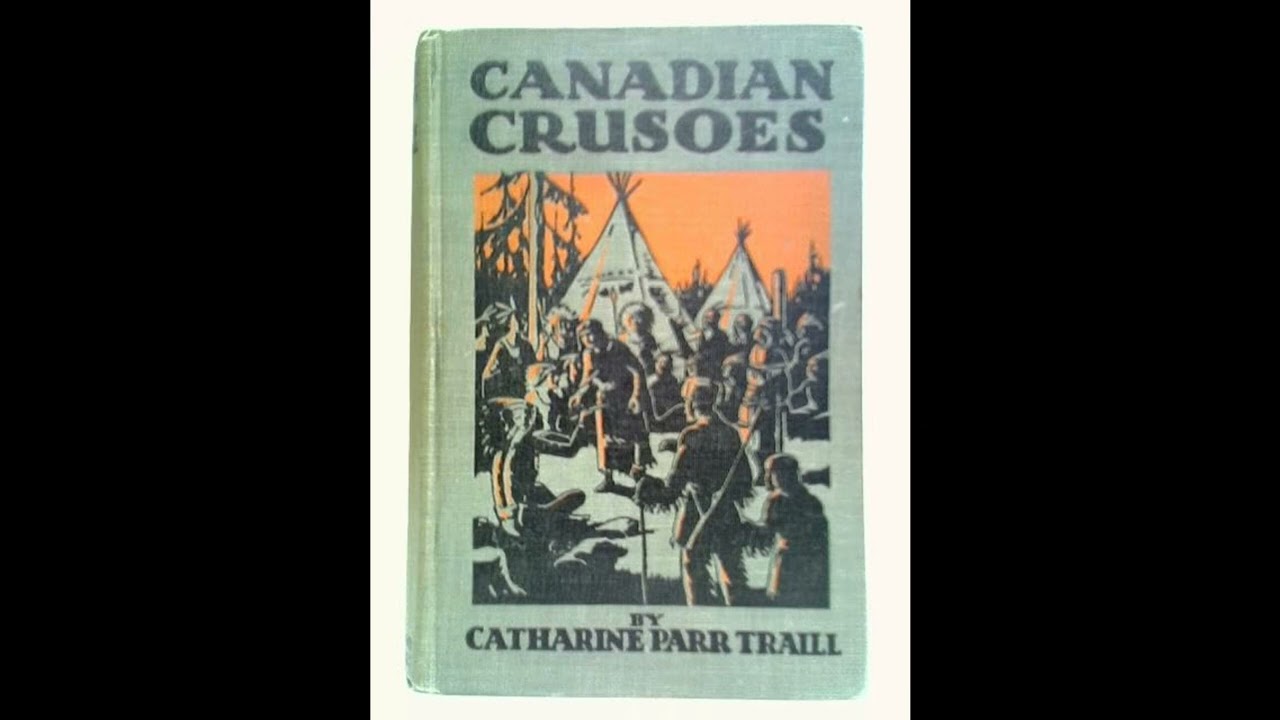
Canadian Crusoes, a Tale of the Rice Lake Plains
Step into a lost world where the vast, untamed Canadian wilderness presents both formidable challenges and unexpected triumphs. Catharine Parr Traill’s Canadian Crusoes, a Tale of the Rice Lake Plains, offers more than a simple survival story; it’s a captivating look at resilience, sisterhood, and the profound beauty and danger of nature through the eyes of three young, resourceful girls. First published in 1852, this classic stands as a testament to the pioneering spirit and the enduring power of human ingenuity when pushed to its limits. It reminds listeners today that courage and adaptability are not confined to grand expeditions but can blossom even in the most unexpected and domestic of settings. The narrative unfolds in the mid-19th century amidst the sprawling, untamed Upper Canada, specifically near the tranquil yet formidable Rice Lake Plains. We meet the well-bred Maxwell sisters: Louisa, Emily, and the youngest, Flora. Raised by loving, capable pioneer parents, they possess an education not only in academics but also in the practical skills essential for life on the frontier. One fateful day, while their parents are away on an extended trip to Toronto, the girls decide to venture deeper into the woods to find some stray cows. What begins as an innocent errand quickly turns into a harrowing ordeal as they become hopelessly lost, their familiar surroundings dissolving into an endless expanse of trees, swamps, and unknown paths. Stranded far from home with only their wits and what little they carried, the sisters must confront the raw realities of the wilderness. Their initial fear soon gives way to a remarkable determination. Louisa, the eldest, takes on the mantle of leadership, drawing upon her memory of her father’s advice and her own growing sense of responsibility. Emily, more observant and quiet, becomes adept at identifying edible plants and tracking, while little Flora, though vulnerable, contributes with her youthful spirit and surprising bursts of insight. They construct makeshift shelters, learn to fish and forage, guard against wild animals, and maintain a precious fire, their daily lives a continuous struggle against hunger, exposure, and the overwhelming isolation. The story follows their ingenious efforts over many months, demonstrating their transformation from sheltered girls to hardened, self-reliant individuals, forever bound by their shared ordeal in the wild. The woman behind this compelling narrative was Catharine Parr Traill, born Catharine Parr Strickland on May 17, 1802, in Rotherhithe, Surrey, England. She was one of several highly accomplished literary sisters, including the celebrated historian Agnes Strickland and the equally renowned Canadian author Susanna Moodie. Catharine’s early life in England saw her writing and publishing children’s books and novels, often focusing on natural history and moral instruction. However, her life took a dramatic turn in 1832 when she married Thomas Traill, a half-pay officer, and emigrated with him to Upper Canada. This move profoundly shaped her literary output and her understanding of the world. Settling in the Peterborough area, Catharine Parr Traill experienced firsthand the arduous realities of pioneer life. Her experiences informed her most famous non-fiction work, The Backwoods of Canada (1836), a series of letters offering a practical and often lyrical account of daily life in the Canadian bush for potential British immigrants. She became a keen naturalist, observing and documenting Canadian flora and fauna, which she continued to do throughout her long life, publishing Studies of Plant Life in Canada in 1885 and Pearls and Pebbles; or, Notes of an old Naturalist in 1894. Traill passed away at the impressive age of 96 on February 10, 1899, in Lakefield, Ontario, leaving behind a significant legacy as a foundational figure in Canadian literature, particularly known for her blend of practical knowledge, detailed observation, and a deep appreciation for the natural world. Canadian Crusoes is a rich repository of themes, chief among them being the power of human resilience and ingenuity. The sisters, initially unprepared, quickly adapt to their harsh environment, fashioning tools, building shelter, and finding sustenance, embodying the spirit of invention born of necessity. For example, their initial attempts at fishing with a bent pin and a piece of thread evolve into more sophisticated techniques using natural materials. Another central theme is the interdependence and strength of sisterhood. The girls’ survival hinges on their ability to cooperate, support one another emotionally, and divide tasks according to their strengths, such as Louisa’s leadership, Emily’s resourcefulness, and Flora’s hopeful spirit. Their arguments and reconciliations highlight the realistic bonds forged under pressure. The text also underscores the duality of nature—its overwhelming beauty and its unforgiving dangers. Traill meticulously describes the changing seasons, the serene forests, and the abundance of wildlife, contrasting these peaceful images with the constant threats of starvation, wild animals, and exposure. The publication of Canadian Crusoes in 1852 places it squarely within a period of significant expansion and settlement in British North America. The mid-19th century saw a continued influx of European immigrants, often driven by economic hardship or the promise of new land, making tales of pioneer life particularly resonant. The book emerged during an era when narratives of survival and self-reliance, famously exemplified by Daniel Defoe’s Robinson Crusoe, held considerable public fascination. Traill, drawing on her own experiences as a settler and her literary heritage, skillfully adapted this popular genre to a distinctly Canadian context, offering a perspective informed by genuine knowledge of the country's unique environment. It spoke to the growing national consciousness in Canada, documenting its wild beauty and the character-building trials faced by those who sought to tame it. Listening to Canadian Crusoes as an audiobook offers a singular opportunity to immerse oneself in this vivid depiction of the Canadian wilderness. The narration brings to life the rustling leaves, the distant calls of birds, and the crackle of a campfire that become the sisters’ constant companions. With its several hours of runtime, this recording allows for a gradual unfolding of their plight and triumphs, enabling listeners to truly settle into the rhythm of their daily struggles and small victories. Pay attention to the pacing of the narration, which can shift from the hurried suspense of a close call with a bear to the quiet, reflective tone of the girls contemplating a sunset. The voice acting for the distinct personalities of Louisa, Emily, and Flora adds depth to their developing characters, while the descriptive passages paint rich atmospheric pictures, transporting you directly to the heart of the Rice Lake Plains and into the indomitable spirit of its young heroines.
Enjoyed Canadian Crusoes, a Tale of the Rice Lake Plains? A few ways to support us
Audible & Amazon links are affiliate; we may earn a small commission at no extra cost.
About this production
Human narration by a volunteer reader from LibriVox.org, the public-domain audiobook project. LibriVox volunteers record literary works whose copyright has expired in the United States, releasing the resulting recordings into the public domain.
Canadian Crusoes, a Tale of the Rice Lake Plains by CATHARINE PARR. The underlying text is in the U.S. public domain. We do not republish any modern copyrighted edition, translation, or commentary.
The 4K cinematic visuals accompanying this audiobook are generated by an AI image model from prompts derived from the source text. No copyrighted photos, paintings, or stock footage are used. AI generation is disclosed on every video on our YouTube channel as required by YouTube's altered/synthetic content policy.
English subtitles are transcribed from the LibriVox recording with OpenAI Whisper. Translations into the 11 other supported languages are produced by Meta's NLLB-200 neural translation model. No human translator's copyrighted translation is used.
Questions about sourcing or rights? See our DMCA & Sourcing policy or contact us.
Enjoyed this audiobook?
If you'd like to own a copy of Canadian Crusoes, a Tale of the Rice Lake Plains or hear a professionally produced edition, the links below help support free audiobook production at no extra cost to you.
As an Amazon Associate we earn from qualifying purchases. Audible / print links are affiliate.