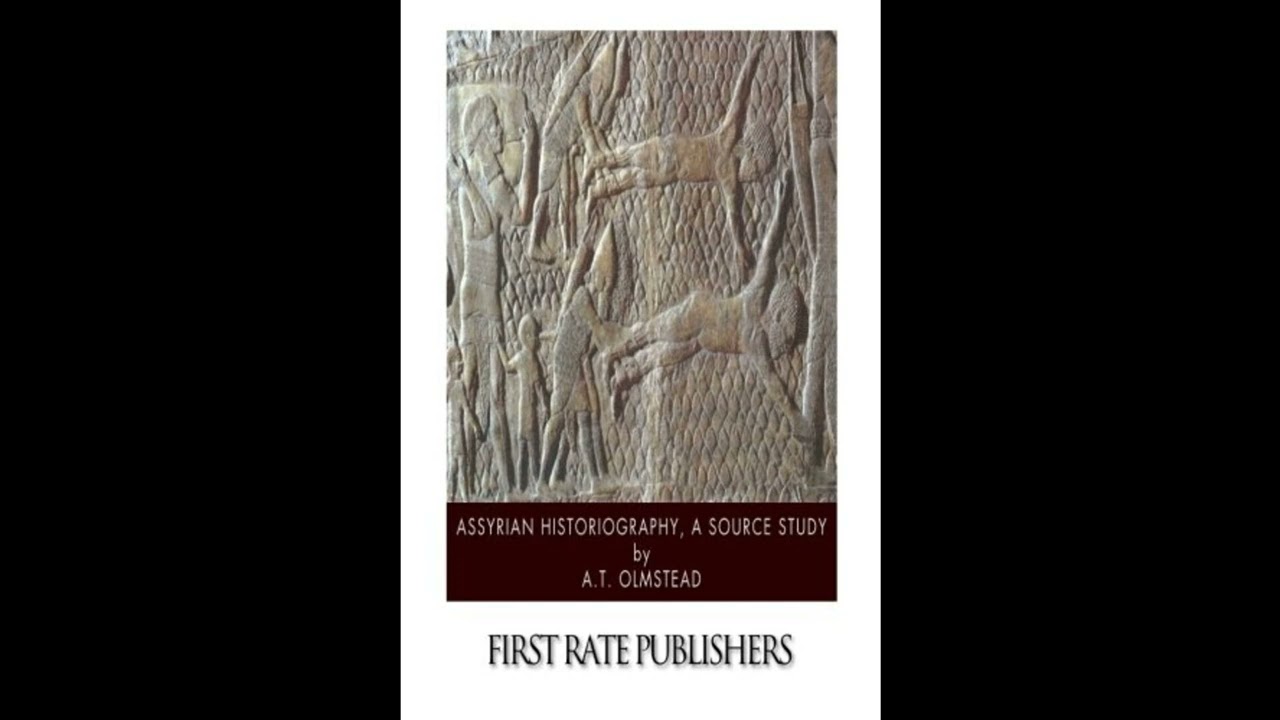
Assyrian Historiography, a Source Study
More than a simple accounting of ancient events, Assyrian Historiography, a Source Study invites us to step into the working mind of a scholar confronting the raw materials of history. This is not a recounting of battles and kings for its own sake, but rather an incisive examination of how we even come to know about such things. It’s a deep inquiry into the very process by which history is made, recorded, and interpreted. For anyone fascinated by how narratives are constructed, how power shapes official accounts, or simply how the distant past yields its secrets to the patient researcher, this book offers an illuminating look at the foundational challenges that continue to face historians, even today, in an age where information—and misinformation—is abundant. It makes the study of history an active intellectual pursuit, not a passive reception of facts. The book takes us back to the heart of the ancient Neo-Assyrian Empire, a vast and formidable power that dominated Mesopotamia and the Near East for centuries, roughly between the ninth and seventh centuries BCE. Our principal "characters" are not necessarily the kings whose names echo through archaeological finds, but rather the scribes, chroniclers, and royal propagandists who were tasked with committing the Assyrian story to clay tablets and monumental stone inscriptions. A.T. Olmstead, the guiding intelligence behind this study, serves as our patient and discerning guide, leading us through a meticulous analysis of the primary sources that form the bedrock of our understanding of this mighty empire. He sets the scene by first categorizing the diverse types of historical records produced by the Assyrians: from the annual records of royal campaigns, etched onto clay prisms and cylinders, to the lengthy inscriptions boasting of a king’s accomplishments on palace walls, and even the more mundane administrative documents and letters that offer candid glimpses into daily life and political maneuvering. The central conflict of this scholarly endeavor emerges from the inherent biases and often contradictory nature of these ancient texts. How does one reconcile the consistently triumphant narratives of royal annals, which always portray the Assyrian king as victorious and divinely favored, with archaeological evidence that sometimes suggests a different reality, or with parallel accounts from rival nations? Olmstead approaches this challenge not with cynicism, but with a rigorous methodology. He demonstrates how careful comparison, textual criticism, and an understanding of the political and cultural motivations behind the creation of these records can help us discern degrees of reliability. His “arc of the story” is the systematic unpacking of these sources, moving from a broad overview of their types to incisive, case-by-case studies, thereby building a more nuanced and accurate understanding of Assyrian historical consciousness and, by extension, Assyrian history itself, without succumbing to the simplistic acceptance of imperial rhetoric. A.T. Olmstead, Albert Ten Eyck Olmstead, was a figure of considerable influence in the study of the ancient Near East during the early decades of the twentieth century. Born in the late nineteenth century, Olmstead dedicated his academic career to meticulously researching and writing about the great empires of antiquity, making significant contributions to our understanding of the region’s long and complex past. He held professorships at prominent American universities, including the University of Missouri, the University of Illinois at Urbana-Champaign, and ultimately the renowned Oriental Institute of the University of Chicago, where he became a cornerstone of its pioneering scholarship in ancient history. Olmstead was widely recognized for his thoroughness and his commitment to grounding his historical narratives firmly in primary source material, a hallmark of modern historical methodology. Among his other celebrated scholarly contributions are History of Assyria, a comprehensive work that synthesized much of the knowledge of its time, and History of the Persian Empire, which became a standard reference for generations of students and scholars. He was not merely a chronicler of events but an analytical historian who sought to understand the mechanisms of power, culture, and information dissemination in ancient societies. His work helped define the emerging academic discipline of Assyriology and Near Eastern studies in the United States, cementing his place as a foundational scholar in a period of intense discovery and intellectual ferment regarding the ancient world. At its core, Assyrian Historiography enacts several profound themes. One of the foremost is the nature of historical truth and bias. Olmstead frequently demonstrates how royal inscriptions, designed for public display and to legitimize the king’s rule, consistently present a carefully curated version of events, glossing over defeats or presenting them as minor setbacks. For instance, he might compare the celebratory account of a specific military campaign found on a palace relief with a brief, almost clinical entry in a more neutral chronicle, showing how different agendas produce different historical records. This contrast highlights the continuous challenge faced by historians: to critically evaluate sources for underlying motivations, rather than accepting them at face value. Another powerful theme is the strategic power of narrative in statecraft. The Assyrians, with their extensive bureaucracy and sophisticated scribal tradition, understood the importance of controlling the official story. Their historical writings were not just records; they were tools of propaganda, designed to instill awe and obedience in their subjects and to project an image of invincibility to their rivals. Olmstead illustrates this by analyzing the formulaic language used in royal dedications, where kings routinely claim divine sanction for their conquests and depict enemies as chaotic and deserving of subjugation. Furthermore, the book underscores the laborious act of historical reconstruction itself—the painstaking, intellectual detective work required to piece together fragmented narratives and disparate pieces of evidence into a coherent and defensible historical account, revealing the discipline as much more than simply memorizing dates. This scholarly work emerged during a dynamic period in the early twentieth century, when the academic study of the ancient Near East was truly coming into its own. Archaeology was rapidly maturing as a scientific discipline, yielding unprecedented numbers of cuneiform tablets and monumental inscriptions from sites across Mesopotamia. Scholars were making significant strides in deciphering these ancient languages, unlocking vast libraries of texts that had been buried for millennia. This era was characterized by a fervent intellectual pursuit of understanding ancient civilizations, spurred by new discoveries and by the development of modern historical methodology which emphasized rigorous source criticism. Olmstead’s approach was deeply influenced by the developing practices of critical scholarship. He belonged to a generation of historians committed to moving beyond anecdotal accounts or uncritically accepted traditions, insisting instead on a meticulous, evidence-based reconstruction of the past. The demand for such a source study was particularly keen given the sheer volume of newly accessible texts and the growing awareness that these ancient records, particularly those from powerful empires, often served specific political and religious functions, rather than purely objective historical aims. His work, therefore, was a timely and necessary response to the challenge of making sense of this burgeoning archive, providing a systematic framework for future generations of scholars. Listening to Assyrian Historiography, a Source Study as an audiobook transforms a traditionally dense academic text into an accessible and engaging intellectual experience. The narration, likely delivered with the clarity and measured pacing befitting such scholarly content, allows the listener to fully absorb Olmstead’s precise arguments and detailed analyses without the visual distraction of footnotes or textual layout. Over its several hours run length, the unfolding of his methodical process becomes a compelling narrative in itself. One can listen for the subtle nuances in how Olmstead distinguishes between types of evidence—the grand pronouncements of a king versus the more understated details from an administrative letter—or how he meticulously builds a case for interpreting seemingly straightforward texts with a critical eye. It offers an opportunity to immerse oneself in the disciplined thought of a leading historian, appreciating the careful construction of his points and the way he guides us through the labyrinth of ancient evidence, making the intricate work of historical analysis remarkably lucid.
Enjoyed Assyrian Historiography, a Source Study? A few ways to support us
Audible & Amazon links are affiliate; we may earn a small commission at no extra cost.
About this production
Human narration by a volunteer reader from LibriVox.org, the public-domain audiobook project. LibriVox volunteers record literary works whose copyright has expired in the United States, releasing the resulting recordings into the public domain.
Assyrian Historiography, a Source Study by A.T. Olmstead. The underlying text is in the U.S. public domain. We do not republish any modern copyrighted edition, translation, or commentary.
The 4K cinematic visuals accompanying this audiobook are generated by an AI image model from prompts derived from the source text. No copyrighted photos, paintings, or stock footage are used. AI generation is disclosed on every video on our YouTube channel as required by YouTube's altered/synthetic content policy.
English subtitles are transcribed from the LibriVox recording with OpenAI Whisper. Translations into the 11 other supported languages are produced by Meta's NLLB-200 neural translation model. No human translator's copyrighted translation is used.
Questions about sourcing or rights? See our DMCA & Sourcing policy or contact us.
Enjoyed this audiobook?
If you'd like to own a copy of Assyrian Historiography, a Source Study or hear a professionally produced edition, the links below help support free audiobook production at no extra cost to you.
As an Amazon Associate we earn from qualifying purchases. Audible / print links are affiliate.