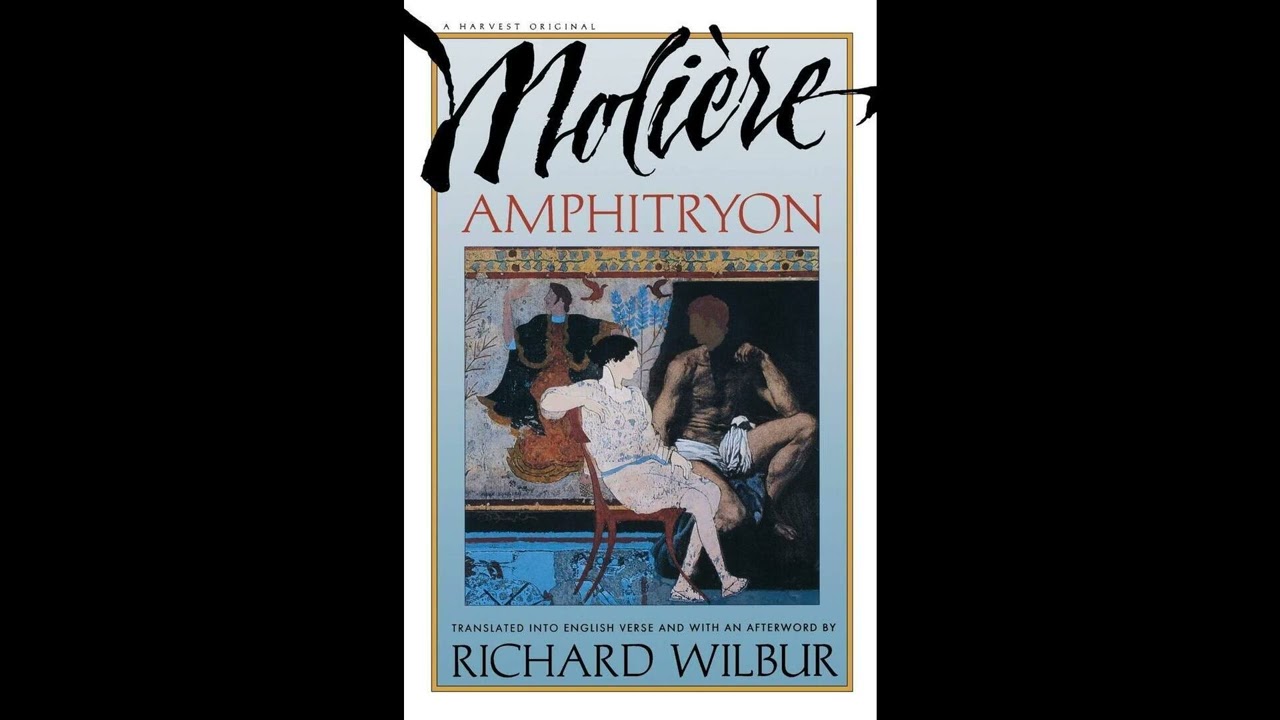
Amphitryon, By Molière
Imagine a world where the very essence of who you are, your face, your voice, your most intimate memories, could be perfectly mimicked by another. Not just a doppelganger, but an entity so convincing that even your spouse and closest companions would be fooled. This unsettling premise, ripe with both profound philosophical questions and uproarious comedic potential, sits at the heart of Molière’s Amphitryon. Penned in the heart of France’s golden age, this ingenious play rips the fabric of identity and marital fidelity with both wit and surprising depth, inviting listeners to question what truly defines a person, a relationship, or even reality itself. Far from being a mere historical curiosity, the issues of manipulated truth and the blurring lines of perception resonate with startling clarity in our own digital age, making this classic tale feel remarkably contemporary. The scene opens in the ancient Greek city of Thebes, where the noble general Amphitryon is away, leading his armies to victory. In his absence, the king of the gods, Jupiter, has set his sights on Amphitryon’s beautiful and virtuous wife, Alcmene. To achieve his illicit desires without arousing suspicion, Jupiter employs his divine power, taking on the exact likeness of Amphitryon, down to every mannerism and memory. Not content with this primary deception, Jupiter enlists his son, the mischievous god Mercury, to stand guard and further the charade. Mercury, ever the trickster, assumes the form of Sosia, Amphitryon’s loyal but cowardly servant, adding another layer of confusion to the unfolding events. The chaos truly begins when the real Sosia returns from the battlefield, sent ahead by Amphitryon to announce his imminent arrival. Encountering Mercury, who insists he is Sosia and assaults the bewildered servant, the first cracks appear in the facade of reality. This initial clash of identities sets the stage for the increasingly absurd and distressing situations that follow. When the real Amphitryon finally makes his triumphant return, he finds Alcmene bewildered by his supposed earlier presence and surprisingly cold to his renewed affections. Their marital bliss quickly sours into a bitter argument, as Alcmene insists they have already spent the night together, celebrating his victory, while Amphitryon, utterly confounded, believes her to be mad or unfaithful. The play masterfully orchestrates this intricate web of misunderstanding, escalating the humor and the human drama with each new confrontation between the real and the counterfeit. The genius behind this comedic and thought-provoking work was Jean-Baptiste Poquelin, known to the world as Molière. Born in Paris in 1622, he initially followed his father into a respectable position as a royal upholsterer, a path he soon abandoned for the unpredictable life of the theatre. Along with the actress Madeleine Béjart and her family, he founded the Illustre Théâtre in 1643, a venture that initially failed, leading him to years of touring the provinces. This period, from 1645 to 1658, was crucial in shaping his understanding of human nature, theatrical timing, and what truly amused and moved an audience. Upon his triumphant return to Paris, Molière and his company quickly earned the patronage of King Louis XIV, securing their place at court and the opportunity to perform for the highest echelons of French society. It was during this golden age that Molière wrote, directed, and often acted in his most celebrated plays, including the biting satire of religious hypocrisy in Tartuffe, the examination of social alienation in The Misanthrope, and the enduring comedy of hypochondria in The Imaginary Invalid. He became the undisputed master of French comedy, skillfully blending classical influences with contemporary social commentary. His career was marked by both immense success and considerable controversy, as his plays frequently satirized powerful figures and societal norms, yet his royal protection allowed him to push boundaries. He collapsed on stage during a performance of The Imaginary Invalid in 1673 and died shortly thereafter, solidifying his legend. Amphitryon is a masterful study in the fragility of identity, a concept that Molière plays with devastating humor and genuine pathos. The plight of Sosia, repeatedly told he is not himself and even physically assaulted for insisting on his own existence, perfectly illustrates this theme. He famously laments, "I am I, if I am I," an assertion that becomes both an anchor and a source of torment in a world where physical form can be so easily counterfeited. This extends to Amphitryon himself, whose very sense of self and position is undermined by Jupiter's imitation, leaving him publicly humiliated and questioning his own sanity. The play also presents a piercing examination of appearance versus reality. Jupiter’s perfect disguise means that Alcmene, though technically deceived, is entirely innocent of infidelity because, to her, every gesture and word comes from her husband. Molière uses this divine deception to probe the very nature of truth: if an illusion is indistinguishable from reality, does it effectively become reality? Furthermore, the stark contrast between divine power and human impotence is a recurring motif. Jupiter’s casual use of his godlike abilities to satisfy a personal whim highlights the arbitrary nature of fate and the utter helplessness of mortals caught in the whims of higher powers. The characters are unable to discern truth, defend their honor, or even prove their own existence when confronted by such overwhelming, unseen forces. The creation of Amphitryon in 1668 occurred during the magnificent reign of Louis XIV, a period often called the Grand Siècle, or the Great Century of France. Under the Sun King, France was establishing itself as a dominant European power, and the arts flourished under royal patronage. This era saw the rise of French Classicism, an aesthetic movement emphasizing order, reason, balance, and decorum, often drawing inspiration from Greco-Roman antiquity. Molière, while a classical playwright in many respects, skillfully imbued his mythological subjects with a contemporary sensibility, using the guise of ancient tales to comment on the manners, morals, and social structures of his own time. His ability to fuse the elevated language of myth with down-to-earth, often farcical, humor allowed plays like Amphitryon to both entertain the court and subtly critique the power dynamics inherent in a society ruled by an absolute monarch. The play’s light treatment of a powerful god’s infidelity might even be seen as a clever, indirect commentary on the occasional libertine behavior of the elite at Versailles, cloaked safely in classical myth. To hear Amphitryon performed as an audiobook is to experience Molière’s brilliant dialogue and comedic timing in its truest form, beyond the printed page. The play’s humor relies heavily on rapid-fire exchanges, the precise inflection of a voice, and the escalating confusion conveyed through spoken word. A skilled narrator, employing distinct character voices, becomes essential for differentiating between the two Amphitryons and the two Sosias, allowing the listener to track the complex, humorous misunderstandings without ever feeling lost. Listen for the subtle shifts in tone that betray Jupiter’s divine arrogance, the earnest confusion in Alcmene’s pleas, and the utter exasperation in Amphitryon’s tirades. The run length provides ample time to settle into the witty banter and the gradually intensifying absurdities, letting the play’s carefully constructed atmosphere wash over you, making the old master’s theatrical magic feel fresh and immediate.
Enjoyed Amphitryon, By Molière? A few ways to support us
Audible & Amazon links are affiliate; we may earn a small commission at no extra cost.
About this production
Human narration by a volunteer reader from LibriVox.org, the public-domain audiobook project. LibriVox volunteers record literary works whose copyright has expired in the United States, releasing the resulting recordings into the public domain.
Amphitryon, By Molière by Molière. The underlying text is in the U.S. public domain. We do not republish any modern copyrighted edition, translation, or commentary.
The 4K cinematic visuals accompanying this audiobook are generated by an AI image model from prompts derived from the source text. No copyrighted photos, paintings, or stock footage are used. AI generation is disclosed on every video on our YouTube channel as required by YouTube's altered/synthetic content policy.
English subtitles are transcribed from the LibriVox recording with OpenAI Whisper. Translations into the 11 other supported languages are produced by Meta's NLLB-200 neural translation model. No human translator's copyrighted translation is used.
Questions about sourcing or rights? See our DMCA & Sourcing policy or contact us.
Enjoyed this audiobook?
If you'd like to own a copy of Amphitryon, By Molière or hear a professionally produced edition, the links below help support free audiobook production at no extra cost to you.
As an Amazon Associate we earn from qualifying purchases. Audible / print links are affiliate.