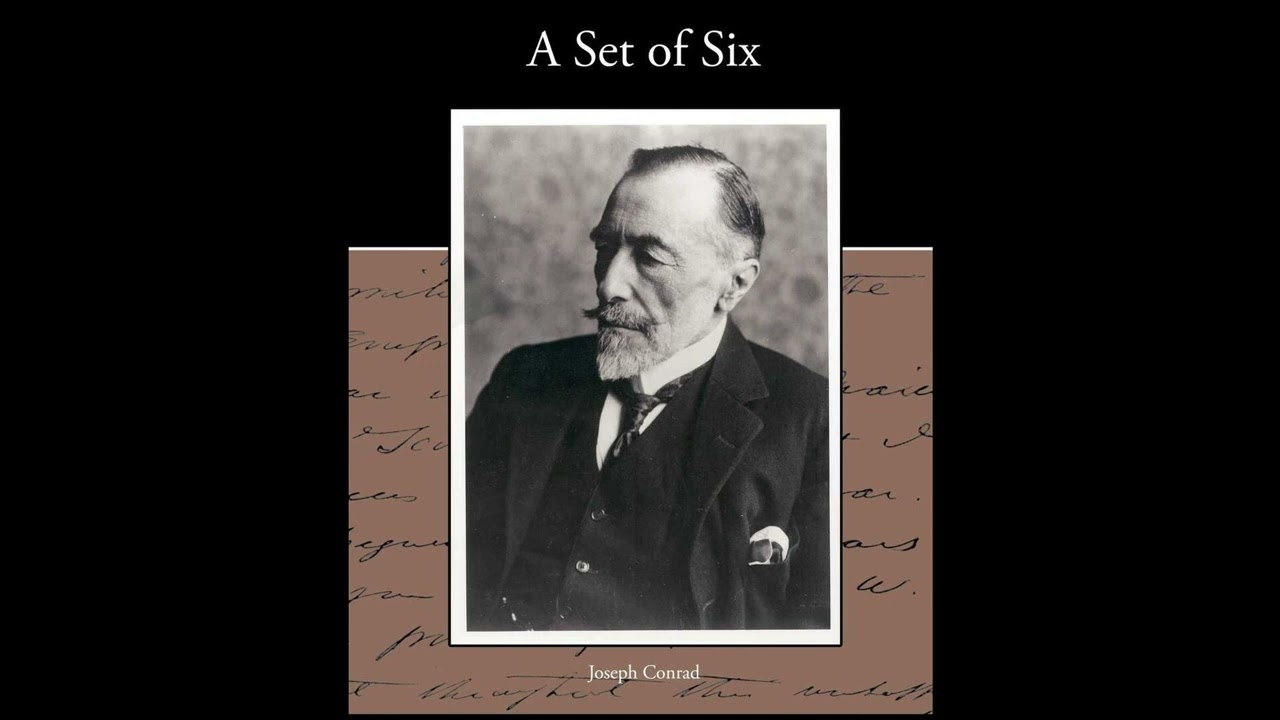
A Set of Six
Joseph Conrad’s A Set of Six invites listeners into a diverse collection of short stories, each a condensed yet potent exploration of human nature under pressure, the ironies of fate, and the often-absurd demands of societal codes. Far from being minor works, these six narratives offer a fascinating cross-section of Conrad’s thematic obsessions and stylistic brilliance, providing both a perfect entry point for those new to his world and a rewarding experience for long-time admirers. This is not simply a gathering of tales; it is a master class in the short form, revealing how Conrad could distill grand themes into compact, compelling dramas that resonate with timeless questions about honor, ambition, and the human capacity for both cruelty and devotion. The collection opens with "Gaspar Ruiz," a sweeping historical romance set amidst the turbulent birth of a South American republic in the early 19th century. It introduces us to a larger-than-life figure, Gaspar Ruiz, a man of extraordinary physical strength and resilience, who finds himself entangled in political rebellions and military skirmishes. His story is intertwined with that of his fiercely loyal and resourceful wife, Isabellia, whose dedication and ingenuity drive much of the narrative, painting a vivid picture of love and survival against a backdrop of national upheaval. Following this grand drama, "The Informer" shifts dramatically to the hushed, paranoid world of European anarchists in London. Here, a seemingly innocuous art collector becomes a reluctant confidant in a network of revolutionaries, unmasking the chilling moral ambiguities of idealism that can lead to betrayal and destruction within a clandestine group. Next, "The Brute" offers a grim, almost supernatural maritime tale, where a ship itself is personified as a malevolent entity. This vessel, named "The Brute," develops a terrifying reputation among sailors for repeatedly causing the deaths of its female passengers, challenging conventional notions of bad luck and exploring the deep-seated superstitions of seafaring life with a chilling sense of inevitability. "An Anarchist" takes us to a remote penal colony in South America, where a French mechanic, wrongly accused of revolutionary activity, endures a life of stark injustice and forced labor. His tale is a poignant study of individual helplessness against the arbitrary power of the state and the crushing weight of circumstance, exploring themes of false accusation and the resilience of the human spirit in the face of profound alienation. Perhaps the most renowned story in the collection is "The Duel," sometimes titled "The Point of Honor." Set during the Napoleonic Wars, it traces the extraordinary, decades-long rivalry between two French cavalry officers, Armand D'Hubert and Gabriel Féraud. Their initial, trivial quarrel escalates into a series of honor duels fought across various European battlefields and peacetime garrisons, becoming a bizarre, almost ritualistic antagonism that defines their lives. This story dissects the absurdities of military pride and the passage of time as their personal vendetta unfolds against the backdrop of world-changing historical events. Finally, "Il Conde" (The Count) offers a quiet, understated psychological portrait of an elderly Neapolitan count whose ordered, tranquil life is shattered by a terrifying, inexplicable encounter during an evening stroll. This incident irrevocably alters his perception of safety and human malevolence, serving as a subtle yet profound meditation on vulnerability and the loss of innocence in old age. The author, Józef Teodor Konrad Korzeniowski, known universally as Joseph Conrad, was born in 1857 in Berdychiv, a city then part of the Russian Empire and located in present-day Ukraine. His early life was profoundly shaped by the political activism of his Polish parents, which led to their exile and his eventual orphanhood. This early experience instilled in him a profound sense of displacement and an acute sensitivity to the struggles of individuals caught in larger historical forces. At the age of sixteen, Conrad left Poland to pursue a career at sea, first with the French merchant navy and subsequently with the British. He spent two decades as a mariner, navigating the globe from the South Pacific and the Indian Ocean to the coasts of Africa, experiencing firsthand the remote corners of the world and the diverse array of human characters that would populate his fiction. Remarkably, Conrad learned English in his twenties, eventually becoming one of the most celebrated stylists in the language, despite it being his third tongue. He began writing seriously in his late thirties, publishing his first novel, Almayer's Folly, in 1895. His oeuvre includes such celebrated and enduring works as Heart of Darkness, a chilling investigation into colonial brutality, Lord Jim, a deep dive into guilt and redemption, and Nostromo, an expansive political novel. Conrad is considered a key figure in literary modernism, known for his innovative narrative techniques, his profound psychological insights, and his ability to construct intricate moral universes. His unique perspective as an outsider, writing about the complexities of identity, loyalty, and the corrupting influence of power, solidified his place as one of the most significant and influential novelists of his time and beyond. Central to A Set of Six are themes of honor and obsession, most vividly portrayed in "The Duel." The relentless, almost irrational commitment of D'Hubert and Féraud to their long-standing vendetta illustrates how a perceived slight can consume a lifetime, elevating personal pride above all reason and even the grander struggles of war. Their repeated encounters, driven by an unyielding code of honor, highlight the destructive potential of rigid adherence to an arbitrary social construct. Another significant theme is the pervasive absurdity of fate and the harshness of injustice. "An Anarchist" powerfully demonstrates how an innocent man can be swept into a brutal system through no fault of his own, his life irrevocably altered by a random confluence of events and political machinations. Similarly, "Il Conde" shows how a single, unprovoked act of violence can shatter an individual's sense of security and force a profound confrontation with the inherent unpredictability and cruelty of the world. The collection also touches upon human isolation and the often-destructive power of abstract ideas. Many of Conrad's characters operate in a state of profound alienation, whether it be the physical exile of the mechanic in "An Anarchist" or the moral detachment of the revolutionaries in "The Informer." These stories reveal how individuals, whether by circumstance or choice, can become profoundly cut off from conventional society. Furthermore, "The Informer" particularly illuminates how abstract political ideals, when pursued with uncompromising zeal, can lead to moral compromise, betrayal, and a brutal disregard for individual lives, demonstrating the dark undercurrents beneath seemingly noble causes. A Set of Six was published in 1908, a period marked by considerable social and political flux across Europe and beyond. The early 20th century was a time when the certainties of the Victorian era were giving way to new anxieties and the first rumblings of global conflict. The historical backdrop for "The Duel," the Napoleonic Wars, was still a relatively recent and potent memory, shaping national identities and the very concept of military honor. Simultaneously, the rise of anarchism as a political force, driven by industrialization and burgeoning social inequalities, was a real and often feared phenomenon, providing a relevant and chilling context for "The Informer" and "An Anarchist." Conrad was writing at a pivotal moment when the British Empire, though still vast, was beginning to face its own internal and external pressures, a questioning of colonial power that often infused his works set in distant lands. His stylistic innovations, particularly his non-linear narratives and deep psychological probing, placed him squarely at the vanguard of the burgeoning modernist literary movement, departing significantly from earlier Victorian sensibilities. Listening to A Set of Six as an audiobook offers a singular opportunity to fully immerse oneself in Conrad's precise, evocative prose and the rich atmospheres he creates. The varied settings—from South American battlefields to clandestine London apartments, from unforgiving seas to quiet Neapolitan streets—are brought to life through a skilled narrator's voice, adding depth to each distinct narrative. With a substantial run length, this collection provides both significant engagement and the flexibility to experience individual stories at one's leisure, making it an ideal companion for diverse listening environments, whether on a daily commute or during moments of quiet reflection. Listen closely for how the narrator navigates Conrad's distinctive sentence rhythms, the subtle shifts in tone between a grand historical saga and an intimate psychological study, and the nuanced portrayals of characters from different social strata and nationalities. The spoken word adds an immediate, resonant quality to Conrad's profound observations on human nature, honor, the capriciousness of destiny, and the complex ethical landscapes his characters inhabit.
Enjoyed A Set of Six? A few ways to support us
Audible & Amazon links are affiliate; we may earn a small commission at no extra cost.
About this production
Human narration by a volunteer reader from LibriVox.org, the public-domain audiobook project. LibriVox volunteers record literary works whose copyright has expired in the United States, releasing the resulting recordings into the public domain.
A Set of Six by Joseph Conrad. The underlying text is in the U.S. public domain. We do not republish any modern copyrighted edition, translation, or commentary.
The 4K cinematic visuals accompanying this audiobook are generated by an AI image model from prompts derived from the source text. No copyrighted photos, paintings, or stock footage are used. AI generation is disclosed on every video on our YouTube channel as required by YouTube's altered/synthetic content policy.
English subtitles are transcribed from the LibriVox recording with OpenAI Whisper. Translations into the 11 other supported languages are produced by Meta's NLLB-200 neural translation model. No human translator's copyrighted translation is used.
Questions about sourcing or rights? See our DMCA & Sourcing policy or contact us.
View 10 famous quotes from this book →
Enjoyed this audiobook?
If you'd like to own a copy of A Set of Six or hear a professionally produced edition, the links below help support free audiobook production at no extra cost to you.
As an Amazon Associate we earn from qualifying purchases. Audible / print links are affiliate.