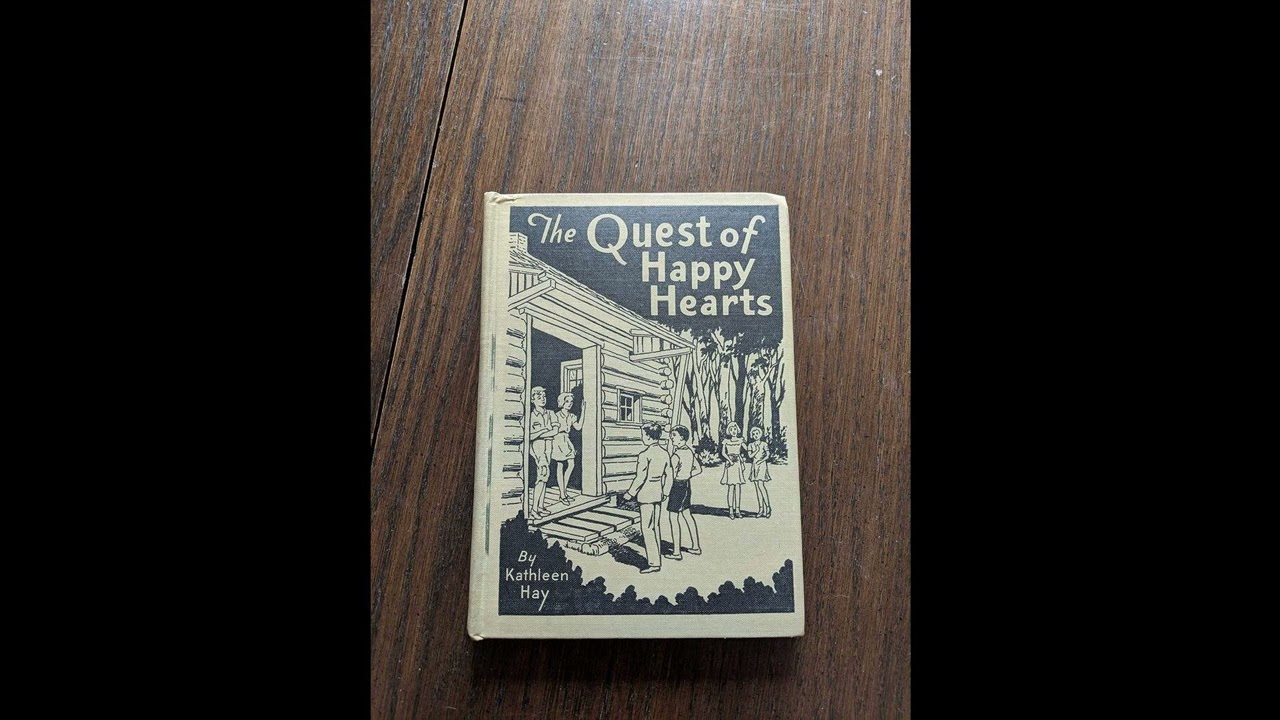
The Quest of Happy Hearts
Step into a world where the quiet stirrings of the human heart hold more drama than any grand adventure, and the search for contentment unfolds not across continents, but within the confines of a soul yearning for truth. Kathleen Hay's The Quest of Happy Hearts invites listeners to a gentler, yet no less profound, examination of existence, an enduring classic that speaks to the perennial human desire for authenticity and joy. This is a story that, despite its seemingly quaint setting and historical distance, resonates powerfully in our modern lives, reminding us that true happiness often lies in understanding ourselves and our place in the world, rather than in chasing external validation or fleeting pleasures. It’s a beautifully rendered portrait of self-discovery, offering solace and wisdom to anyone who has ever questioned their path or sought a deeper sense of belonging. The narrative transports us to the idyllic, if sometimes stifling, village of Oakhaven in the late nineteenth century. Here we meet Elara Vance, a young woman of keen intellect and an independent spirit, whose life seems destined to follow the well-trodden path laid out for respectable young ladies of her station. Her days are marked by social calls, needlework, and the expectation of a suitable marriage that promises comfort but little genuine passion or intellectual companionship. However, Elara harbors a restless longing for something more meaningful, a feeling that the accepted notions of happiness—wealth, social standing, and a well-ordered domestic life—are not quite enough to satisfy her spirited temperament. She finds herself increasingly at odds with the conservative views of her aunt, who raised her, and the prevailing societal pressures to conform. Elara's internal struggle intensifies when she forms an unlikely friendship with Mr. Thorne, the village's reclusive, unconventional scholar, and finds herself drawn to the earnest, idealistic physician, Dr. Alistair Finch. Each presents a different vision of life and happiness, challenging Elara’s preconceived notions and forcing her to confront her deepest desires. Her "quest" is not for a tangible object, but for an understanding of what truly constitutes a "happy heart" – a state of being she observes in others, sometimes in unexpected places, and yearns to cultivate within herself. The story follows Elara as she navigates these complex relationships, makes difficult choices that defy convention, and slowly begins to discern the difference between superficial contentment and profound, authentic joy. Her journey is a series of quiet revelations, as she learns to trust her own intuition and redefine what fulfillment means on her own terms, facing the societal whispers and personal doubts with growing courage. Kathleen Hay, though not a name often shouted from the literary rooftops, occupied a quiet but significant corner in the literary landscape of her time. Born in a small market town in rural England in the 1870s, she was largely self-taught, absorbing vast amounts of knowledge from her father's modest library. Her life was characterized by a deep connection to the rhythms of country life and a keen observational eye for the nuances of human behavior. While she rarely left her native county, her fiction traversed the inner lives of individuals with remarkable insight. Hay published several novels and a collection of short stories during her lifetime, which extended into the middle of the twentieth century. Her early work, such as The Weaver's Daughter and Echoes in the Valley, often focused on the lives of women in constrained circumstances, exploring their resilience and their quiet acts of rebellion against societal strictures. Hay's writing style is often described as possessing a gentle realism, bridging the gap between the grand social panoramas of the Victorians and the more psychologically intense narratives that would follow. She was never part of a major literary movement in the way some of her contemporaries were, preferring to cultivate her own distinct voice, one that emphasized character over intricate plot mechanics, and emotional truth over dramatic flourish. Nevertheless, she earned a small but devoted following for her empathetic portrayals of ordinary people grappling with universal questions of love, purpose, and belonging. Her place in the literary canon, though perhaps less prominent than some, rests on her sensitive rendering of domestic life and her ability to find profundity in the everyday, making her a precursor to the subtle character studies that would become a hallmark of twentieth-century fiction. The Quest of Happy Hearts enacts several enduring themes with grace and subtlety. Foremost among these is the fundamental question of what constitutes true happiness. Elara, for instance, initially believes that marrying Mr. Henderson, a man of considerable means and social standing, would secure her future and provide the contentment society prescribes. Yet, during a visit to his estate, she observes his meticulous attention to possessions and social appearances, realizing that while he possesses much, his spirit seems singularly untouched by genuine warmth or joy, prompting her to question whether external success truly equates to inner peace. Another central theme is the tension between societal expectations and individual desire. Early in the story, Elara feels the immense pressure from her aunt to accept a proposal from a respectable, if uninspiring, suitor. She struggles with the feeling that to deny this expected path would be to disappoint her family and face social censure, even as her heart quietly yearns for intellectual stimulation and a partnership based on mutual respect rather than mere convenience. Further, the book beautifully illustrates the importance of authentic connection and intellectual companionship. Elara finds solace and stimulation in her conversations with Mr. Thorne, the scholarly recluse. Their discussions, often taking place amidst dusty books and quiet tea, allow her to voice her unspoken thoughts and fears, offering a rare space where her intellect is celebrated rather than overlooked. These moments highlight how genuine understanding and shared ideas can nourish the spirit in ways that conventional social interactions cannot. Finally, the narrative champions the theme of self-discovery and the courage required to live authentically. Elara’s gradual realization that her happiness is not an external commodity to be acquired, but an internal state to be cultivated through integrity and self-knowledge, forms the very backbone of her development. A memorable scene has her walking through a quiet meadow, the scent of wildflowers in the air, contemplating a difficult choice, and feeling a nascent strength blossom within her as she determines to follow her own convictions, even if it means forging a solitary path for a time. Kathleen Hay's work emerged during a fascinating transitional period, bridging the rigid social structures of the Victorian era and the burgeoning modern world. Published in the early 1900s, The Quest of Happy Hearts reflects the cultural shifts underway—a time when women were beginning to seek greater independence, both intellectually and socially, though still largely bound by tradition. The lingering sentimentality of the previous era was giving way to a more pragmatic, psychologically informed view of human nature in literature. Politically, the world was on the cusp of significant change, with whispers of industrial unrest and growing calls for social reform. This backdrop of both continuity and impending change provides a rich soil for a story about personal evolution within a seemingly static community. Hay's decision to focus on the internal life of a woman questioning her prescribed role was not entirely revolutionary for its time, but her nuanced, non-judgmental approach offered a fresh perspective on the quiet battles waged within the domestic sphere, aligning with a broader literary trend towards realism and a deeper understanding of individual psychology. The work stands as a gentle but firm statement on the importance of individual fulfillment amidst the expectations of a changing society. Listening to The Quest of Happy Hearts as an audiobook offers a singular opportunity to fully immerse oneself in Hay's delicate prose and the contemplative pace of Elara's story. A skilled narrator can bring forth the subtle inflections in the dialogue, distinguishing between the guarded pronouncements of societal figures and the more genuine expressions of the characters seeking truth. The several hours of listening time provide ample space for reflection, making it an ideal companion for quiet moments—whether during a solitary walk, while engaged in gentle housework, or simply relaxing with a cup of tea. Pay close attention to the narrator's pacing, which should mirror the measured, observant rhythm of Hay's writing, allowing the listener to truly absorb the nuanced descriptions of Oakhaven's landscapes and the intricate shifts in Elara's inner world. The spoken word can particularly enhance the character's internal monologues, giving voice to her unspoken doubts and aspirations, making her "quest" feel incredibly personal and immediate.
Enjoyed The Quest of Happy Hearts? A few ways to support us
Audible & Amazon links are affiliate; we may earn a small commission at no extra cost.
About this production
Human narration by a volunteer reader from LibriVox.org, the public-domain audiobook project. LibriVox volunteers record literary works whose copyright has expired in the United States, releasing the resulting recordings into the public domain.
The Quest of Happy Hearts by Kathleen Hay. The underlying text is in the U.S. public domain. We do not republish any modern copyrighted edition, translation, or commentary.
The 4K cinematic visuals accompanying this audiobook are generated by an AI image model from prompts derived from the source text. No copyrighted photos, paintings, or stock footage are used. AI generation is disclosed on every video on our YouTube channel as required by YouTube's altered/synthetic content policy.
English subtitles are transcribed from the LibriVox recording with OpenAI Whisper. Translations into the 11 other supported languages are produced by Meta's NLLB-200 neural translation model. No human translator's copyrighted translation is used.
Questions about sourcing or rights? See our DMCA & Sourcing policy or contact us.
Enjoyed this audiobook?
If you'd like to own a copy of The Quest of Happy Hearts or hear a professionally produced edition, the links below help support free audiobook production at no extra cost to you.
As an Amazon Associate we earn from qualifying purchases. Audible / print links are affiliate.