Tales of Fantasy and Fact
"Tales of Fantasy and Fact" offers a unique window into the literary landscape of a bygone era, a collection that boldly asserts the power of narrative to both transport listeners beyond the mundane and anchor them firmly in the observed realities of life. Brander Matthews, a pivotal figure in American letters, curated this volume to demonstrate the full spectrum of his imaginative reach and keen social perception. Far from being a mere historical curiosity, these stories resonate today with a surprising freshness, prompting contemplation on the elusive line between what we imagine and what we accept as truth. Here is an opportunity to encounter a writer who saw no inherent contradiction in presenting both the whimsical and the rigorously realistic, understanding that both are essential components of the human experience. Listeners will discover a writer with a playful intellect and a profound understanding of human nature, a guide through worlds both familiar and utterly new. This collection, rather than following a single overarching plot, invites the listener into a succession of distinct narrative experiences, each story a world unto itself, yet collectively building a comprehensive portrait of Brander Matthews' literary vision. One might find themselves initially immersed in a story set within the gaslit drawing rooms of New York society, where the subtle politics of reputation and class play out with biting wit and meticulous detail. Here, the characters are often figures of privilege or ambition, their dialogue sharp, their motivations often veiled beneath layers of social decorum. A quiet observer might navigate the intricacies of a forgotten social ritual, or witness the delicate unravelling of a well-kept secret, all rendered with an eye for psychological nuance and the prevailing customs of the time. Then, with an almost imperceptible shift, the collection might introduce a scenario where the rules of the everyday world gently bend, or even snap entirely. A character might encounter an impossibility—a ghost that offers sage advice, a peculiar invention that alters perception, or a dream that seems to possess a tangible reality. These moments of "fantasy" are rarely gratuitous; instead, they serve to illuminate some deeper truth about the human condition, often acting as a mirror to the "fact" stories that precede or follow them. The central conflict within these varied narratives is frequently an internal one, a character grappling with belief, doubt, or the limits of their own understanding, whether confronting the absurdities of society or the wonders of the unexplained. The arc of "Tales of Fantasy and Fact" is therefore not linear, but rather cyclical, a continuous interplay between the grounded and the ethereal. Listeners will find themselves moving from the precise observation of human foibles and societal pressures to imaginative excursions into the realm of the improbable, each tale contributing to a broader understanding of how human beings navigate a world that is at once concrete and filled with unseen possibilities. The stories frequently pivot on a moment of unexpected realization, a quiet epiphany, or a clever reversal, leaving the listener to ponder the often-thin line separating the believable from the utterly fantastical. The discerning mind behind "Tales of Fantasy and Fact" was James Brander Matthews (1852-1929), an American author, critic, and academic whose influence on late nineteenth and early twentieth-century letters cannot be overstated. Born in New Orleans, Matthews spent the majority of his life in New York, where he became a prominent figure in the city's intellectual and theatrical circles. After graduating from Columbia College and Columbia Law School, he initially pursued a career in law before dedicating himself entirely to writing and scholarship, a decision that profoundly shaped the landscape of American literary criticism and dramatic theory. Matthews is perhaps best remembered as a professor of dramatic literature at Columbia University, a position he held for many years, becoming the first full professor of dramatic literature at any American university. Through his teaching and extensive writings, he became a fervent advocate for the establishment and recognition of a distinctly American literature and drama, arguing passionately for American authors to embrace their own unique voices and subjects rather than merely imitating European models. He was a close friend and confidant of literary giants such as Mark Twain and Theodore Roosevelt, men with whom he shared a commitment to American cultural independence and a fascination with the complexities of modern life. Beyond his critical and academic work, Brander Matthews was a prolific writer of fiction, essays, and plays. His other notable contributions include "An Introduction to the Study of American Literature," which helped define the nascent field, and "French Dramatists of the Nineteenth Century," a foundational text in the study of modern theatre. Matthews stood firmly within the emerging realist movement, championing clear, direct prose and a focus on observable reality, yet as "Tales of Fantasy and Fact" clearly shows, he possessed a keen appreciation for the imaginative and speculative as well, seeing both as legitimate avenues for artistic expression and social commentary. At the heart of "Tales of Fantasy and Fact" lies a persistent engagement with the interplay between illusion and reality. One might encounter a narrative where a seemingly straightforward event is revealed to be a meticulously constructed deception, challenging the protagonist—and the listener—to question the very nature of perception. Conversely, a story may present a fantastical element, such as a ghostly visitation or a moment of precognition, not as mere spectacle, but as a catalyst for a character's profound introspection, blurring the lines between what is empirically verifiable and what exists only within the mind's eye. Matthews uses these narrative devices to prompt reflection on how readily we accept certain truths and how easily we can be swayed by appearances. Another prominent theme resonating throughout the collection is social critique, often delivered with a subtle, incisive wit. In the "fact" stories, Matthews frequently casts a critical, yet often empathetic, gaze upon the manners, hypocrisies, and unspoken rules governing society during his time. A specific scene might vividly depict a character navigating the rigid strictures of a formal dinner party, where every gesture and word carries coded meaning, or another might illustrate the quiet desperation beneath a veneer of polite conversation. These narratives highlight the pressures of conformity, the pursuit of social status, and the often-unseen struggles of individuals within a rapidly changing urban environment, offering a lens through which to consider the enduring challenges of human interaction and societal expectation. He also touches upon the power of storytelling itself, implicitly asking the listener to consider the role of fiction in shaping understanding, whether through flights of fancy or stark depictions of life. "Tales of Fantasy and Fact" emerged from a period of tremendous transition in American culture and literature—the late nineteenth and early twentieth centuries. Following the Civil War, the United States was undergoing rapid industrialization and urbanization, leading to significant social shifts, new economic realities, and a burgeoning sense of national identity. This era saw the ascendance of realism in literature, a movement that sought to depict life as it truly was, often focusing on the struggles of the common person and the intricacies of everyday experience, a direct counterpoint to the romantic ideals that had previously dominated American letters. Brander Matthews himself was a key proponent of this shift, advocating for a literature that reflected American conditions and utilized American voices. The emergence of the short story as a popular and respected literary form during this time provided the perfect vehicle for authors like Matthews to experiment with narrative styles and address diverse subjects concisely. His collection, with its deliberate blend of the imaginative and the observational, perfectly encapsulates the literary ferment of the era, showcasing an author grappling with the very definition of narrative truth and exploring how both empirical evidence and human imagination contribute to our understanding of the world around us. It stands as a testament to a time when American writers were consciously forging a distinct literary path, unafraid to blend genres and challenge conventions. To experience "Tales of Fantasy and Fact" as an audiobook is to gain direct access to the nuanced tones and understated wit that are hallmarks of Brander Matthews' prose. The spoken word allows the listener to fully appreciate the delicate rhythm of his sentences, whether he is crafting a tense moment of dramatic irony in a society tale or imbuing a supernatural encounter with a compelling sense of mystery. The narrator’s voice becomes an essential guide, expertly pacing the varied narratives, highlighting the subtle shifts in atmosphere from one story to the next, and giving individual voice to the diverse array of characters—from the outwardly composed socialite to the quietly bewildered dreamer. The run length, several hours, makes this collection ideal for extended periods of focused listening or for savoring individual stories during shorter breaks, each offering a complete, satisfying narrative experience. It provides an intimate encounter with a writer whose work rewards close attention, allowing the listener to truly inhabit the worlds Brander Matthews created, to feel the weight of his observations, and to relish the subtle cleverness of his imagination.
Enjoyed Tales of Fantasy and Fact? A few ways to support us
Audible & Amazon links are affiliate; we may earn a small commission at no extra cost.
About this production
Human narration by a volunteer reader from LibriVox.org, the public-domain audiobook project. LibriVox volunteers record literary works whose copyright has expired in the United States, releasing the resulting recordings into the public domain.
Tales of Fantasy and Fact by Brander Matthews. The underlying text is in the U.S. public domain. We do not republish any modern copyrighted edition, translation, or commentary.
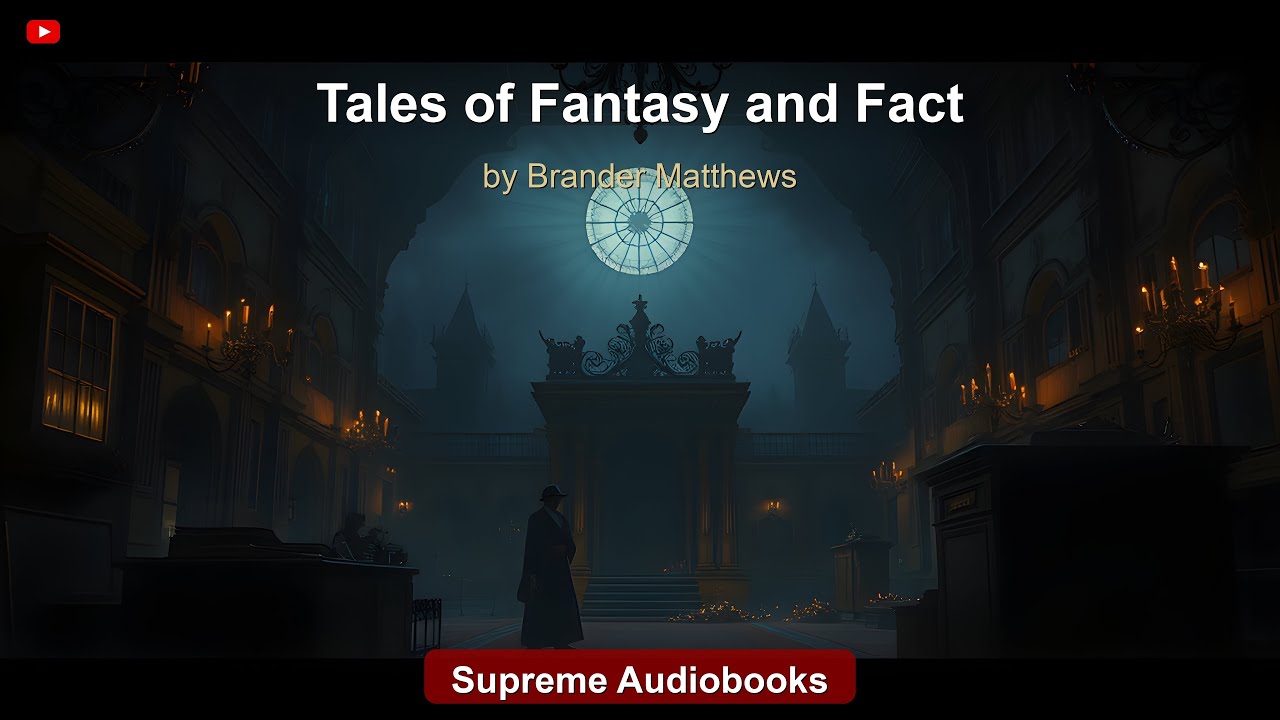
The 4K cinematic visuals accompanying this audiobook are generated by an AI image model from prompts derived from the source text. No copyrighted photos, paintings, or stock footage are used. AI generation is disclosed on every video on our YouTube channel as required by YouTube's altered/synthetic content policy.
English subtitles are transcribed from the LibriVox recording with OpenAI Whisper. Translations into the 11 other supported languages are produced by Meta's NLLB-200 neural translation model. No human translator's copyrighted translation is used.
Questions about sourcing or rights? See our DMCA & Sourcing policy or contact us.
View 10 famous quotes from this book →
Enjoyed this audiobook?
If you'd like to own a copy of Tales of Fantasy and Fact or hear a professionally produced edition, the links below help support free audiobook production at no extra cost to you.
As an Amazon Associate we earn from qualifying purchases. Audible / print links are affiliate.