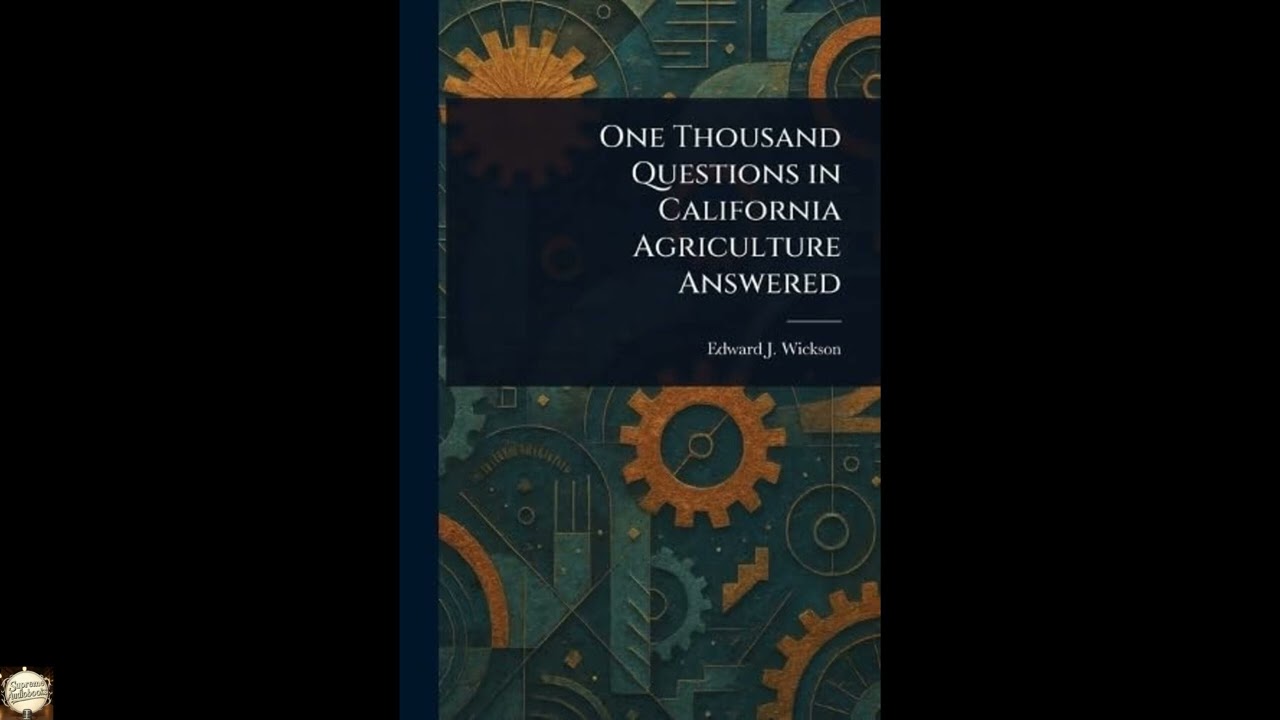
One Thousand Questions in California Agriculture Answered
California. The name alone evokes images of golden sunshine, fertile valleys, and a boundless horizon promising prosperity. Yet, beneath this romantic veneer lies a land of profound natural challenge, a place where success in agriculture has always demanded not just grit, but deep, meticulous knowledge. It is this foundational wisdom that Edward J. Edward James, a true pioneer of practical insight, distilled into his monumental work, One Thousand Questions in California Agriculture Answered. Far from being a mere dry manual, this book stands today as a classic of its kind, a vibrant snapshot of a pivotal era, offering listeners an unparalleled window into the very making of California's agricultural identity. To hear these carefully considered responses, framed by the concerns of an earlier time, is to understand the enduring spirit of innovation and adaptation that continues to shape one of the world's most productive food baskets, revealing the roots of challenges we still face today regarding land use, water, and sustainable practice. The "story" of One Thousand Questions in California Agriculture Answered unfolds not through fictional characters, but through the inherent drama of a landscape being tamed and understood. The setting is the entire sweep of California’s agricultural potential, from the fog-kissed coastal plains to the arid expanse of the Central Valley, from the rolling foothills to the nascent citrus groves of the south. It is a land of extremes, promising immense bounty if understood, and offering harsh lessons if disrespected. The main protagonists are, in a sense, the questions themselves—the collective anxieties and hopes of farmers, settlers, and aspiring cultivators arriving in this promised land. These questions are met by the steady, authoritative voice of Edward James, who acts as a wise mentor, guiding the listener through the bewildering array of choices and obstacles. The central conflict of this narrative is the age-old struggle of humanity against the raw forces of nature, amplified by California's unique ecological profile. How does one grow peaches in sandy loam? What are the best irrigation methods for alfalfa in a dry climate? How can vineyards be protected from devastating pests? Each query represents a micro-conflict, a specific problem demanding a precise solution. The arc of this comprehensive work begins with the most fundamental considerations—soil types, climate zones, basic crop selection—and systematically builds towards more complex issues of pest management, water conservation, market strategies, and the specialized cultivation of everything from almonds and olives to figs and walnuts. It’s a progressive unveiling of expertise, mirroring the journey of countless individuals who sought to wrest a living from the earth, transforming a frontier into a garden through diligent application of learned principles. Edward James emerges through his writing as a figure of remarkable dedication and encyclopedic knowledge. While specific biographical dates are not widely known, it is evident from the depth and breadth of his work that he was a preeminent authority in California agriculture during the period of its most dramatic expansion and modernization. He was likely a scholar, an agricultural extension agent, or a successful large-scale farmer whose experiences spanned decades, accumulating a vast reservoir of practical data and observations. His method reflects a keen eye for detail and a rigorous scientific approach, blending theoretical understanding with real-world application. He was not merely recounting facts but synthesizing them, making complex agricultural science accessible to a broad audience, from seasoned growers to brand-new homesteaders. His enduring legacy rests significantly on this one singular achievement, a testament to his profound influence on the practical development of a nascent industry. The literary significance of One Thousand Questions in California Agriculture Answered lies in its embodiment of several enduring themes. Foremost among these is the theme of human ingenuity and adaptation. James provides countless examples of how farmers, faced with the specific challenges of California’s varied microclimates and soils, devised ingenious solutions. For instance, his detailed discussions on irrigation—from gravity-fed ditches to early pump systems—illustrate humanity’s ceaseless effort to master the environment, turning arid land into fertile ground. Another powerful theme is the stewardship of the land. Throughout the answers, there is an implicit understanding that the land is not merely a resource to be exploited, but a complex system requiring careful attention. James offers advice on proper fertilization, crop rotation, and soil aeration, emphasizing practices that maintain long-term fertility rather than short-term gains, thereby subtly advocating for a respectful relationship between cultivator and earth. A third theme is the inherent optimism tempered by pragmatism that characterized the California dream. While the state promised boundless opportunity, James’s answers often underscore the very real difficulties and the necessity of diligence and informed decision-making. His advice on selecting the right crops for specific locations, or warning against unrealistic expectations for certain ventures, grounds the listener in the practical realities of farming. Finally, the entire structure of the book champions the power of knowledge itself. The very act of answering a thousand questions underscores the belief that problems, however daunting, can be overcome through education and systematic understanding. It positions knowledge as the primary tool for prosperity and resilience, a message as relevant today as it was when the book first appeared. This seminal work emerged during a transformative period in California's history. Following the initial frenzy of the Gold Rush, the late nineteenth and early twentieth centuries saw the state pivot towards agricultural development as its primary economic engine. Massive irrigation projects were undertaken, railroad networks expanded, and waves of new settlers arrived, all eager to cultivate the land. However, many were new to farming or unfamiliar with California's unique conditions, leading to a pressing demand for practical, reliable information. Agricultural colleges were burgeoning, and scientific farming was gaining traction. One Thousand Questions in California Agriculture Answered filled a critical void, serving as an essential guide for an entire generation. It reflected the era's optimistic belief in progress through science and industry, and its pragmatic recognition that such progress required comprehensive, accessible education for all. Listening to One Thousand Questions in California Agriculture Answered as an audiobook transforms it from a historical reference into an immersive experience. The "several hours" run time allows for a true deep dive, paced thoughtfully to absorb the density of information. A skilled narrator can bring clarity and a steady, reassuring authority to Edward James's meticulously researched answers, making even the most technical explanations feel approachable and engaging. The question-and-answer format lends itself remarkably well to audio; it feels less like a static text and more like a sustained dialogue between an expert and the perpetually curious. Listen for the careful precision of James’s language, the methodical progression from one topic to the next, and the way the narration creates an atmosphere of earnest inquiry and practical wisdom, transporting you back to a pivotal moment in California's rich agricultural story.
Enjoyed One Thousand Questions in California Agriculture Answered? A few ways to support us
Audible & Amazon links are affiliate; we may earn a small commission at no extra cost.
About this production
Human narration by a volunteer reader from LibriVox.org, the public-domain audiobook project. LibriVox volunteers record literary works whose copyright has expired in the United States, releasing the resulting recordings into the public domain.
One Thousand Questions in California Agriculture Answered by Edward J (Edward James. The underlying text is in the U.S. public domain. We do not republish any modern copyrighted edition, translation, or commentary.
The 4K cinematic visuals accompanying this audiobook are generated by an AI image model from prompts derived from the source text. No copyrighted photos, paintings, or stock footage are used. AI generation is disclosed on every video on our YouTube channel as required by YouTube's altered/synthetic content policy.
English subtitles are transcribed from the LibriVox recording with OpenAI Whisper. Translations into the 11 other supported languages are produced by Meta's NLLB-200 neural translation model. No human translator's copyrighted translation is used.
Questions about sourcing or rights? See our DMCA & Sourcing policy or contact us.
Enjoyed this audiobook?
If you'd like to own a copy of One Thousand Questions in California Agriculture Answered or hear a professionally produced edition, the links below help support free audiobook production at no extra cost to you.
As an Amazon Associate we earn from qualifying purchases. Audible / print links are affiliate.