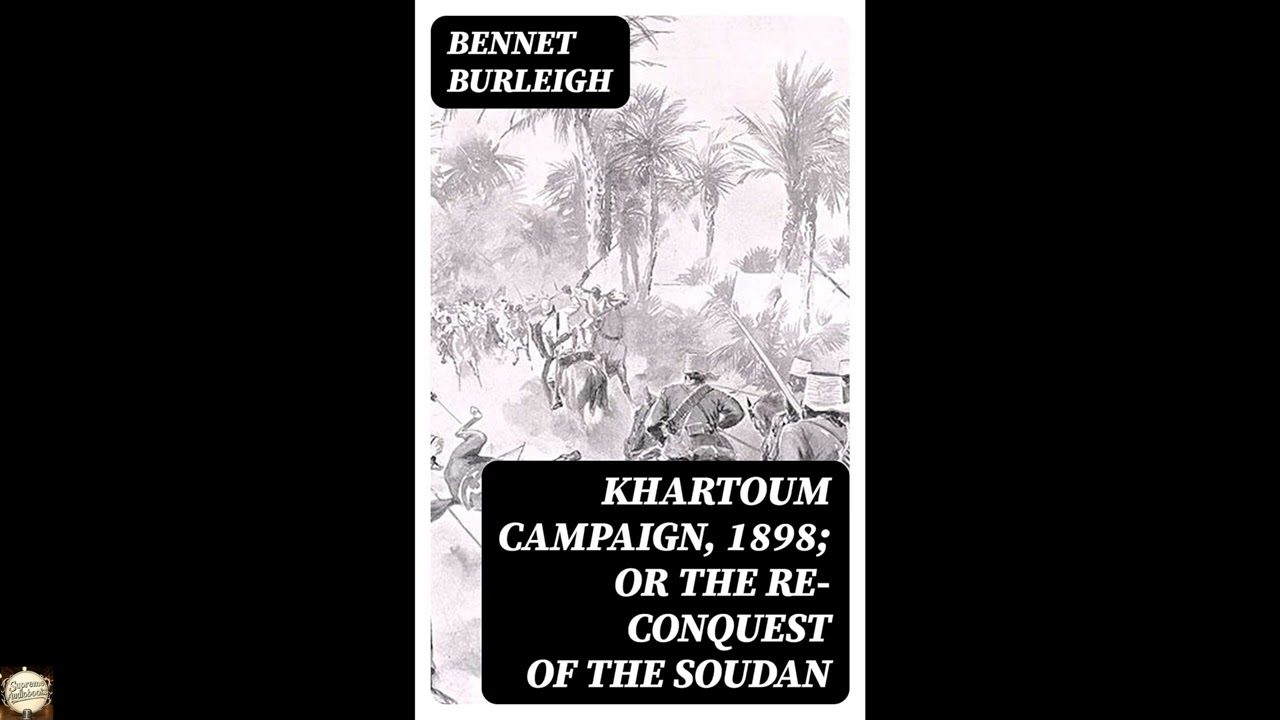
Khartoum Campaign, 1898; or the Re-Conquest of the Soudan
For listeners drawn to the foundational narratives of modern warfare and the sweeping, often brutal, march of history, Bennet Burleigh's Khartoum Campaign, 1898; or the Re-Conquest of the Soudan offers an unparalleled, boots-on-the-ground perspective. This isn’t a dry academic treatise but a vivid, immediate reportage, penned by a seasoned war correspondent who witnessed the decisive moments of late Victorian imperialism firsthand. It plunges listeners into the heart of a conflict that shaped the geopolitical landscape of Northeast Africa, revealing the strategic ambitions, the technological disparities, and the profound human cost of empire. To hear this account today is to gain a visceral understanding of how such historical events unfolded, providing crucial context for ongoing discussions about global power, intervention, and the enduring legacies of colonialism. The stage for this dramatic account is set in the vast, arid expanse of the Anglo-Egyptian Sudan, a territory that had fallen under the sway of the Mahdist state following the death of General Charles Gordon at Khartoum in 1885. For thirteen years, the region remained largely cut off, a source of simmering grievance and strategic concern for the British Empire. Burleigh’s narrative picks up as a new expedition is meticulously assembled under the command of General Sir Horatio Herbert Kitchener. The objective: to systematically advance up the Nile, subdue the Mahdist forces, and reclaim the lost territory. This was no swift strike but a methodical, almost industrial undertaking, involving the construction of a railway line across the desert and the careful coordination of riverine gunboats and infantry columns, all battling not just an enemy army but also the immense logistical challenges of a hostile environment. Listeners follow the deliberate, grinding progress of Kitchener's army, comprised of British and Egyptian regiments, as they push southwards. The central conflict builds steadily, characterized by skirmishes, the strategic outmaneuvering of Dervish forces, and the ever-present threat of disease and heatstroke. Burleigh captures the tension and the slow crescendo of preparation leading up to the inevitable, large-scale confrontation. He details the anticipation, the tactical decisions, and the stark contrast between the disciplined, technologically advanced imperial forces and the religiously fervent, courageous but often outgunned Mahdist warriors. The story culminates in the monumental clash at Omdurman, a battle that would determine the fate of the Soudan and leave an indelible mark on military history, though Burleigh carefully crafts his narrative to convey the sheer scale and immediate impact without revealing every last detail of the campaign's ultimate conclusion. Bennet Burleigh, the author of this remarkable document, was born in Glasgow, Scotland, in 1840, and lived a life that reads like an adventure novel until his death in 1914. His early life saw him cross the Atlantic to fight on the Confederate side during the American Civil War, where he was captured but famously escaped a Union prison. This early experience in reporting from the front lines — sometimes as a participant, always as an observer – forged him into one of the most celebrated war correspondents of his era. Burleigh went on to cover nearly every major conflict of the late 19th and early 20th centuries for The Daily Telegraph, a testament to his tenacity and his seemingly insatiable desire to be at the heart of the action. From the Franco-Prussian War to the Ashanti War, the Zulu War, the First Boer War, and the Russo-Japanese War, Burleigh’s dispatches were renowned for their immediacy, detail, and descriptive power. He was not a detached academic, but a reporter embedded with the troops, experiencing the dust, the danger, and the daily grind alongside them. This unique position allowed him to capture not just the grand strategies, but the individual moments, the personalities, and the atmosphere of campaigns like the one he recounts here. His contributions helped define the burgeoning field of war journalism, establishing a precedent for direct, experiential reporting that continues to influence how conflicts are covered even today. At its core, Khartoum Campaign, 1898 functions as a vivid case study of late Victorian imperialism. The text vividly portrays the prevailing British attitudes towards their "civilizing mission" in Africa, often juxtaposed with the harsh realities of military conquest and control. Burleigh’s descriptions of the methodical advance, the imposition of European technology and administration, and the explicit aims of "restoring order" reveal the deep-seated ideologies that underpinned the Scramble for Africa. For example, he meticulously details the construction of the railway, not merely as a logistical feat, but as a symbolic act of imposing order and infrastructure onto a "wild" landscape, showcasing the relentless, almost industrial nature of imperial expansion. Beyond its imperial dimensions, the book offers a sobering look at the evolution of military technology and its devastating impact. The battle of Omdurman stands out as a stark illustration of this theme, where the Dervish forces, armed primarily with spears and outdated rifles, faced the concentrated firepower of modern machine guns and artillery. Burleigh’s descriptions of the overwhelming British and Egyptian firepower, and the resulting casualties on the Mahdist side, provide a chilling account of the changing face of warfare, demonstrating how industrial-era innovations dramatically shifted the balance of power on the battlefield. His eyewitness accounts capture the terrible efficiency of these new weapons, and the desperate courage of those who faced them. This work emerged during a pivotal moment in both global politics and the world of journalism. The late 19th century was the zenith of European colonial expansion, a period known as the Scramble for Africa, where competing powers vied for territorial control and strategic advantage across the continent. Britain, already a vast imperial power, was particularly sensitive to any challenges to its influence, especially in a region as strategically vital as the Nile Valley, which was crucial for protecting the Suez Canal route to India. The Fashoda Incident with France, almost concurrent with the Khartoum campaign, underscored these intense rivalries. Culturally, there was a public appetite for news from these distant frontiers, fueled by a mixture of patriotic fervor, genuine curiosity, and sometimes, a romanticized view of imperial adventure. Literarily, this was also the era of "new journalism," a movement that prioritized immediacy, sensationalism, and eyewitness accounts over more detached, traditional forms of reporting. War correspondents like Burleigh became celebrities in their own right, their dispatches devoured by a public hungry for authentic tales from the front lines. Khartoum Campaign, 1898 is a quintessential product of this environment, a direct address from the battlefield to the reading public, shaping perceptions of the conflict and reinforcing the narrative of British imperial might and determination. It represents a vital bridge between purely official military histories and the burgeoning genre of immersive, on-the-spot reportage. Listening to Khartoum Campaign, 1898 as an audiobook brings an added dimension to Burleigh's already immediate prose. The narrator's voice transforms the written word into a living testimony, allowing the listener to truly experience the cadences of 19th-century reportage. The sustained run length of several hours makes this a perfect companion for long walks, commutes, or dedicated listening sessions, inviting a deep immersion into the narrative flow. Pay attention to the shifts in pacing – the slow, deliberate rhythm mirroring the army's arduous advance up the Nile, punctuated by moments of intense, rapid-fire description during engagements. The voice acting can bring to life the heat and dust of the Soudan, the stern commands of officers, and the thunder of battle, lending a visceral atmosphere to Burleigh's vivid observations and bringing the sounds and feelings of that distant campaign directly to the present moment.
Enjoyed Khartoum Campaign, 1898; or the Re-Conquest of the Soudan? A few ways to support us
Audible & Amazon links are affiliate; we may earn a small commission at no extra cost.
About this production
Human narration by a volunteer reader from LibriVox.org, the public-domain audiobook project. LibriVox volunteers record literary works whose copyright has expired in the United States, releasing the resulting recordings into the public domain.
Khartoum Campaign, 1898; or the Re-Conquest of the Soudan by Bennet Burleigh. The underlying text is in the U.S. public domain. We do not republish any modern copyrighted edition, translation, or commentary.
The 4K cinematic visuals accompanying this audiobook are generated by an AI image model from prompts derived from the source text. No copyrighted photos, paintings, or stock footage are used. AI generation is disclosed on every video on our YouTube channel as required by YouTube's altered/synthetic content policy.
English subtitles are transcribed from the LibriVox recording with OpenAI Whisper. Translations into the 11 other supported languages are produced by Meta's NLLB-200 neural translation model. No human translator's copyrighted translation is used.
Questions about sourcing or rights? See our DMCA & Sourcing policy or contact us.
Enjoyed this audiobook?
If you'd like to own a copy of Khartoum Campaign, 1898; or the Re-Conquest of the Soudan or hear a professionally produced edition, the links below help support free audiobook production at no extra cost to you.
As an Amazon Associate we earn from qualifying purchases. Audible / print links are affiliate.