Child Christopher and Goldilind the Fair
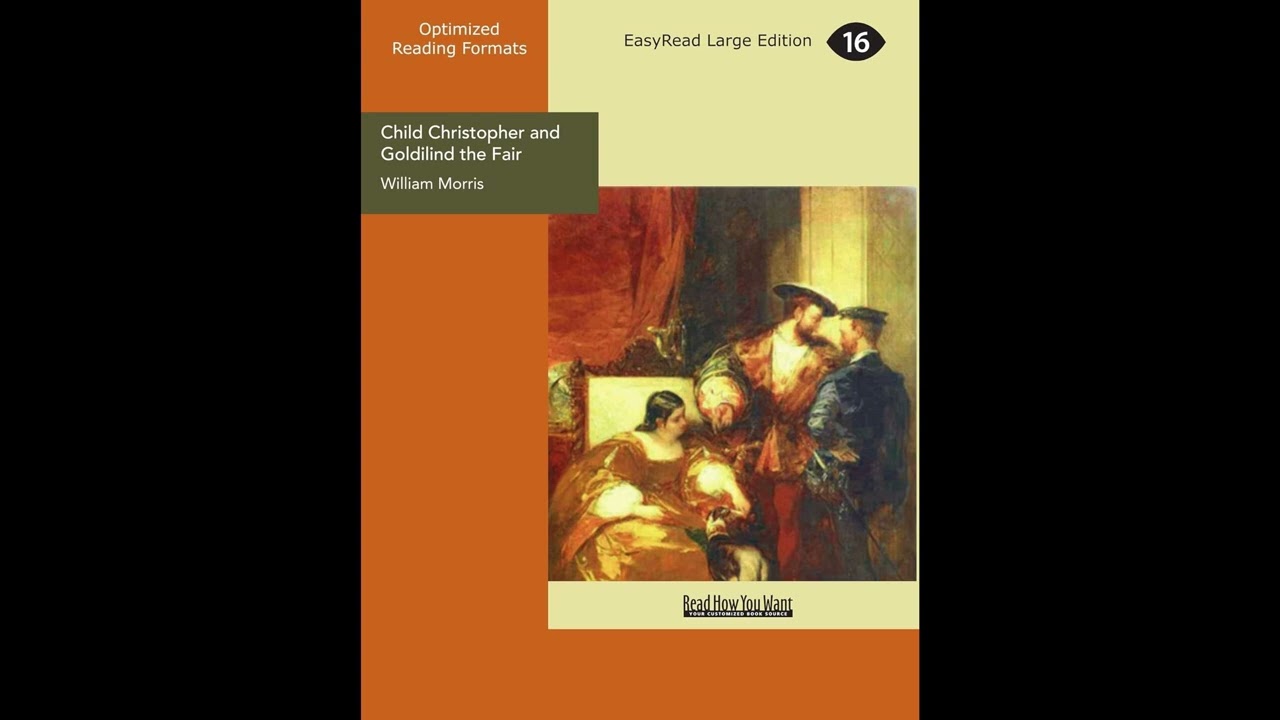
Step into a world spun from forgotten sagas and ancient chronicles, a realm where honor, love, and loyalty stand against the forces of treachery and chaos. William Morris's Child Christopher and Goldilind the Fair offers more than a simple romantic tale; it presents a deliberate return to the heroic age, a narrative that feels both deeply familiar and utterly unique. For those seeking escape from the clamor of modern life, or anyone who appreciates the foundational works of fantasy literature, this prose romance serves as a gateway to a meticulously imagined past, reminding us that even in an era of rapid change, the yearning for beauty, justice, and enduring affection remains constant. It is a story whose gentle, almost meditative pace allows a listener to truly dwell within its boundaries, appreciating the carefully wrought language and the moral clarity of its characters. The narrative unfolds in a loosely defined medieval landscape, conjuring images of forested wildernesses, walled cities, and the somber grandeur of ancient castles. We are introduced first to Christopher, a child of noble lineage whose birthright, the kingdom of Oakenrealm, is snatched from him by a ruthless usurper. Forced to flee, Christopher grows up in exile, fostered by loyal retainers in a remote, hidden valley. His upbringing emphasizes strength, courage, and a deep connection to the natural world, preparing him unknowingly for the great tasks that lie ahead. In another corner of this scattered realm lives Goldilind, a princess from a neighboring land, also orphaned and displaced, now residing under the watchful eye of a powerful, often mercurial, lord. She is a figure of grace and spirit, possessing a quiet resilience that belies her gentle upbringing. Their paths converge through circumstance, and a powerful, innocent affection quickly blossoms between them, rooted in shared experiences of loss and an innate understanding of each other's virtues. However, their nascent love is quickly tested by the harsh realities of their world: political intrigue, the ambitions of powerful lords, and the ever-present danger of discovery by Christopher's enemies. They must contend with separations, perilous flights, and the constant threat to their lives, all while Christopher struggles with the burden of his heritage and the need to reclaim his stolen kingdom. The story follows their journey, both physical and emotional, as they mature from displaced youth into figures determined to shape their own destinies and find a place of peace and rightful rule amidst the prevailing strife. William Morris (1834-1896) stands as one of the most remarkable figures of the Victorian age—a poet, novelist, translator, and socialist activist, but perhaps most famously, a groundbreaking designer and artist. Born into a wealthy family near London, his early education led him to Oxford University, where he formed a lifelong friendship with Edward Burne-Jones and became deeply enamored with medieval art and literature. This passion fueled his involvement with the Pre-Raphaelite Brotherhood and, more significantly, his founding of Morris, Marshall, Faulkner & Co. in 1861, which later became Morris & Co. This venture revolutionized decorative arts, producing stained glass, furniture, textiles, and wallpaper characterized by their exquisite craftsmanship and natural motifs. Beyond his contributions to art and design, Morris was a prolific writer. His poetic works, such as The Defence of Guenevere and Other Poems and The Earthly Paradise, established his reputation as a major poet. Towards the end of his life, he turned increasingly to prose romances, works like The Story of the Glittering Plain and The Wood Beyond the World, which are now recognized as foundational texts in the development of modern fantasy literature. Child Christopher and Goldilind the Fair, penned in his later years, was published posthumously in 1897 as part of The Sundering Flood. Through his Kelmscott Press, Morris also dedicated himself to the art of printing, producing beautiful, hand-crafted books that echoed the aesthetics of medieval manuscripts, further cementing his legacy as a polymath whose influence stretched across nearly every facet of cultural life in his era. At its core, Child Christopher and Goldilind the Fair is a profound meditation on the power of love and loyalty as redemptive forces. Even when separated by vast distances and formidable obstacles, Christopher and Goldilind's commitment to each other never wavers, serving as a beacon of hope and a source of strength that propels them through their trials. Their devotion is not merely romantic; it is a moral anchor in a world adrift in ambition and conflict, illustrating how personal bonds can inspire acts of courage and self-sacrifice. Furthermore, the book enacts Morris's long-standing fascination with and idealized vision of the past, specifically a pre-industrial medieval world. The story presents a society where the hand of the craftsman is evident, where social structures, though hierarchical, possess a certain clarity, and where human actions bear direct consequences. This setting functions as a gentle critique of the industrialized England Morris knew, expressing a deep longing for a simpler, more beautiful society rooted in community and connection to nature. The narrative also powerfully conveys the universal theme of the quest for identity and home. Both protagonists begin their lives dispossessed, outsiders seeking to reclaim their rightful status and establish a secure, just place for themselves and their people. Christopher's struggle to regain Oakenrealm is not just about political power; it is deeply intertwined with his personal quest to understand who he is and where he belongs. Similarly, Goldilind's journey is one of finding her voice and agency within a world that often seeks to constrain her. Their individual pursuits converge, illustrating that a true home is not merely a physical location but a state of belonging and peace achieved through integrity and shared purpose. The very language Morris employs—an archaic, almost hymn-like prose—further underscores these themes, evoking the spirit of ancient sagas and reinforcing the idea of a timeless struggle for beauty and meaning. This work emerged during a fascinating period in the late nineteenth century, a time marked by immense social and technological upheaval. Victorian England was grappling with the consequences of rapid industrialization, the growth of vast cities, and an increasingly complex political landscape. Amidst this march of modernity, there was a noticeable counter-current in the arts and literature—a revival of interest in medievalism, a yearning for simpler times, and a powerful aesthetic movement. Morris, deeply involved in socialist activism at the time, saw the prose romances not just as flights of fancy, but as powerful vehicles for expressing his utopian ideals and his critique of the alienating effects of industrial capitalism. These stories provided a vision of a world where beauty, communal bonds, and meaningful labor were paramount, offering a stark contrast to the perceived ugliness and injustice of contemporary society. His tales, with their emphasis on individual virtue and the possibility of a better communal life, directly addressed the anxieties and aspirations of an era caught between tradition and an uncertain future. Listening to Child Christopher and Goldilind the Fair as an audiobook offers a unique and profoundly immersive experience. The length, spanning several hours, is perfectly suited for allowing the listener to settle into Morris's distinctive prose style and the unhurried rhythm of his storytelling. A skilled narrator can bring out the inherent musicality of the language, translating the slightly archaic diction into something both comprehensible and enchanting. Pay close attention to the pacing, which often mirrors the gentle unfolding of ancient oral traditions, giving scenes and dialogue a particular weight. The voices of Christopher, Goldilind, and the various lords and retainers come alive through thoughtful performance, allowing the listener to differentiate characters and fully appreciate their individual struggles and virtues. The overall atmosphere created through careful narration transforms the act of listening into an experience akin to being told a legendary tale by a seasoned storyteller, conjuring the world of Oakenrealm and its neighboring lands with clarity and evocative power.
Enjoyed Child Christopher and Goldilind the Fair? A few ways to support us
Audible & Amazon links are affiliate; we may earn a small commission at no extra cost.
About this production
Human narration by a volunteer reader from LibriVox.org, the public-domain audiobook project. LibriVox volunteers record literary works whose copyright has expired in the United States, releasing the resulting recordings into the public domain.
Child Christopher and Goldilind the Fair by William Morris. The underlying text is in the U.S. public domain. We do not republish any modern copyrighted edition, translation, or commentary.
The 4K cinematic visuals accompanying this audiobook are generated by an AI image model from prompts derived from the source text. No copyrighted photos, paintings, or stock footage are used. AI generation is disclosed on every video on our YouTube channel as required by YouTube's altered/synthetic content policy.
English subtitles are transcribed from the LibriVox recording with OpenAI Whisper. Translations into the 11 other supported languages are produced by Meta's NLLB-200 neural translation model. No human translator's copyrighted translation is used.
Questions about sourcing or rights? See our DMCA & Sourcing policy or contact us.
Enjoyed this audiobook?
If you'd like to own a copy of Child Christopher and Goldilind the Fair or hear a professionally produced edition, the links below help support free audiobook production at no extra cost to you.
As an Amazon Associate we earn from qualifying purchases. Audible / print links are affiliate.
![Children's Classics in Dramatic Form, Book Two. [1909] by Augusta Stevenson — free full audiobook](https://img.youtube.com/vi/h4bTKUeuO7U/maxresdefault.jpg)