The Chain of Destiny
When one hears the name Bram Stoker, images of shadowy castles, ancient curses, and the immortal Count Dracula immediately spring to mind. Yet, to confine Stoker's literary genius solely to the realm of the Gothic macabre would be to overlook the breadth of his storytelling talent. In "The Chain of Destiny," listeners are offered a surprising, yet deeply moving, excursion into the territory of pure romance. This concise narrative, though far removed from the chilling corridors of Transylvania, carries Stoker's signature blend of dramatic tension and profound human emotion, distilling the essence of fated love into a mere twenty-one minutes. It is a perfect, potent reminder that the threads of destiny can intertwine with as much compelling force in a whispered declaration as in a bloodcurdling scream, speaking to the enduring human fascination with serendipity, choice, and the powerful, unseen currents that guide our hearts. The story unfolds in a picturesque, if somewhat isolated, coastal town in the late Victorian era, where the relentless crash of waves against the cliffs seems to echo the tumultuous emotions brewing within its inhabitants. Our protagonist is Eleanor Vance, a young woman of modest means but keen artistic sensibilities, who spends her days capturing the rugged beauty of the shore on her easel. Her quiet life is abruptly disturbed by the arrival of Captain Julian Ashworth, a man whose reserved demeanor hints at a past marked by unspoken sorrow or a heavy burden of responsibility. Their initial meeting is a moment of palpable, almost mystical, connection – a shared glance across a crowded village market that suggests a recognition deeper than mere acquaintance. As their paths begin to cross with increasing frequency, an undeniable attraction blossoms between them, fueled by shared moments of quiet understanding and a growing sense that their encounter was not accidental. However, the "chain of destiny" is rarely without its entanglements. Julian is bound by an old family promise, a commitment that threatens to pull him away from Eleanor and back into a life of pre-arranged duty and expectation. Eleanor, for her part, grapples with the anxieties of her social station and the perceived impossibility of a future with a man seemingly from a different world. A series of misunderstandings, fueled by societal pressures and the veiled machinations of a rival suitor, complicate their burgeoning romance. They find themselves at a precipice, forced to confront whether the powerful, inexplicable bond they feel is strong enough to withstand the practicalities and prejudices of their time, or if their destined connection will be severed by the very forces that seem to have brought them together. The narrative builds with delicate precision towards a moment of crucial decision, leaving the listener poised on the edge, wondering if love can truly conquer all when pitted against the dictates of fate and circumstance. Abraham "Bram" Stoker, born in Clontarf, Dublin, Ireland, in 1847, lived a life that would eventually imbue his fiction with an extraordinary blend of the mundane and the otherworldly. Though famously frail in childhood, he later excelled physically and academically at Trinity College Dublin. His early career as a civil servant at Dublin Castle, followed by his tenure as an un-salaried drama critic for the Dublin Mail, honed his observational skills and introduced him to the vibrant, often theatrical, characters who would populate his later narratives. The pivotal turn in his life came in 1878 when he became business manager for the renowned actor Sir Henry Irving and for Irving's Lyceum Theatre in London. This position immersed him in a world of travel, late nights, diverse personalities, and the dramatic flair of stagecraft, an experience that undoubtedly shaped his flair for dramatic pacing and character development. Despite the monumental success of Dracula in 1897, which cemented his place as a master of horror, Stoker's literary output was surprisingly varied. He penned numerous other novels and short stories across genres, including historical romances like The Lady of the Shroud, adventure tales such as The Jewel of Seven Stars, and even children's stories. Works like The Lair of the White Worm and Miss Betty further attest to his willingness to experiment beyond the confines of the supernatural. Stoker passed away in London in 1912, leaving behind a legacy not just as the creator of one of fiction's most enduring villains, but as a writer deeply attuned to the complexities of human nature, capable of crafting narratives that moved between the terrifying and the tender with equal skill. "The Chain of Destiny," though lesser known, stands as a testament to his broader talents, demonstrating his capacity to spin a tale of heartfelt connection and yearning. "The Chain of Destiny" enacts several profound themes relevant to the human condition. Foremost is the perennial tension between fate and free will. The very title suggests an inexorable force guiding the characters, yet their choices, their struggles, and their moments of hesitation demonstrate the enduring power of individual agency. When Eleanor considers dismissing Julian due to their differing social strata, or when Julian is torn between his family's honor and his feelings, the story shows characters actively wrestling with what appears pre-ordained, highlighting the human capacity for resistance and self-determination even in the face of destiny's pull. Another powerful theme is love as a transformative and redemptive force. Eleanor and Julian's burgeoning affection offers solace and new perspectives to characters who might otherwise remain isolated or bound by convention. Their connection provides a sense of belonging and purpose, illustrating how genuine affection can inspire individuals to defy expectations and pursue a happiness they once deemed unattainable. Furthermore, the story subtly touches upon the theme of societal expectation versus personal desire. The pressures Julian faces from his family and Eleanor's awareness of her own perceived limitations are concrete examples of how external forces can clash with inner longings. The narrative creates a vivid sense of the era's social strictures, where class and familial obligations often dictated one's path, and then pits the raw, undeniable emotion between the protagonists against these formidable barriers. It is a story that asks whether the heart's true compass can override the rigid maps drawn by society, suggesting that authentic love often requires a defiance of convention. Finally, there is the quiet power of first impressions and instant connection, suggesting that some bonds are forged instantaneously, defying logic or gradual acquaintance. The initial shared glance between Eleanor and Julian is not merely an introduction; it is presented as a moment of profound recognition, hinting at a connection that existed long before their paths physically converged, underscoring the romantic idea of souls meant to find each other. Stoker's formative years coincided with a period of immense change in Victorian Britain and Ireland. The late nineteenth century was a time marked by rapid industrialization, burgeoning scientific inquiry that challenged traditional religious beliefs, and widespread social stratification. Simultaneously, the rise of the novel as a popular form of entertainment was firmly established, and the demand for serialized fiction, short stories, and diverse narratives was high. Stoker's theatrical background provided him a unique vantage point into human psychology and the dramatic structures that hold an audience spellbound, skills he applied equally to his Gothic horror and to his lesser-known romances. The era’s blend of strict social codes, a fascination with the unseen and spiritual, and a burgeoning sense of individualism all contributed to a literary landscape where tales of fated love, struggles against convention, and the inexplicable nature of human connection could resonate deeply. "The Chain of Destiny" emerged from this rich cultural soil, reflecting an enduring public appetite for narratives that affirmed the power of emotion and the mystery of human bonds. Listening to "The Chain of Destiny" as an audiobook transforms a brief story into an intimate, focused experience. At just twenty-one minutes, it is perfectly suited for a quiet moment alone, a short commute, or a contemplative pause in a busy day. The narrator's voice becomes the conduit for Eleanor and Julian's most private thoughts and the unspoken tension that binds them. A skilled performance brings out the subtle nuances of Stoker's prose, allowing listeners to hear the rustle of Eleanor's dress, the solemnity in Julian's tone, and the unspoken yearning between them. The pacing of the narration can heighten the sense of mounting inevitability and the dramatic weight of the characters' choices, while the careful modulation of voice adds depth to the dialogue, making each whispered word and heartfelt declaration resonate with greater emotional impact. It is an experience that immerses you completely in the romantic atmosphere, allowing Stoker's unexpected foray into affairs of the heart to truly take hold.
Enjoyed The Chain of Destiny? A few ways to support us
Audible & Amazon links are affiliate; we may earn a small commission at no extra cost.
About this production
Human narration by a volunteer reader from LibriVox.org, the public-domain audiobook project. LibriVox volunteers record literary works whose copyright has expired in the United States, releasing the resulting recordings into the public domain.
The Chain of Destiny, first published in 2022 by Bram Stoker. The underlying text is in the U.S. public domain. We do not republish any modern copyrighted edition, translation, or commentary.
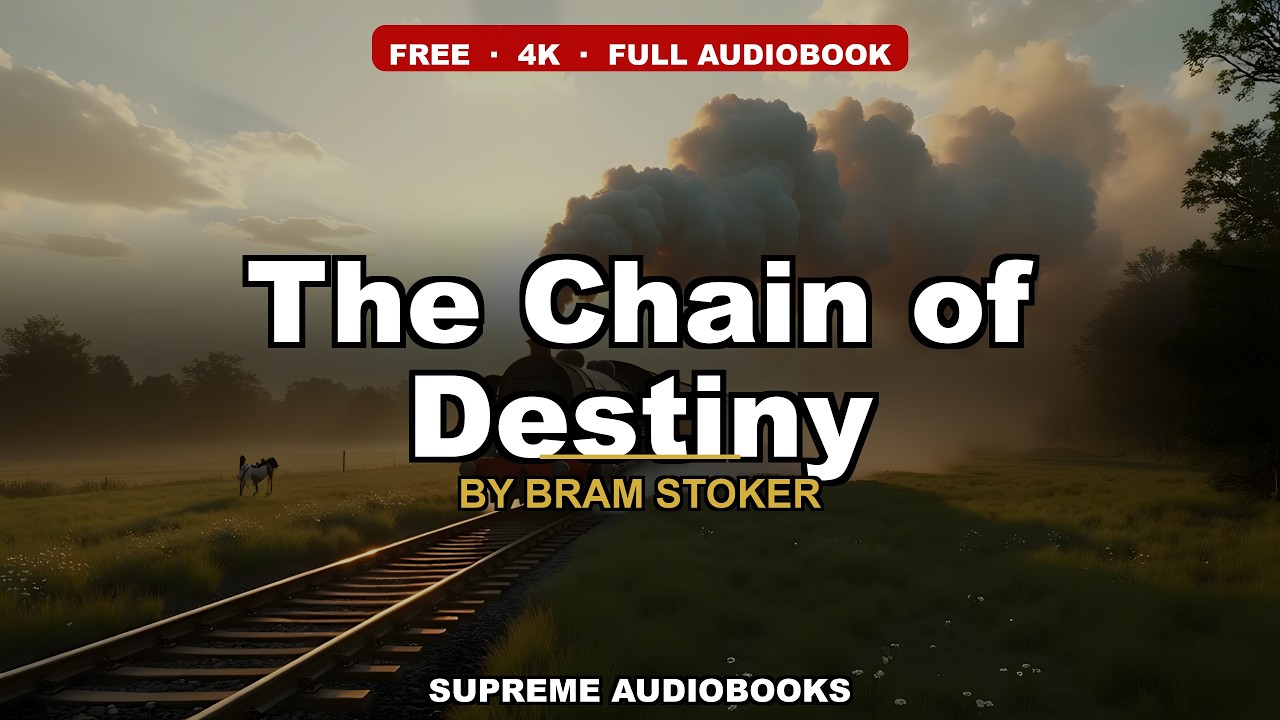
The 4K cinematic visuals accompanying this audiobook are generated by an AI image model from prompts derived from the source text. No copyrighted photos, paintings, or stock footage are used. AI generation is disclosed on every video on our YouTube channel as required by YouTube's altered/synthetic content policy.
English subtitles are transcribed from the LibriVox recording with OpenAI Whisper. Translations into the 11 other supported languages are produced by Meta's NLLB-200 neural translation model. No human translator's copyrighted translation is used.
Questions about sourcing or rights? See our DMCA & Sourcing policy or contact us.
Enjoyed this audiobook?
If you'd like to own a copy of The Chain of Destiny or hear a professionally produced edition, the links below help support free audiobook production at no extra cost to you.
As an Amazon Associate we earn from qualifying purchases. Audible / print links are affiliate.