Studies in Early Victorian Literature
"Studies in Early Victorian Literature" invites listeners into the vibrant intellectual life of the late nineteenth century, offering a sophisticated window into how the literary giants of a preceding generation were understood and assessed by a discerning contemporary critic. This is not a novel of sweeping narratives or dramatic personal struggles, but rather a profound collection of critical essays penned by Frederic Harrison, a prominent public intellectual and positivist philosopher. Listeners today will find more than just academic analysis here; they gain access to the very foundations of modern critical thought, witnessing how the works that shaped the Victorian mind were interpreted, debated, and canonized in their own time. It's an opportunity to see the early Victorian era through eyes that knew its immediate legacy, providing a valuable counterpoint to contemporary literary evaluations and revealing the enduring power and sometimes surprising fragility of literary reputations. The "story" within this collection of essays is less about narrative progression and more about a carefully constructed intellectual argument. Harrison sets his stage in the bustling intellectual landscape of early Victorian England, spanning roughly from the 1830s to the 1860s. Here, the titans of literature—Thomas Carlyle, John Ruskin, Charles Dickens, William Makepeace Thackeray, Alfred, Lord Tennyson, and George Eliot, among others—emerge as the central "characters." Harrison systematically brings each of these monumental figures under his critical gaze, examining their most significant works, their distinctive styles, and their profound impact on their society. He does not merely describe; he analyzes, praises, and critiques with a clear, authoritative voice. The central "conflict" of Harrison's "Studies" lies in his critical engagement with these literary giants. He grapples with the tension between the moral earnestness, social reform aspirations, and sometimes contradictory ideals that characterized the early Victorian period, as reflected in its literature. Harrison, writing from the perspective of the fin-de-siècle, often finds himself weighing the enduring artistic merit of these authors against their immediate social and ethical influence. He seeks to discern which aspects of their genius held universal appeal and which were more transient, tied to the specific moment of their creation. The arc of this literary "story" follows Harrison's meticulous progression through the major figures, building a comprehensive portrait of an era not just through its literature, but through the act of evaluating that literature. He strives to define the very spirit of early Victorianism by dissecting its most articulate voices, offering his own considered judgments on their lasting contributions to both art and thought. Frederic Harrison, born in London in 1831, was a towering figure in late Victorian intellectual circles, known as a lawyer, historian, and philosopher. His life spanned nearly a century, concluding in 1923, allowing him to witness profound shifts in British society and culture. Educated at Oxford, Harrison became a barrister, but his true calling lay in public intellectualism and social reform. He was a devoted follower of Auguste Comte, the French philosopher who founded positivism, a philosophy that emphasized scientific observation and social progress as the keys to human development. Harrison became a leading proponent of Comte's ideas in England, advocating for a "Religion of Humanity" that sought to replace traditional theology with a rational, ethical framework focused on human welfare. Throughout his long and productive career, Harrison authored numerous books and essays that addressed a wide range of topics, from history and politics to literature and philosophy. Notable among his other works are "The Meaning of History," a foundational text for his positivist historical understanding, and "Order and Progress," which articulated his vision for societal improvement. His place in the literary canon is that of a significant public intellectual and critic, one who actively engaged with the social and moral questions of his day through both his philosophical writings and his literary assessments. He was not merely an observer but an active participant in shaping the intellectual discourse, always with an eye toward the betterment of humanity, a perspective that distinctly colors his literary criticisms. Harrison's "Studies in Early Victorian Literature" is deeply informed by several key themes, both those he attributes to the authors he analyzes and those inherent in his own critical method. One prominent theme Harrison champions is the social utility of literature. He frequently assesses authors like Dickens and Carlyle not just for their artistic prose but for their capacity to provoke social change or provide moral guidance. For instance, he might discuss Dickens's vivid portrayals of poverty and injustice in novels like "Oliver Twist" or "Bleak House" as powerful calls for reform, demonstrating how literature can serve as a catalyst for societal improvement rather than merely entertainment. Another significant theme is the search for meaning in a rapidly changing world, a concern that resonated both with the early Victorians and with Harrison himself. He scrutinizes how writers like Tennyson, in poems such as "In Memoriam A.H.H.," grappled with doubt, loss, and the implications of scientific discovery for faith. Harrison's analysis reveals his critical lens: he appreciates the emotional honesty and philosophical depth of such works, viewing them as essential responses to the intellectual anxieties of the age. His own positivist philosophy, which sought to provide a new framework for meaning, informs his appreciation for authors who confronted these existential questions head-on, solidifying the idea that literature could offer solace and direction amidst upheaval. Published in 1895, Harrison's "Studies" arrived at a pivotal moment in British cultural history—the fin-de-siècle, the very end of Queen Victoria's long reign. This was a period of both imperial confidence and underlying anxieties. Britain was at the zenith of its global power, yet internally, there were growing social tensions, new scientific discoveries challenging old beliefs, and a discernible shift in literary tastes away from Victorian earnestness towards new movements like Aestheticism and Decadence. Writers such as Oscar Wilde and Aubrey Beardsley were pushing boundaries, prioritizing beauty and art for art's sake, sometimes in defiance of traditional moral strictures. In this context, Harrison's collection emerged as a retrospective look at the literary giants who had dominated the preceding half-century. It represented an attempt to consolidate, define, and evaluate the "Victorian" literary legacy before the full tide of modernism swept over the intellectual landscape. His work provided a measured, morally grounded assessment from a generation that still valued literature for its ethical and social implications, a perspective that was beginning to wane in the face of more experimental and less didactic artistic impulses. "Studies in Early Victorian Literature" thus stands as a vital bridge, capturing the critical values of a departing era even as new ones were rapidly taking shape. Listening to "Studies in Early Victorian Literature" as an audiobook, clocking in at 6 hours and 7 minutes, allows for a truly immersive intellectual experience. A well-modulated narration brings Harrison's measured prose to life, giving his arguments a resonant clarity that might feel different when encountered purely on the page. The pacing of the narration can highlight Harrison's careful logical constructions and the nuances of his critical judgments, allowing the listener to absorb his complex ideas without feeling rushed. Pay attention to the narrator's tone when Harrison shifts from praise to critique, capturing the subtle inflections of his authoritative yet reflective voice. The run length makes it ideal for a commute or for multiple focused listening sessions, enabling a gradual engagement with the intellectual atmosphere of late Victorian criticism. It provides a unique opportunity to appreciate not just what Harrison says about these authors, but how he constructs his arguments, offering a scholarly yet accessible entry point into the history of literary thought.
Enjoyed Studies in Early Victorian Literature? A few ways to support us
Audible & Amazon links are affiliate; we may earn a small commission at no extra cost.
About this production
Human narration by a volunteer reader from LibriVox.org, the public-domain audiobook project. LibriVox volunteers record literary works whose copyright has expired in the United States, releasing the resulting recordings into the public domain.
Studies in Early Victorian Literature, first published in 1895 by Frederic Harrison. The underlying text is in the U.S. public domain. We do not republish any modern copyrighted edition, translation, or commentary.
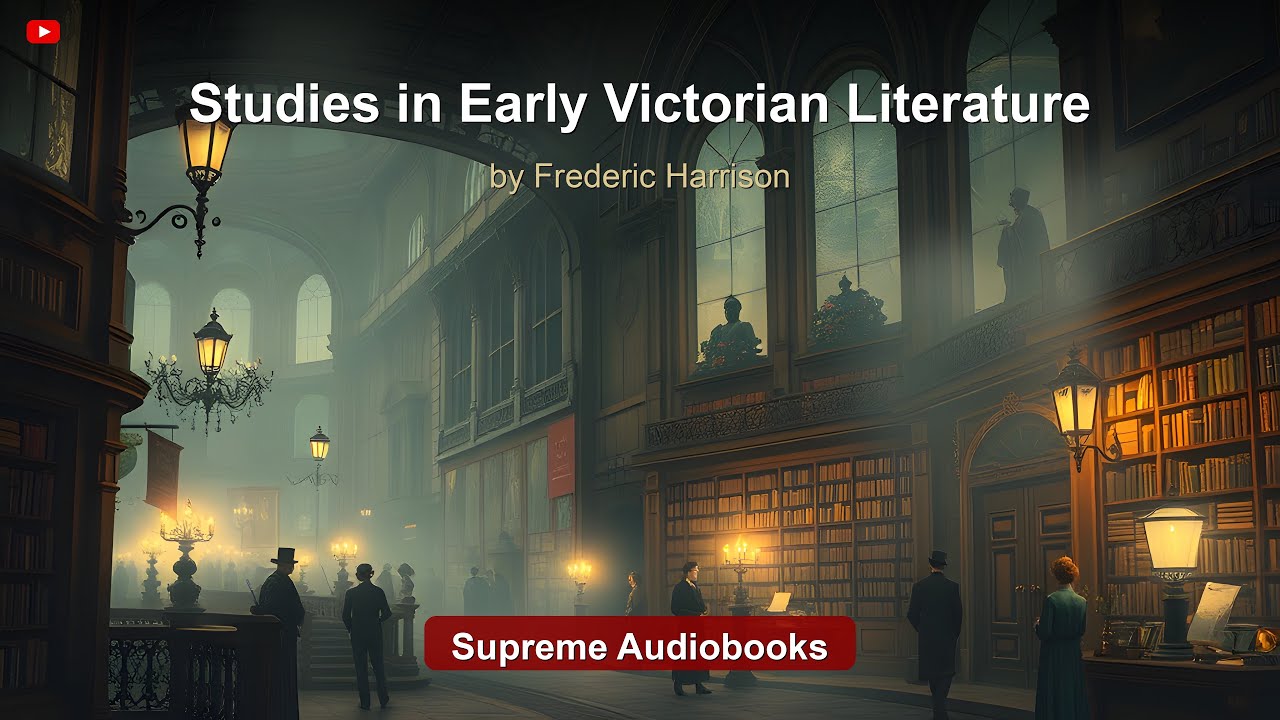
The 4K cinematic visuals accompanying this audiobook are generated by an AI image model from prompts derived from the source text. No copyrighted photos, paintings, or stock footage are used. AI generation is disclosed on every video on our YouTube channel as required by YouTube's altered/synthetic content policy.
English subtitles are transcribed from the LibriVox recording with OpenAI Whisper. Translations into the 11 other supported languages are produced by Meta's NLLB-200 neural translation model. No human translator's copyrighted translation is used.
Questions about sourcing or rights? See our DMCA & Sourcing policy or contact us.
Enjoyed this audiobook?
If you'd like to own a copy of Studies in Early Victorian Literature or hear a professionally produced edition, the links below help support free audiobook production at no extra cost to you.
As an Amazon Associate we earn from qualifying purchases. Audible / print links are affiliate.