Studies in Literature
Step into the intellectual currents of the late Victorian era with John Morley's Studies in Literature, a collection that offers far more than a mere historical curiosity. This is not simply a retrospective glance at the titans of English letters, but a deeply engaged argument for a particular way of understanding art, ethics, and society. Morley, a figure of formidable intellect and political influence, brings his signature clarity and moral earnestness to bear on the works of his contemporaries and predecessors, challenging listeners to reconsider how literature shapes—and is shaped by—the human condition. For anyone who believes that reading is a conversation, a negotiation of ideas that continues to echo through the centuries, Morley’s incisive criticism remains remarkably pertinent, illuminating not only the past but also the enduring questions we face today about truth, beauty, and the public duty of the writer. The "story" within Studies in Literature unfolds not through characters and plot in the traditional sense, but as a series of intellectual encounters, each essay a focused investigation into a prominent literary figure or a significant cultural debate. Morley establishes the setting as the broad intellectual landscape of the nineteenth century, stretching from the Romantic passions of the early years to the complex ethical quandaries of the Victorian period. The main "characters" are, of course, the literary giants Morley chooses to scrutinize—William Wordsworth, Thomas Carlyle, Lord Byron, and George Eliot, among others. Each essay positions Morley as a judicious, often skeptical, interpreter, weighing the genius of these writers against their philosophical leanings, their political positions, and their perceived moral impact on their age. The central intellectual conflict animating the collection is Morley’s persistent quest to reconcile literary greatness with a principled, rational humanism. He wrestles with the tendency of certain artists towards mysticism or political reaction, even while acknowledging their profound artistic contributions. The arc of the "narrative" progresses as Morley moves from one author to another, building a cumulative argument about the responsibilities of art and criticism. He invites listeners to witness the process of a keen mind dissecting complex ideas, seeking to understand the enduring power of literature while also holding it accountable to the highest standards of reason and social conscience. The satisfaction comes not from a resolution of a physical conflict, but from the elegant unfolding of well-reasoned arguments and profound insights into the human spirit as expressed through words. John Morley (1838-1923) was a towering figure in British public life, a true man of letters who seamlessly blended a career in politics with profound contributions to journalism and literary criticism. Born in Blackburn, Lancashire, he rose from humble beginnings to become a Member of Parliament, serving as Chief Secretary for Ireland and later as Secretary of State for India, key positions that put him at the heart of imperial governance. Before his political ascendancy, Morley honed his critical acumen as editor of the influential Fortnightly Review, transforming it into a platform for advanced liberal thought and scientific inquiry. His deep commitment to rationalism and individual liberty defined both his political philosophy and his literary judgments. Morley was a close associate and biographer of William Gladstone, the towering Liberal Prime Minister, and his Life of Gladstone remains a foundational text for understanding Victorian statesmanship. His other notable biographical works, such as Rousseau and Voltaire, reflect his profound interest in the intellectual foundations of modern thought and his affinity for the Enlightenment’s emphasis on reason. He was a leading voice of philosophical radicalism, advocating for social reform, religious toleration, and a robust, unsentimental approach to public life. His essays reflect this commitment, positioning him as a significant bridge between the intellectual fervor of the mid-Victorian era and the rapidly changing world of the early twentieth century, solidifying his place as a pivotal figure in the canon of liberal thought. Several key themes emerge consistently throughout Studies in Literature, revealing Morley's overarching concerns. One prominent theme is the indispensable connection between literature and moral responsibility. Morley often evaluates authors not just for their aesthetic achievement but for the ethical stance embedded within their work and its potential societal impact. For example, in his appraisal of Wordsworth, Morley might commend the poet's profound connection to nature and his early revolutionary zeal, yet he would also critically examine the poet's later political conservatism, questioning how such shifts in belief resonated through his artistic output. This demonstrates Morley's belief that a writer's personal philosophy is inextricably linked to the quality and enduring relevance of their art. Another central idea is the ongoing tension between rationalism and various forms of emotionalism or spiritualism in art. As a committed agnostic and advocate for scientific inquiry, Morley frequently measures literary figures against the standards of clear reason and empirical observation. His essay on Thomas Carlyle, for instance, might celebrate Carlyle’s powerful prose and historical imagination, while simultaneously expressing skepticism about his tendencies towards hero-worship and his sometimes mystical pronouncements. Morley’s critical method implicitly argues for a balanced approach to understanding the world, where the insights of art are valued but always tempered by intellectual rigor and a refusal to succumb to uncritical sentiment. Studies in Literature appeared in 1891, a period of immense intellectual and social ferment in Great Britain. The late Victorian era was marked by the ongoing impact of Darwinian thought, which challenged traditional religious beliefs and prompted widespread philosophical reassessment. Industrialization continued to transform society, creating new social classes and raising urgent questions about poverty, labor, and political representation. In the literary world, there was a growing fascination with realism and naturalism, yet also a powerful counter-current of aestheticism and symbolism that prioritized art for art's sake. Morley's work, with its emphasis on rational critique and moral purpose, stood as a significant voice against what he perceived as the dangers of uncritical aestheticism or sentimental escapism, asserting the enduring importance of literature as a force for intellectual and ethical engagement during a time of profound cultural shifting. Listening to Studies in Literature as an audiobook offers a unique opportunity to engage directly with Morley’s meticulously crafted prose and persuasive arguments. At 6 hours and 48 minutes, it is a substantial but highly digestible collection, perfect for listeners who appreciate the depth of sustained intellectual inquiry. The narration brings to life the measured cadence and nuanced argument of Morley’s writing, allowing the intricate layering of his thoughts to unfold audibly. Listeners can savor his precise vocabulary and the rhythmic flow of his sentences, gaining a deeper appreciation for the clarity and rigor of Victorian non-fiction. This allows for absorption of complex critical ideas in a way that reading might not always facilitate, inviting contemplation and reflection on the literary figures and philosophical debates that shaped an entire epoch.
Enjoyed Studies in Literature? A few ways to support us
Audible & Amazon links are affiliate; we may earn a small commission at no extra cost.
About this production
Human narration by a volunteer reader from LibriVox.org, the public-domain audiobook project. LibriVox volunteers record literary works whose copyright has expired in the United States, releasing the resulting recordings into the public domain.
Studies in Literature, first published in 1891 by John Morley. The underlying text is in the U.S. public domain. We do not republish any modern copyrighted edition, translation, or commentary.
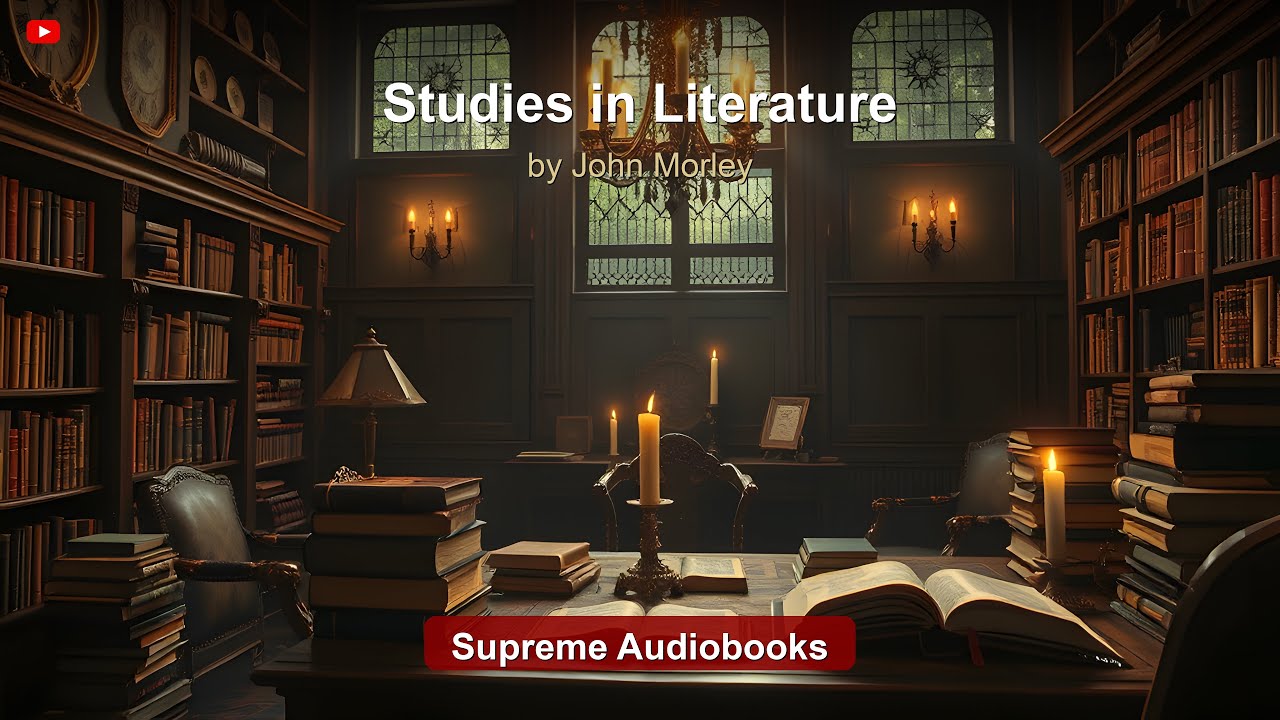
The 4K cinematic visuals accompanying this audiobook are generated by an AI image model from prompts derived from the source text. No copyrighted photos, paintings, or stock footage are used. AI generation is disclosed on every video on our YouTube channel as required by YouTube's altered/synthetic content policy.
English subtitles are transcribed from the LibriVox recording with OpenAI Whisper. Translations into the 11 other supported languages are produced by Meta's NLLB-200 neural translation model. No human translator's copyrighted translation is used.
Questions about sourcing or rights? See our DMCA & Sourcing policy or contact us.
Enjoyed this audiobook?
If you'd like to own a copy of Studies in Literature or hear a professionally produced edition, the links below help support free audiobook production at no extra cost to you.
As an Amazon Associate we earn from qualifying purchases. Audible / print links are affiliate.