Dracula (Part 2)
Bram Stoker's Dracula looms large in the landscape of supernatural horror, a foundational text whose influence ripples through every vampire story, film, and cultural reference that has followed. This second part of the audiobook captures the relentless pursuit of the titular Count, elevating the story from a creeping dread to an urgent, transnational hunt. Why should listeners care today, more than a century after its publication? Because the tale of Dracula is more than just a scary story; it is a profound examination of fear itself – fear of the unknown, fear of contamination, fear of a primal force disrupting the veneer of civilized society. It confronts us with the ultimate predator, a creature that feeds not only on blood but on the very essence of human vitality, challenging our understanding of life, death, and what lies beyond. Listening to this continued struggle is to witness the birth of a legend and to feel the cold breath of an ancient evil that still haunts our collective imagination. As Dracula (Part 2) opens, the initial terror has solidified into a grim understanding for a small band of courageous individuals. Young solicitor Jonathan Harker has returned from his harrowing imprisonment in Transylvania, a shadow of his former self, traumatized by his encounter with the monstrous Count. His fiancE, Mina Murray, a woman of remarkable intelligence and resilience, painstakingly compiles their fragmented accounts, realizing the horrifying truth: the dark entity from the Carpathian Mountains has made its way to England. The tranquil shores of Whitby and the bustling streets of London become the Count's new hunting ground. Dracula's arrival heralds a series of inexplicable illnesses and deaths, most tragically impacting Mina's dearest friend, Lucy Westenra, who succumbs to a mysterious wasting sickness, drained of her life force and transformed into something monstrous. It is at this point that the eccentric but brilliant Dr. Abraham Van Helsing, a Dutch professor of various sciences and arts, is called in. He quickly pieces together the supernatural puzzle, revealing the ancient, undead nature of their foe. United by personal loss and a shared sense of impending doom, Van Helsing rallies a diverse group: Lucy's three devoted suitors – the noble Lord Arthur Godalming, the dashing American Quincey Morris, and the dedicated asylum doctor Dr. John Seward – along with the now recovered Jonathan Harker and the astute Mina. Their mission is clear: to track down Count Dracula, destroy him, and prevent his evil from spreading across the modern world. The narrative shifts from bewildered horror to a focused, desperate chase. The group uses every available resource, from old lore and modern science to their combined intellect and courage, to understand Dracula's methods and predict his movements. They meticulously collect evidence – diaries, letters, newspaper clippings, ship logs – each piece a clue in their intensifying battle against an enemy who defies all conventional understanding. The stakes are immense, not just for their personal safety, but for the very soul of England, and perhaps, the world. The man behind this enduring tale of terror was Abraham "Bram" Stoker, born in Clontarf, Ireland, in 1847. Frail during his early childhood, he spent his initial years bedridden, listening to his mother's chilling tales of local legends and folklore, an experience that undoubtedly nourished his imagination. Despite his early infirmity, Stoker grew into a robust athlete at Trinity College Dublin, where he also excelled academically. His early professional life saw him as a civil servant in Dublin Castle, but his passion lay elsewhere, specifically in the theatre. He became an unpaid drama critic for the Dublin Evening Mail, a role that introduced him to the renowned actor-manager Henry Irving. This fateful meeting led to a pivotal change in Stoker's life. In 1878, Stoker moved to London to become Irving's business manager for the Lyceum Theatre, a position he held for nearly three decades. This role immersed him in the theatrical world and allowed him to travel extensively with Irving, observing human nature and various cultures across Europe and America. During this demanding period, Stoker somehow found time to write. While Dracula, published in 1897, remains his most famous work, he also authored other Gothic novels and short stories, including The Snake's Pass (1890) and The Jewel of Seven Stars (1903), many of which share a fascination with the supernatural, ancient curses, and psychological suspense. His unique blend of administrative acumen and creative imagination positioned him perfectly to craft a novel that was both meticulously detailed and wildly imaginative, defining the modern vampire for generations to come. At its heart, Dracula examines the eternal struggle between good and evil, painting its characters in stark moral contrasts. Dracula embodies an ancient, predatory darkness, while Van Helsing and his allies represent the forces of light, reason, and humanity. This is powerfully enacted in the repeated, desperate attempts to save Lucy Westenra from Dracula's influence, first through numerous blood transfusions, a cutting-edge medical procedure at the time, and ultimately through the ritualistic staking that frees her tormented soul. The novel also wrestles with Victorian anxieties about foreign invasion and the corrupting "Other." Dracula, with his aristocratic charm masking monstrous intent, represents a threat from outside the familiar, orderly world of England. His ability to shapeshift, to infiltrate, and to turn individuals into extensions of his will speaks to a deep-seated fear of contagion, both physical and moral, that permeated late nineteenth-century society. A significant theme woven throughout the narrative is the tension between modern science and ancient superstition. Van Helsing, a man of profound intellect, understands that conventional medicine alone is insufficient to combat Dracula. He expertly blends scientific knowledge, such as blood transfusions and psychiatry, with ancient folklore, garlic, crucifixes, and holy wafers. This synthesis is vital to the group's efforts, as they record their findings using phonographs and typewriters while simultaneously consulting old texts and sacred rituals. This approach suggests that some evils require a broader understanding, one that transcends purely rational thought. The narrative also explores the shifting roles of women in society, contrasting Lucy's initial innocence and vulnerability with Mina Harker's intellectual prowess and organizational skills. Mina's ability to logically compile the various accounts and devise strategies for the group makes her indispensable, presenting a woman who is both a victim of the vampire's curse and a formidable intellectual adversary against him. Dracula emerged from a specific cultural moment in the late Victorian era, a period characterized by a fascinating confluence of scientific advancement and societal unease. The fin-de-siecle, or "end of the century," brought with it anxieties about degeneration, moral decay, and the limits of imperial power. While science was making incredible strides – Darwin's theories had shaken religious dogma, psychology was beginning to probe the human mind, and medicine was introducing groundbreaking concepts like antisepsis and blood transfusions – there was also a pervasive fear that modern civilization was fragile and susceptible to primal, ancient forces. The novel also resonates with the era's burgeoning interest in the occult, mesmerism, and the supernatural, a countercurrent to the rationalist scientific tide. Stoker cleverly taps into these cultural currents, crafting a story that pits cutting-edge technology and logical deduction against an entity rooted in ancient myth and dark magic. The book's epistolary format – composed of journal entries, letters, telegrams, and newspaper clippings – reflects the journalistic and analytical spirit of the time, even as it recounts events that defy all rational explanation. This structure immerses readers in the characters' subjective experiences, making their terror and determination all the more immediate and believable within the context of their time. Listening to Dracula (Part 2) as an audiobook provides an exceptionally immersive way to experience Stoker's gothic masterpiece. The novel's original design, a mosaic of diaries, letters, and news reports, lends itself perfectly to audio narration. A skilled reader can give distinct voices to each character, from the anguished confessions of Jonathan Harker to the authoritative pronouncements of Van Helsing, and the chilling, insidious whisper of Dracula himself. The 8 hour and 19 minute run length allows for a sustained, focused listen, building the story's considerable tension over time rather than rushing through it. Listen for the subtle shifts in pacing as the group moves from desperate planning sessions to frantic chases across Europe. The narrator's ability to convey the emotional nuances in dialogue – the fear, the resolve, the despair – is crucial. The atmosphere of encroaching darkness, the chill of the supernatural, and the relentless pressure on the protagonists are amplified by the spoken word, drawing listeners deeper into the terrifying and thrilling hunt for the world's most infamous vampire.
Enjoyed Dracula (Part 2)? A few ways to support us
Audible & Amazon links are affiliate; we may earn a small commission at no extra cost.
About this production
Human narration by a volunteer reader from LibriVox.org, the public-domain audiobook project. LibriVox volunteers record literary works whose copyright has expired in the United States, releasing the resulting recordings into the public domain.
Dracula (Part 2), first published in 1897 by Bram Stoker. The underlying text is in the U.S. public domain. We do not republish any modern copyrighted edition, translation, or commentary.
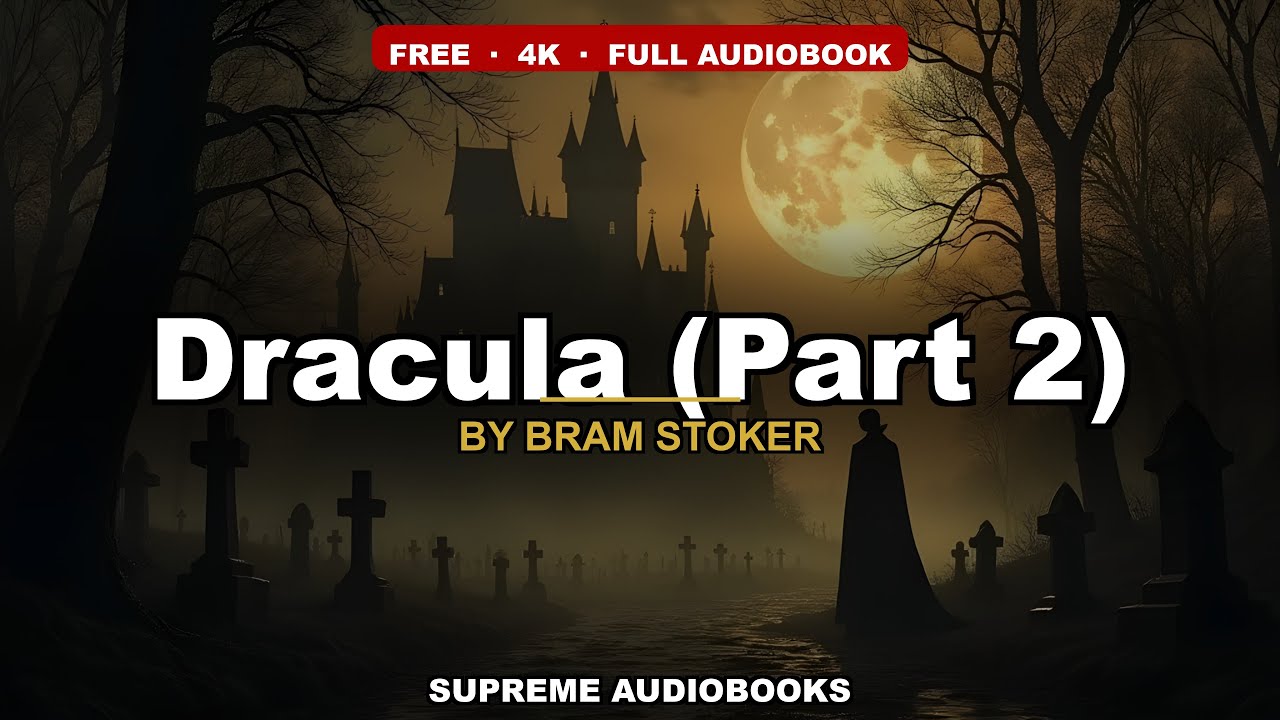
The 4K cinematic visuals accompanying this audiobook are generated by an AI image model from prompts derived from the source text. No copyrighted photos, paintings, or stock footage are used. AI generation is disclosed on every video on our YouTube channel as required by YouTube's altered/synthetic content policy.
English subtitles are transcribed from the LibriVox recording with OpenAI Whisper. Translations into the 11 other supported languages are produced by Meta's NLLB-200 neural translation model. No human translator's copyrighted translation is used.
Questions about sourcing or rights? See our DMCA & Sourcing policy or contact us.
Enjoyed this audiobook?
If you'd like to own a copy of Dracula (Part 2) or hear a professionally produced edition, the links below help support free audiobook production at no extra cost to you.
As an Amazon Associate we earn from qualifying purchases. Audible / print links are affiliate.