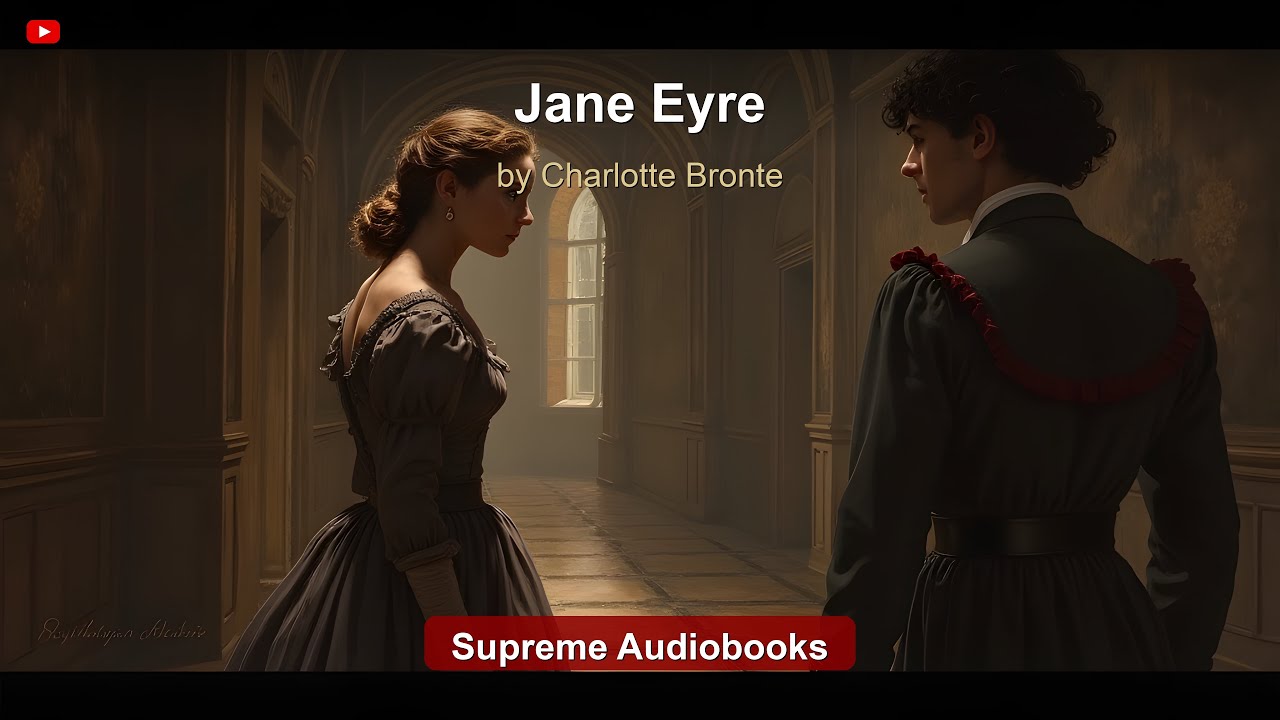
Jane Eyre
Few novels possess the enduring power and raw emotional honesty of Jane Eyre. More than a simple romance or a tale of hardship overcome, it stands as a fiery declaration of self-worth, a psychological drama that peels back the layers of societal expectation to reveal the passionate heart beneath. Charlotte Bronte's revolutionary novel, published in 1847, ignited controversy and captivated readers with its fiercely independent heroine and its unflinching portrayal of class, gender, and personal conviction. Today, it remains a vital conversation starter, its central questions about identity, love, and the price of true freedom resonating with profound relevance in any era. Listeners will find themselves drawn into a world both harrowing and exhilarating, where the struggle for a genuine life is fought with intellect, integrity, and an unyielding spirit. The story begins with the bleak, challenging childhood of Jane Eyre, an orphaned girl suffering under the cruel guardianship of her aunt, Mrs. Reed, at Gateshead Hall. Subjected to neglect and emotional abuse, young Jane finds herself an outcast, deemed difficult and undeserving of affection. Her rebellious spirit, however, refuses to be broken. Eventually banished to Lowood Institution, a charity school for girls, she endures further privation and the rigid discipline of its austere director, Mr. Brocklehurst. It is here that Jane learns resilience, forms a formative friendship with the gentle Helen Burns, and receives an education that will become her most valuable asset. Years later, having qualified as a governess, Jane seeks a new beginning at Thornfield Hall, a secluded country estate shrouded in an air of mystery. Here she encounters Edward Rochester, the estate's brooding and enigmatic master, whose sharp wit and unconventional nature immediately pique her interest. Despite his cynicism and her own reserved demeanor, a powerful intellectual and emotional connection begins to blossom between them. Yet, an unsettling undercurrent pervades Thornfield – strange laughter echoing through the halls, a series of disturbing and inexplicable events – suggesting a hidden secret threatening to shatter the fragile happiness Jane has finally found. As their bond deepens, the truth about Thornfield and its master edges closer to the surface, promising a revelation that will test Jane's resolve and force her to confront the deepest questions of morality and love. Charlotte Bronte, born in Yorkshire, England, in 1816, was one of six children to her clergyman father, Patrick Bronte. Growing up in the isolated parsonage at Haworth, she, alongside her younger sisters Emily and Anne, developed a vivid imagination and a profound love for literature. Their early lives were marked by a lack of social interaction, leading them to create elaborate fantasy worlds and stories. This intense, internal existence fueled their creative output. The tragic deaths of her two elder sisters at a young age, followed by the passing of Emily, Anne, and their brother Branwell later in her life, profoundly shaped Charlotte's perspective, imbuing her work with a keen understanding of suffering, loss, and the resilience of the human spirit. Bronte, like her sisters, initially published her novels under a masculine pseudonym, Currer Bell, a common practice for women writers in the Victorian era seeking to avoid gender-based prejudice and ensure their work was judged on its own merit. Beyond Jane Eyre, she penned other significant novels such as Shirley and Villette, each demonstrating her remarkable talent for psychological realism and complex character development. She challenged the sentimental conventions of her time, pushing the boundaries of what a heroine could be and how a woman's interior life could be honestly portrayed. Her work stands as a cornerstone of Victorian literature, influencing generations of writers with its emotional intensity and its courageous spirit. Jane Eyre distinguishes itself through its powerful engagement with several universal themes. Foremost among these is the assertion of individual autonomy and self-respect. Jane consistently refuses to compromise her moral principles or sacrifice her integrity for social standing or even love. When she discovers Mr. Rochester's devastating secret, for instance, her immediate decision to leave Thornfield, despite her profound love for him and the prospect of destitution, showcases her unwavering commitment to her own sense of right and wrong, and her refusal to be a kept woman. She asserts, "I am no bird; and no net ensnares me: I am a free human being with an independent will." Another central theme is the sharp critique of social class and gender inequality. Jane, as an orphan and a governess, occupies a precarious position in Victorian society, constantly reminded of her lower status by figures like Mrs. Reed and Blanche Ingram. Her struggles highlight the limited opportunities and oppressive expectations placed upon women, especially those without wealth or family connections. Bronte also masterfully weaves in Gothic elements, using the unsettling atmosphere of Thornfield Hall—the mysterious laughter, the eerie cries in the night, the sense of an unseen presence—to not only build suspense but also externalize Jane's internal anxieties and subconscious fears. These supernatural undertones reflect the protagonist's profound psychological torment and the hidden truths lurking beneath the surface of polite society. The novel burst onto the literary scene in 1847, a pivotal moment in the Victorian era. Great Britain was experiencing rapid industrialization, which led to significant social upheaval, the growth of a burgeoning middle class, and increasingly rigid class distinctions. This period also saw the intensification of debates surrounding "the Woman Question," a widespread public discussion about women's roles, rights, and proper place in society. Women writers were gaining prominence, yet still faced considerable societal pressure to conform to ideals of domesticity and submission. Against this backdrop, Jane Eyre emerged as a revolutionary text. Its portrayal of a passionate, intelligent, and fiercely independent female protagonist directly challenged prevailing Victorian notions of feminine propriety and subservience. Bronte gave voice to a woman who demanded equality, respect, and a love based on mutual esteem, not dependency. The novel's raw emotionality and its direct address of social injustices resonated deeply with a public grappling with questions of morality, individual liberty, and the societal constraints placed on personal fulfillment. It was a bold statement that signaled a shift in literary focus toward deeper psychological realism and a more critical examination of social structures. Listening to Jane Eyre as an audiobook offers a uniquely intimate experience with this seminal work. The narrative is often driven by Jane's internal monologue, her thoughts and feelings laid bare, making it an ideal candidate for a skilled narrator to bring her voice to life. A talented performer can convey the subtle nuances of Jane's passionate yet controlled nature, the biting sarcasm of Mr. Rochester, the cold cruelty of Mrs. Reed, and the gentle wisdom of Helen Burns. Over its duration of eight hours and forty-five minutes, listeners can become fully immersed in the shifting moods of the story—from the quiet desperation of Lowood to the thrilling suspense of Thornfield Hall, and through the dramatic emotional landscape of Jane's inner world. The spoken word allows the listener to savor Bronte's evocative language, absorb the atmospheric descriptions, and appreciate the intense, often breathless, pacing as Jane navigates a world determined to suppress her spirit. Hearing the dialogue exchanged, the whispered secrets, and the powerful declarations of love and defiance adds an unforgettable layer to an already profound story.
Enjoyed Jane Eyre? A few ways to support us
Audible & Amazon links are affiliate; we may earn a small commission at no extra cost.
About this production
Human narration by a volunteer reader from LibriVox.org, the public-domain audiobook project. LibriVox volunteers record literary works whose copyright has expired in the United States, releasing the resulting recordings into the public domain.
Jane Eyre, first published in 1847 by Charlotte Bronte. The underlying text is in the U.S. public domain. We do not republish any modern copyrighted edition, translation, or commentary.
The 4K cinematic visuals accompanying this audiobook are generated by an AI image model from prompts derived from the source text. No copyrighted photos, paintings, or stock footage are used. AI generation is disclosed on every video on our YouTube channel as required by YouTube's altered/synthetic content policy.
English subtitles are transcribed from the LibriVox recording with OpenAI Whisper. Translations into the 11 other supported languages are produced by Meta's NLLB-200 neural translation model. No human translator's copyrighted translation is used.
Questions about sourcing or rights? See our DMCA & Sourcing policy or contact us.
Enjoyed this audiobook?
If you'd like to own a copy of Jane Eyre or hear a professionally produced edition, the links below help support free audiobook production at no extra cost to you.
As an Amazon Associate we earn from qualifying purchases. Audible / print links are affiliate.