Frankenstein
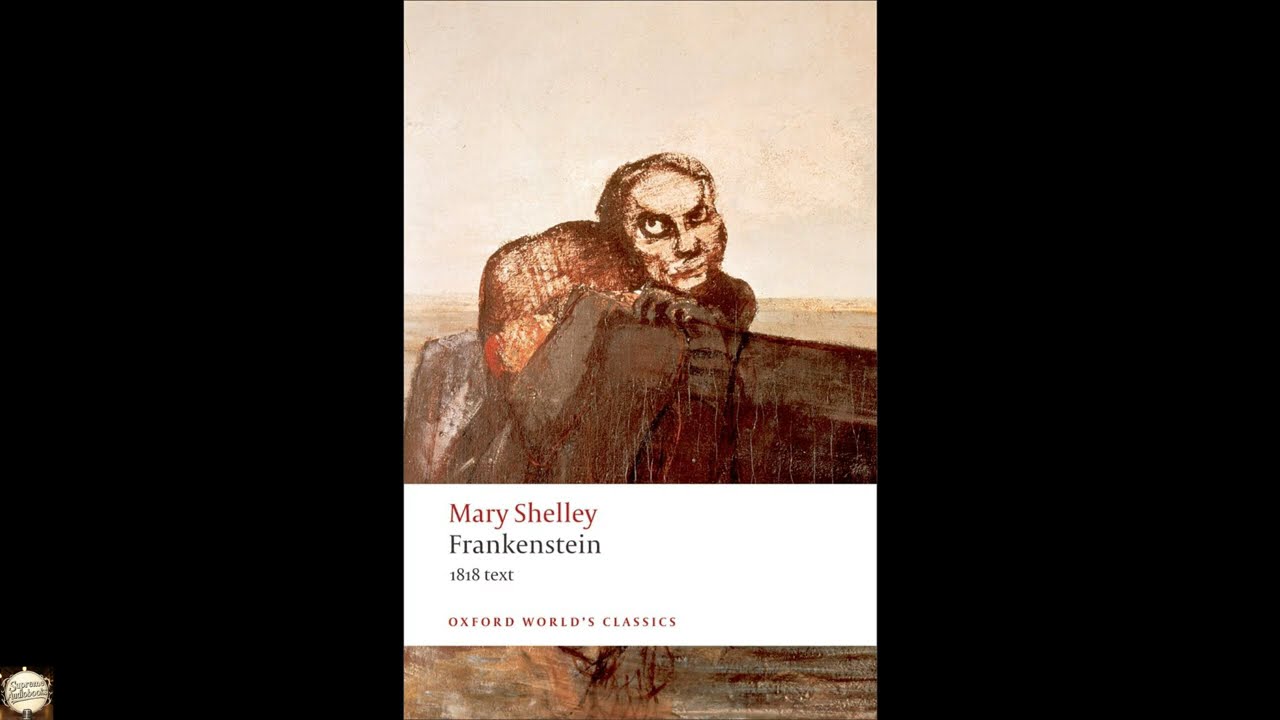
Few works of fiction have permeated culture as deeply or as enduringly as Mary Shelley's Frankenstein. More than just a cautionary tale or a chilling horror story, this enduring novel asks profound questions about creation, responsibility, and what it means to be human—questions that resonate with startling clarity even today. It challenges us to confront the ethical boundaries of scientific ambition, the devastating consequences of isolation, and the inherent prejudice faced by those perceived as "other." Listeners will discover not merely the genesis of the iconic monster, but a powerful, prescient meditation on progress, identity, and the very nature of humanity’s potential for both brilliance and destruction. The narrative unfolds through a series of letters from Captain Robert Walton, an ambitious explorer sailing through the perilous Arctic seas, who encounters a near-dead man adrift on an ice floe: Victor Frankenstein. Rescued and revived, Victor begins to recount his own tragic history, a tale of brilliance curdled into obsession. We follow Victor from his idyllic childhood in Geneva, through his student years in Ingolstadt, where a burgeoning fascination with the secrets of life and death consumes him. Driven by an insatiable desire to conquer mortality and create a new species, Victor dedicates himself to a secret, horrific experiment—piecing together a colossal being from various body parts, then bestowing upon it the spark of life. The moment of creation is not one of triumph, however, but of revulsion. Victor is horrified by the appearance of his creature, abandoning it in a fit of despair and fear. Left to navigate a world that immediately recoils from its grotesque form, the creature learns to speak, to read, and to understand the cruelties of humanity through observation and bitter experience. It develops a sophisticated intellect and a deeply sorrowful understanding of its own isolation. The creature eventually confronts its creator, demanding companionship—a female counterpart to alleviate its profound loneliness. Victor, plagued by guilt and fear, reluctantly agrees to this desperate plea, only to make a decision that unleashes a cycle of vengeful destruction and relentless pursuit across the wild landscapes of Europe, culminating in a final, chilling confrontation in the desolate Arctic. Mary Shelley herself led a life as unconventional and impactful as her most famous creation. Born Mary Wollstonecraft Godwin in 1797, she was the daughter of two of England’s most radical thinkers: the pioneering feminist writer Mary Wollstonecraft, who died shortly after her birth, and the influential political philosopher William Godwin. Raised in an intellectually stimulating but emotionally challenging environment, Mary found love and intellectual companionship with the poet Percy Bysshe Shelley, eloping with him at the tender age of sixteen. Their life together was marked by travel, bohemian living, intense intellectual exchange, and profound personal tragedy, including the loss of multiple children in infancy. It was during the "Year Without a Summer" in 1816, while staying with Percy Shelley, Lord Byron, and John Polidori at the Villa Diodati near Geneva, that a challenge to write ghost stories led to the germ of Frankenstein. Inspired by conversations about galvanism and the nature of life, Shelley conceived the idea of a student who creates a sentient being. Beyond Frankenstein, Shelley wrote several other novels, including the dystopian The Last Man, essays, and travelogues, and she dedicated much of her later life to promoting and editing her late husband's poetry. Her work firmly positions her as a pivotal figure in the Romantic literary movement, particularly its darker, Gothic currents, and as an undeniable foremother of science fiction. At its core, Frankenstein dissects the dangerous allure of unchecked scientific ambition. Victor Frankenstein’s relentless pursuit of the "secret of life" blinds him to the moral and ethical ramifications of his actions, illustrating how the thirst for knowledge, when unmoored from compassion, can lead to devastation. His fervent monologues about bestowing life, driven by a desire for glory, highlight the perils of a creator shirking responsibility. The subsequent abandonment of his creation stands as a stark indictment of a creator’s failure to nurture or even acknowledge the sentient being brought into existence. The Creature’s desperate pleas for understanding, its eloquent arguments for its right to companionship, directly challenge Victor’s initial act of repudiation, demanding that he reckon with the living consequence of his ambition. Beyond the ethics of creation, Shelley’s novel powerfully examines the profound human need for acceptance and the devastating impact of prejudice. The Creature, though initially benevolent and inquisitive, is repeatedly met with terror and hatred based solely on its appearance. Its experiences with humanity—from being driven away by villagers with stones to the horror it inspires in the kind De Lacey family—underscore the arbitrary cruelty of societal judgment. This constant rejection fuels its isolation and eventually turns its initial goodness into vengeful despair, arguing that it is society's prejudice, not its inherent nature, that makes it a monster. The story posits that alienation is a fundamental human terror, capable of corrupting even the purest intentions. When Frankenstein first appeared in 1818, the world was on the cusp of significant change. The early nineteenth century was an era defined by the aftermath of the French Revolution, the Napoleonic Wars, and the nascent stirrings of the Industrial Revolution. Scientific advancements, particularly in areas like galvanism and electricity, were captivating the public imagination, leading to both excitement and apprehension about humanity's increasing power over the natural world. Shelley’s novel emerged from this context, deeply influenced by the Romantic movement’s emphasis on intense emotion, the sublime in nature, and the individual's inner world, while simultaneously offering a powerful critique of the dangers of excessive human pride and reason. It questioned the Enlightenment's faith in unlimited progress, hinting at the darker consequences of knowledge divorced from wisdom, and drawing on anxieties about reanimation and the tampering with life itself. To experience Frankenstein as an audiobook is to immerse oneself in its chilling atmosphere and profound psychological depth. With a run length of nearly nine hours, the narration allows for a deliberate, measured unfolding of Victor's tormented confession and the Creature's poignant, articulate arguments. A skilled narrator can deftly navigate the novel's layered structure—Walton's framing letters, Victor's harrowing tale, and the Creature's own sorrowful account—bringing distinct voices to each perspective. Listen for the subtle shifts in pacing, reflecting Victor’s escalating madness or the Creature’s gradual descent into rage. The performance should allow the listener to fully absorb the novel’s gothic mood, its moments of intellectual argument, and its heart-wrenching emotional pleas, painting vivid soundscapes of desolate arctic wastes and bustling European cities, all within the confines of a mind consumed by creation and regret.
Enjoyed Frankenstein? A few ways to support us
Audible & Amazon links are affiliate; we may earn a small commission at no extra cost.
About this production
Human narration by a volunteer reader from LibriVox.org, the public-domain audiobook project. LibriVox volunteers record literary works whose copyright has expired in the United States, releasing the resulting recordings into the public domain.
Frankenstein, first published in 1818 by Mary Shelley. The underlying text is in the U.S. public domain. We do not republish any modern copyrighted edition, translation, or commentary.
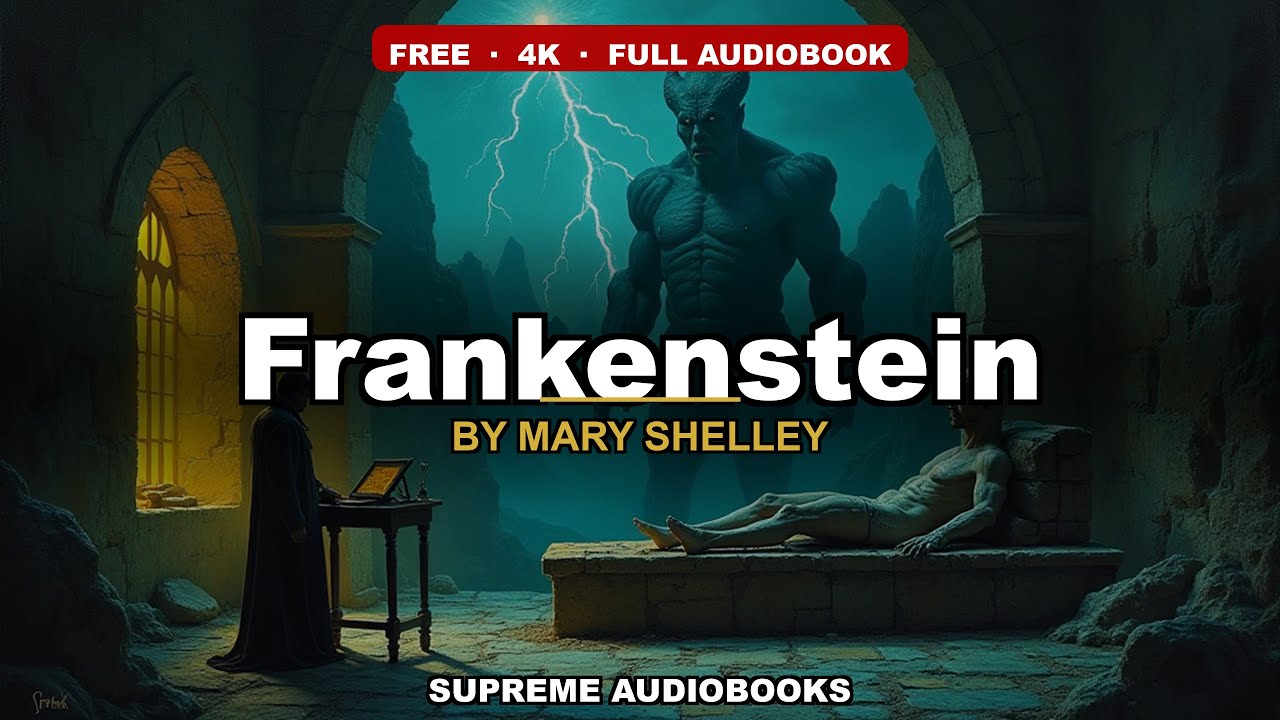
The 4K cinematic visuals accompanying this audiobook are generated by an AI image model from prompts derived from the source text. No copyrighted photos, paintings, or stock footage are used. AI generation is disclosed on every video on our YouTube channel as required by YouTube's altered/synthetic content policy.
English subtitles are transcribed from the LibriVox recording with OpenAI Whisper. Translations into the 11 other supported languages are produced by Meta's NLLB-200 neural translation model. No human translator's copyrighted translation is used.
Questions about sourcing or rights? See our DMCA & Sourcing policy or contact us.
Enjoyed this audiobook?
If you'd like to own a copy of Frankenstein or hear a professionally produced edition, the links below help support free audiobook production at no extra cost to you.
As an Amazon Associate we earn from qualifying purchases. Audible / print links are affiliate.