The Odyssey
The Odyssey has resonated across millennia, a foundational story of perseverance, ingenuity, and the profound ache for home. It is an epic poem that plunges listeners into a world where gods meddle, monsters lurk, and the ultimate test is not just strength, but wit. From the dust of Troy to the familiar shores of Ithaca, this ancient narrative lays bare the fundamental human desire to return to what is known and loved—a longing as potent today as it was three millennia ago. More than a tale of adventure, it meditates on identity, memory, and the struggle to reclaim one's place after immense loss and prolonged absence. It poses questions that still echo: What does it truly mean to be home? How do we endure the trials that keep us from it? What kind of person do we become in the process? Our story begins in the aftermath of the Trojan War. One brilliant tactician, Odysseus, King of Ithaca, finds himself cursed and adrift. The god Poseidon, angered by Odysseus's hubris, prevents his return, condemning him to years of relentless wandering across perilous seas. Back on his island kingdom of Ithaca, his loyal wife Penelope faces a different kind of siege. Hundreds of arrogant suitors, presuming Odysseus dead, have invaded his palace, squandering his wealth and pressuring Penelope to choose a new husband, threatening his household and his young son, Telemachus. Telemachus struggles with his father's absence and the suitors' disrespect, desperate for news but powerless to act. Odysseus's unwilling travels take him to the farthest reaches of the known world and beyond, into realms of myth and wonder. He confronts the deadly Sirens whose songs lure sailors to their doom, navigates the terrifying strait between the six-headed monster Scylla and the swirling whirlpool Charybdis, and escapes the seductive charms of the sorceress Circe, who transforms his men into swine. He must also contend with the powerful nymph Calypso, who holds him captive for seven long years on her secluded island, offering him immortality if he will abandon his desire for Ithaca. Through all these trials, Odysseus survives through a combination of immense intellect, his capacity for endurance, and occasional divine aid from the goddess Athena. He must constantly adapt, disguise himself, and outwit seemingly insurmountable threats, always with the distant glimmer of his homeland guiding his spirit. The authorship of The Odyssey is traditionally attributed to Homer, a legendary Greek poet believed to have lived around the 8th century BCE. While concrete biographical details are scarce, the prevailing image is of a blind bard from Ionia, a region in present-day Turkey, who composed or codified these monumental epic poems. Homer is considered the foundational figure of Western literature, shaping not only Greek identity but influencing countless poets, playwrights, and thinkers throughout history. His method was deeply rooted in the oral tradition, where stories were passed down and performed over generations, likely evolving before Homer himself gave them their enduring written form. His other recognized work is The Iliad, which recounts a critical episode from the Trojan War — the rage of Achilles. Together, these epics stand as the earliest and most influential texts of the Western canon, defining the heroic ideal, the relationship between mortals and gods, and the very structure of narrative itself. They served as educational texts, moral guides, and a repository of cultural memory for the ancient Greeks. The enduring mystery surrounding Homer’s true identity only adds to the allure of his name, casting him as the enigmatic voice behind stories that have resonated for three millennia. At its heart, The Odyssey examines the profound human longing for nostos, the ancient Greek concept of homecoming. Odysseus's relentless desire to return to Ithaca, his wife, and his son drives every decision and provides the emotional core of the narrative. We see this enacted not only in his physical struggles across the seas but also in the poignant scenes of Penelope's patient waiting, famously unraveling her shroud each night to delay remarriage—a testament to enduring loyalty and hope. Another central theme is metis, or cunning intelligence. Odysseus is not primarily a warrior; his strength lies in his sharp wit, his ability to deceive, to adapt, and to speak eloquently. He outsmarts the Cyclops Polyphemus by calling himself "Nobody," and later, uses disguises and strategic silence to navigate the treacherous political landscape of his own palace. The epic also places significant emphasis on xenia, the sacred guest-host relationship in ancient Greek society. Throughout his wanderings, Odysseus encounters both exemplary instances of xenia, such as the hospitality of the Phaeacians, and egregious violations, particularly by the suitors who brazenly consume his wealth and disrespect his household. This theme underscores the moral order of the world Homer depicts, where divine punishment often follows transgressions against fundamental social customs. Furthermore, the theme of identity—how it is lost, hidden, and finally reclaimed—is crucial. Odysseus spends years stripped of his name and status, forced to reinvent himself or hide his true nature, before proving who he is upon his return, a potent exploration of what defines a person beyond their reputation or appearance. The Odyssey emerged from a period of significant cultural transition in the Greek world, roughly around the 8th century BCE. This era marked the transition from the Greek Dark Ages into the Archaic period, seeing the gradual rise of city-states, the adoption of the Phoenician alphabet, and the beginnings of a more unified Hellenic identity. While the stories themselves likely existed in various forms for centuries, Homer's compilation and shaping of them coincided with the development of writing, allowing these oral traditions to be permanently recorded. The poem therefore serves as a vital window into the values, beliefs, and societal structures of early Greek civilization, reflecting the importance of honor, family lineage, divine favor, and the deep-seated fear of social chaos when these elements are disrupted. It offered a common narrative framework for emerging communities, solidifying shared myths and providing moral guidance for generations. Listening to The Odyssey as an audiobook offers a unique and authentic experience, echoing its original oral tradition. The narrator’s voice becomes the modern bard, bringing the ancient world to life with every inflection and cadence. Over its 10 hours and 46 minutes, a skillful reading highlights the rhythmic qualities inherent in Homeric verse, allowing the grandeur of the epic to unfold at a natural, immersive pace. Listen for how the narrator differentiates Odysseus’s cunning dialogue, Penelope’s dignified pleas, the booming pronouncements of the gods, and the distinct voices of various creatures and mortals. The atmosphere built through spoken performance—the crash of waves, the solemnity of a prayer, the tension of a confrontation—enhances the dramatic power, transforming a foundational text into a living performance. This presentation allows the listener to appreciate the poem's sonic qualities, its evocative imagery, and the deep emotional resonance of one of humanity's oldest and most beloved tales.
Enjoyed The Odyssey? A few ways to support us
Audible & Amazon links are affiliate; we may earn a small commission at no extra cost.
About this production
Human narration by a volunteer reader from LibriVox.org, the public-domain audiobook project. LibriVox volunteers record literary works whose copyright has expired in the United States, releasing the resulting recordings into the public domain.
The Odyssey, first published in -800 by Homer. The underlying text is in the U.S. public domain. We do not republish any modern copyrighted edition, translation, or commentary.
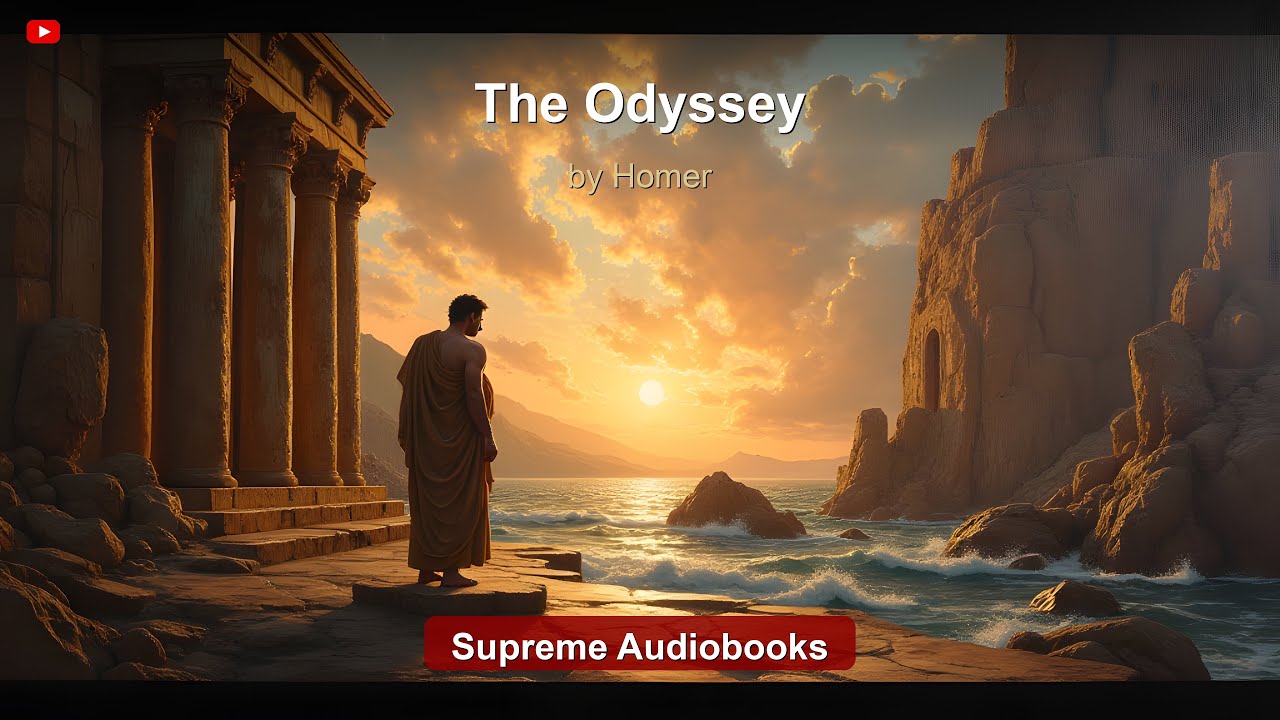
The 4K cinematic visuals accompanying this audiobook are generated by an AI image model from prompts derived from the source text. No copyrighted photos, paintings, or stock footage are used. AI generation is disclosed on every video on our YouTube channel as required by YouTube's altered/synthetic content policy.
English subtitles are transcribed from the LibriVox recording with OpenAI Whisper. Translations into the 11 other supported languages are produced by Meta's NLLB-200 neural translation model. No human translator's copyrighted translation is used.
Questions about sourcing or rights? See our DMCA & Sourcing policy or contact us.
Enjoyed this audiobook?
If you'd like to own a copy of The Odyssey or hear a professionally produced edition, the links below help support free audiobook production at no extra cost to you.
As an Amazon Associate we earn from qualifying purchases. Audible / print links are affiliate.