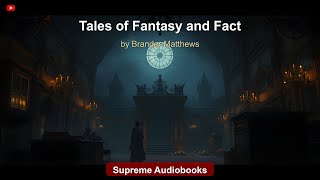
Tales of Fantasy and Fact
Brander Matthews' Tales of Fantasy and Fact, first published in 1896, invites us into a unique literary parlor where the veil between the tangible and the imagined is delightfully thin. This collection from a prominent American man of letters offers more than just a series of entertaining short stories; it serves as a fascinating portal to the fin-de-siècle mind, a period wrestling with rapid scientific advancement alongside a persistent human appetite for the marvelous and the unknown. In an era often characterized by its turn towards realism and naturalism, Matthews — a critic and scholar intimately familiar with the mechanics of storytelling — consciously plays with the very definitions of reality and invention. His stories pose enduring questions about perception, belief, and the narratives we construct to make sense of our world, making this collection a compelling listen for anyone interested in the roots of modern speculative fiction or a thoughtful examination of the human condition at the cusp of a new century. The collection, true to its deceptively simple title, presents a range of narratives that oscillate between the grounded and the ethereal. Listeners will find themselves immersed in scenarios that often begin with an impeccably detailed, seemingly plausible setup, only for a subtle shift, a curious coincidence, or an outright supernatural occurrence to unravel the predictable. One might encounter characters navigating familiar urban landscapes—the bustling streets of New York or the academic halls of a university—who suddenly find their reality infiltrated by improbable events or figures from legend. The central conflict across these varied narratives frequently revolves around the characters' (and by extension, the listener's) struggle to reconcile what they know to be true with what they are experiencing. Is the strange phenomenon a trick of the mind, a carefully crafted hoax, or a genuine breach in the fabric of the ordinary world? The arc of these stories often moves from initial skepticism or rational explanation towards a gradual, sometimes unsettling, acceptance of the inexplicable, or at least a profound questioning of established beliefs. Matthews skillfully crafts situations where the line between verifiable information and pure conjecture becomes delightfully blurred, forcing a reconsideration of how we categorize our experiences. The narratives in Tales of Fantasy and Fact are populated by a diverse cast, from astute scholars and curious observers to ordinary individuals caught in extraordinary circumstances. Matthews’ characters, while firmly rooted in their late Victorian milieu, frequently confront situations that challenge their understanding of physics, history, or psychology. Whether it's a scholar stumbling upon a bizarre historical anomaly that defies logical explanation, or an urbanite witnessing a spectral event within the confines of a modern city, their reactions provide the narrative tension. The stories generally progress not through grand, sprawling adventures, but through a series of focused incidents designed to disorient and provoke thought, often leaving the listener with a sense of wonder, slight unease, or intellectual satisfaction at the cleverness of the conceit. Brander Matthews (1852–1929) was far more than just a writer of short stories; he was a pivotal figure in American literary and academic life. Born in New Orleans and educated at Columbia College and Columbia Law School, Matthews eventually abandoned a legal career to pursue his passion for literature and theatre. He became one of the first professors of dramatic literature at an American university, holding a chair at Columbia from 1892 until his retirement in 1924. His influence extended beyond the classroom; he was instrumental in founding the Modern Language Association and served as its president. Matthews was a tireless advocate for American literature and American English, even championing simplified spelling reforms. Known for his witty prose and critical acumen, Matthews cultivated friendships with many literary giants of his time, including Mark Twain, Theodore Roosevelt, and Rudyard Kipling. His scholarly output was immense, covering topics from Molière and Shakespeare to the history of the short story and the development of American drama. Though primarily remembered today as a critic and educator, Matthews did author a respectable body of fiction, including novels like The Last Meeting (1885) and His Father's Son (1895), as well as numerous short stories collected in volumes such as Vignettes of Manhattan (1894) and, of course, Tales of Fantasy and Fact. His early fiction, particularly, showcases his interest in blending the everyday with the unexpected, often with a distinctly urban American flavor. He occupied a unique place in the literary canon, bridging the world of creative writing with rigorous academic analysis, shaping how American literature was taught and perceived for generations. A primary theme running through Tales of Fantasy and Fact is the malleability of truth and perception. Matthews consistently challenges the listener to question what constitutes reality, deftly demonstrating how easily our understanding can be swayed by perspective, belief, or simply a well-told story. For instance, in one type of narrative, a meticulously researched historical account might gradually introduce an element of the utterly implausible—a lost civilization defying all known records, or an anachronistic artifact appearing in an ancient context. The effect is to show that even the most "factual" presentations are filtered through interpretation and that the boundaries of what we accept as possible are often arbitrary. This blending of the verifiable with the imagined serves as a potent reminder that our consensus reality is perhaps more fragile than we admit. Another key theme is the power of narrative itself. Matthews, as a literary critic, understood deeply how stories shape human experience. In his fiction, he often highlights how a compelling tale, regardless of its basis in fact, can exert a profound influence on individuals and even societies. A story might feature characters who become obsessed with a fantastical legend, allowing it to dictate their actions or alter their perception of events around them. This suggests that the human need for explanation and meaning often leads us to embrace narratives, even those that strain credulity. Furthermore, the collection touches upon the interplay between modernity and mystery. Writing at a time of immense scientific and technological progress, Matthews often places his fantastical elements squarely within contemporary settings. A sophisticated scientific instrument might uncover something utterly unscientific, or a seemingly rational, urban environment might reveal a hidden layer of ancient magic or unexplained phenomena. This contrast underscores a persistent human fascination with the unknown, even as the world around them becomes increasingly rationalized. The late nineteenth century, the period in which Tales of Fantasy and Fact appeared, was a fascinating crossroads for Western civilization, marked by both profound optimism and lurking anxieties. It was the heart of the Gilded Age in America, characterized by rapid industrialization, urbanization, and the rise of great fortunes, yet also by social inequality and labor unrest. Intellectually, Charles Darwin's theories had challenged traditional religious beliefs, and scientific advancements promised a new era of understanding and control over the natural world. Simultaneously, there was a widespread public interest in spiritualism, the occult, and paranormal phenomena, a testament to humanity’s ongoing quest for meaning beyond the material. Literarily, this was a period of transition. Realism and naturalism were ascendant, championed by figures like William Dean Howells and Henry James, who sought to depict life as it truly was. Yet, the appetite for romance, adventure, and the supernatural persisted, fueling the popularity of writers like Robert Louis Stevenson, Rudyard Kipling, and the burgeoning genre of science fiction exemplified by H.G. Wells. Brander Matthews’ collection perfectly captures this cultural tension. By explicitly titling his work Tales of Fantasy and Fact, he acknowledged the dual impulses of his era—the desire for verifiable truth and the enduring lure of imaginative possibility—and crafted stories that deliberately blurred the lines between them, offering a literary commentary on his time's intellectual landscape. Listening to Tales of Fantasy and Fact as an audiobook provides an intimate and particularly rewarding experience. The collection's relatively concise run length of three hours and twenty-eight minutes makes it an ideal choice for a sustained listening session or for enjoying individual stories during commutes or quiet evenings. The voice artist, through skillful pacing and nuanced characterizations, can bring to life the specific cadence of late 19th-century prose, making the more formal language accessible and engaging. Listen for the subtle shifts in tone as a narrative moves from a straightforward, almost journalistic accounting to something more speculative or overtly fantastical. The narrator’s ability to differentiate between various voices, from the earnest academic to the bewildered citizen, enhances the collection's atmosphere, drawing the listener further into Matthews' clever literary experiments. The audible experience allows one to truly appreciate the precise language and the deliberate construction of these tales, letting the blend of the familiar and the uncanny truly sink in.
Enjoyed Tales of Fantasy and Fact? A few ways to support us
Audible & Amazon links are affiliate; we may earn a small commission at no extra cost.
About this production
Human narration by a volunteer reader from LibriVox.org, the public-domain audiobook project. LibriVox volunteers record literary works whose copyright has expired in the United States, releasing the resulting recordings into the public domain.
Tales of Fantasy and Fact, first published in 1896 by Brander Matthews. The underlying text is in the U.S. public domain. We do not republish any modern copyrighted edition, translation, or commentary.
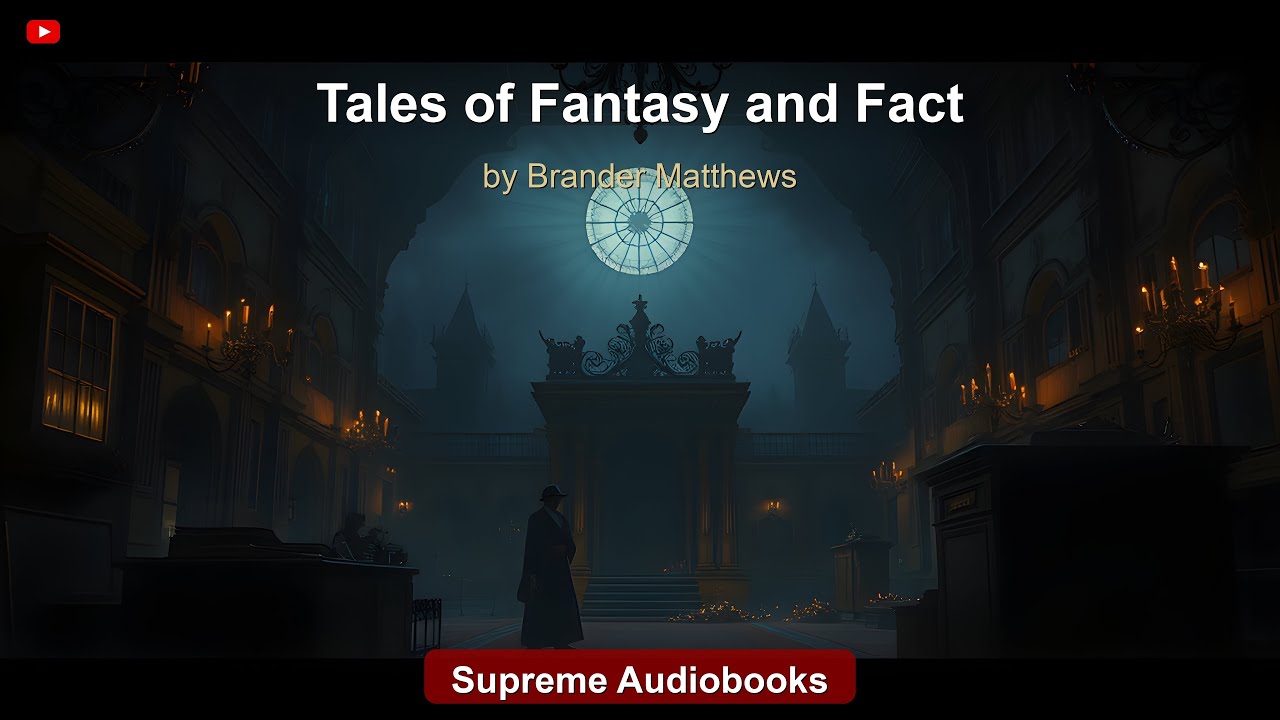
The 4K cinematic visuals accompanying this audiobook are generated by an AI image model from prompts derived from the source text. No copyrighted photos, paintings, or stock footage are used. AI generation is disclosed on every video on our YouTube channel as required by YouTube's altered/synthetic content policy.
English subtitles are transcribed from the LibriVox recording with OpenAI Whisper. Translations into the 11 other supported languages are produced by Meta's NLLB-200 neural translation model. No human translator's copyrighted translation is used.
Questions about sourcing or rights? See our DMCA & Sourcing policy or contact us.
Enjoyed this audiobook?
If you'd like to own a copy of Tales of Fantasy and Fact or hear a professionally produced edition, the links below help support free audiobook production at no extra cost to you.
As an Amazon Associate we earn from qualifying purchases. Audible / print links are affiliate.