Studies in Moro History, Law and Religion
Step into the early years of the twentieth century with Najeeb M. Saleeby's foundational text, "Studies in Moro History, Law and Religion," a work that transports listeners to the complex, often misunderstood world of the Moro people in the southern Philippines. Published in 1905, at a pivotal moment in American colonial history, this book offers an unparalleled window into the unique cultural, legal, and spiritual landscape of an Islamic society confronting the encroachment of Western power. More than a mere historical record, Saleeby's meticulous scholarship presents a rare, empathetic lens on a civilization defined by its resilience and distinct traditions, making it essential listening for anyone seeking to understand the enduring legacies of colonialism, the intricacies of Southeast Asian history, or the persistent quest for self-determination against a backdrop of global change. Saleeby’s comprehensive volume lays out its subject with the methodical precision of a scholar aiming to systematize knowledge for both academic and administrative understanding. The study establishes its setting in the vast island of Mindanao and the sprawling Sulu Archipelago, the ancestral domains of various Muslim ethnolinguistic groups collectively known as the Moros. From the Maguindanao and Maranao of Mindanao to the Tausug of Sulu, the book introduces the listener to the diverse peoples who, by 1905, had already forged distinct sultanates, legal codes, and religious practices over centuries. The author’s central aim is to present a coherent picture of their history, beginning with their migrations, tracing the establishment of their early political structures, and illuminating the continuous interplay between indigenous customs and Islamic influences. The arc of Saleeby's investigation moves from a broad historical sweep to a detailed examination of specific societal pillars. He dedicates significant attention to the complex legal systems that governed Moro life, meticulously detailing the workings of adat, or customary law, and its integration with Islamic sharia principles. Listeners will gain insight into the nuanced application of these laws in matters ranging from property disputes to social offenses, revealing a sophisticated jurisprudence shaped by centuries of self-governance. Following this, Saleeby shifts his focus to the deeply embedded religious beliefs and practices, explaining how Islam arrived, flourished, and became an inseparable part of Moro identity, guiding daily rituals, ethical frameworks, and communal cohesion. His work thus acts as a systematic unveiling of a distinct civilization, presenting its internal logic and enduring strengths. Najeeb M. Saleeby, born in Lebanon (then part of Ottoman Syria) in 1870, brought a unique background to his pioneering ethnographic work. After pursuing a medical education in the United States, he found himself drawn into the complexities of colonial administration in the newly acquired American Philippines. Stationed in Mindanao and Sulu during the early years of American rule—a period marked by significant military and political challenges—Saleeby served not only as a physician but also as a keen observer and administrator. His fluency in Arabic and his non-Western heritage granted him a level of access and rapport with the Moro leaders and communities that was rare among his American contemporaries, allowing him to gather insights often unavailable to others. Saleeby’s role extended beyond medicine; he became a crucial figure in the American effort to understand and govern the diverse populations of the Moro Province. He was among a small group of scholars and administrators whose dedication laid the groundwork for future studies of the region. His earlier work, "The History of Sulu," published in 1908, further cemented his reputation as a foundational voice in the field. Saleeby's scholarship is generally recognized as a significant contribution to the burgeoning field of ethnography in the early 20th century, particularly within the context of American colonial expansion. He passed away in 1935, leaving behind a legacy of works that remain indispensable for historical and anthropological studies of the southern Philippines. "Studies in Moro History, Law and Religion" brings several crucial themes into sharp focus. Foremost among them is the theme of cultural identity and resilience. Saleeby demonstrates how, despite centuries of attempts by Spanish colonizers to subjugate them and convert them to Christianity, the Moro people steadfastly maintained their distinct identity, rooted in their Islamic faith and indigenous customs. He provides concrete examples through his documentation of the sultanates' political structures and their ability to resist external pressures, detailing how the intertwined systems of governance, law, and religion created a durable social fabric. The book also highlights the profound interplay of history, law, and religion, showing these are not separate spheres but rather integral components that shaped every facet of Moro society. Saleeby's descriptions of the datus (chiefs) and sultans, whose authority derived from both traditional lineage and religious legitimacy, exemplify this seamless integration. Another significant theme present in the work, though perhaps subtly, is colonialism and its gaze. While Saleeby’s perspective is often sympathetic, the book itself is a product of its time—an attempt by a colonial power to understand and categorize a colonized people. His systematic approach to documenting Moro laws, for instance, reflects a broader administrative impulse to codify and control. Yet, within this framework, Saleeby’s deep dives into the nuances of specific legal texts, such as the Luwaran code, offer invaluable primary data that transcends mere administrative utility. The book also stands as an early testament to ethnographic methodology, showcasing an emergent academic approach to understanding non-Western societies through direct observation, textual analysis, and interviews with community leaders, setting a precedent for future anthropological studies in the region. The publication of "Studies in Moro History, Law and Religion" in 1905 unfolded during a transformative period for the Philippines. Following the Spanish-American War and the subsequent Philippine-American War, the United States had asserted control over the archipelago, inheriting the complex issue of administering the predominantly Muslim areas of Mindanao and Sulu. This was a time of "pacification campaigns" and the establishment of the Moro Province in 1903, under American military governance. Saleeby’s book thus emerged from an urgent political necessity: for the American administrators to understand the people they were now tasked with governing, especially a group that had fiercely resisted Spanish and now American authority. Culturally and intellectually, the early 20th century saw a burgeoning interest in anthropology and ethnology. Colonial powers worldwide were investing in detailed studies of their subjects, often driven by a mix of scientific curiosity and practical administrative needs. Saleeby’s work fit squarely into this intellectual current, contributing to a body of literature that sought to document non-Western societies. It was a time when scholars grappled with questions of cultural evolution, societal organization, and the impact of modernization, making Saleeby's detailed account of a resilient Islamic culture particularly relevant to the prevailing academic discourse. Listening to "Studies in Moro History, Law and Religion" as an audiobook offers a unique opportunity to immerse oneself in this scholarly yet accessible work. A clear, measured narration allows the listener to absorb the intricate details of Moro history, legal frameworks, and religious practices without the visual distraction of a dense academic text. With a running length of nine hours, it is ideal for extended listening sessions, whether over several days during a commute, while tending to household tasks, or during dedicated periods of study. The voice of the narrator, steady and authoritative, brings clarity to complex historical chronologies and legal interpretations, fostering an atmosphere akin to an engaging university lecture. This format ensures that the rich historical and cultural information is conveyed with precision, making it easier to follow Saleeby's meticulous arguments and appreciate the depth of his ethnographic research.
Enjoyed Studies in Moro History, Law and Religion? A few ways to support us
Audible & Amazon links are affiliate; we may earn a small commission at no extra cost.
About this production
Human narration by a volunteer reader from LibriVox.org, the public-domain audiobook project. LibriVox volunteers record literary works whose copyright has expired in the United States, releasing the resulting recordings into the public domain.
Studies in Moro History, Law and Religion, first published in 1905 by Najeeb M. Saleeby. The underlying text is in the U.S. public domain. We do not republish any modern copyrighted edition, translation, or commentary.
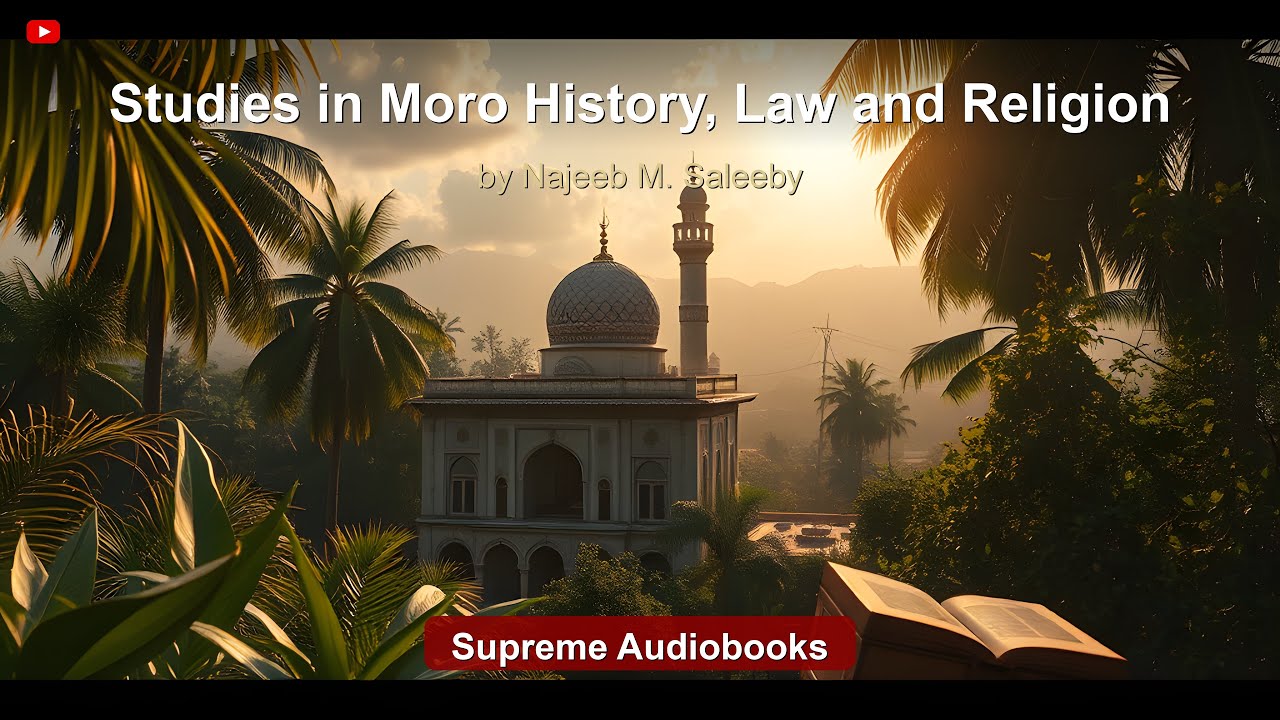
The 4K cinematic visuals accompanying this audiobook are generated by an AI image model from prompts derived from the source text. No copyrighted photos, paintings, or stock footage are used. AI generation is disclosed on every video on our YouTube channel as required by YouTube's altered/synthetic content policy.
English subtitles are transcribed from the LibriVox recording with OpenAI Whisper. Translations into the 11 other supported languages are produced by Meta's NLLB-200 neural translation model. No human translator's copyrighted translation is used.
Questions about sourcing or rights? See our DMCA & Sourcing policy or contact us.
Enjoyed this audiobook?
If you'd like to own a copy of Studies in Moro History, Law and Religion or hear a professionally produced edition, the links below help support free audiobook production at no extra cost to you.
As an Amazon Associate we earn from qualifying purchases. Audible / print links are affiliate.