Pauline
Pauline, a lesser-known yet intensely atmospheric novella from Alexandre Dumas, offers a distinctive flavor compared to his epic swashbuckling sagas. Published in 1838, this lean, psychologically charged tale pulls listeners into a world of gothic romance, hidden pasts, and obsessive passions that resonate with surprising force even today. Far from the sprawling adventures of d'Artagnan or Edmond Dantès, Pauline presents a tightly wound domestic drama, tinged with suspense and an almost feverish emotional intensity. It’s a story about the dangerous allure of secrets and the devastating consequences of love tainted by jealousy and delusion, showcasing Dumas’s impressive range beyond his most famous historical novels. Anyone who appreciates a story where human psychology takes center stage amidst a brooding, mysterious atmosphere will find this brief but potent narrative a gripping experience. The story opens in Parisian society, where the young, somewhat naive Horace de Beuzeval finds himself drawn to the enigmatic Pauline de Nerval. Her pale complexion, haunting eyes, and an air of profound melancholy distinguish her. Horace, prone to intense attachments, quickly becomes infatuated, determined to uncover the mystery surrounding Pauline, who carries an unspoken burden. Despite warnings and a palpable sense of unease, Horace pursues Pauline with desperate ardor, winning her hand. Their life together begins in a secluded country chateau, a setting that amplifies Pauline's reserved nature and Horace's growing suspicions. The idyllic façade cracks as Horace, driven by possessive love and consuming curiosity, pushes Pauline to reveal her past. She recounts a tale of a profound, devastating attachment to a man named Alfred, filled with dramatic twists and desperate measures, leaving Horace both horrified and obsessed. Pauline's confession unfolds like a fever dream, painting events so extreme they border on unbelievable, blurring lines between truth, madness, manipulation. The isolated chateau becomes a stage for escalating psychological tension, where the ghosts of her past hover, threatening to consume their present. Alexandre Dumas père, born in 1802 in Villers-Cotterêts, France, lived a life as dramatic and prolific as many of his characters. The son of a French general, early years were marked by financial hardship, but his literary ambition was undeniable. Moving to Paris, he initially made a name for himself as a successful playwright, achieving acclaim with historical dramas like Henri III and His Court (1829), helping usher in the Romantic movement in French theater. Dumas was a literary powerhouse, producing an astounding volume of work. While Pauline stands as an earlier, more intimate work from 1838, it was in the 1840s that he cemented his legendary status with The Three Musketeers (1844) and The Count of Monte Cristo (1844–1846). These monumental historical novels, with their grand scope and thrilling narratives, defined a generation in popular fiction. Despite immense success, Dumas faced financial difficulties. His singular genius for storytelling, his creation of archetypal characters, and his ability to evoke historical periods is undiminished. He died in 1870, leaving a legacy that continues to entertain and inspire. At its core, Pauline grapples with the destructive nature of obsessive love and the allure of mystery. Horace's fixation is not merely romantic; it's a consuming need to possess Pauline's entire being, including her concealed past. This manifests as a relentless, almost cruel insistence that she reveal her secrets, ultimately undermining their marital trust. The story illustrates how love, mixed with possessiveness and jealousy, can transform into a suffocating force. Pauline's agonizing reluctance to speak, contrasted with Horace's unwavering pressure, creates a stark dynamic, highlighting the tension between personal autonomy and intimacy's demands. Another prominent theme is the haunting power of the past. Pauline’s narrative suggests that certain events are inescapable, leaving indelible marks that dictate future actions. The dark, atmospheric chateau, isolated, becomes a psychological space where echoes of her past literally and figuratively hold sway. Dumas also subtly questions the nature of truth and delusion; as Pauline relays her incredible story, the listener, much like Horace, is left to wonder about its reliability and the fine line between trauma and potential fabrication. The novella also touches on 19th-century societal constraints on women, particularly regarding reputation and past indiscretions, which often dictated social standing and marriage prospects. Pauline emerged during the French July Monarchy (1830-1848), a period of relative political stability under King Louis-Philippe that simmered with social and intellectual ferment. Culturally, it was the heyday of Romanticism, a movement championing emotion, individualism, the supernatural, and a return to nature through dramatic and passionate narratives. Dumas, a pivotal figure in French Romanticism, particularly in theater, imbued Pauline with many of these literary hallmarks. The novella’s focus on intense personal emotions, the isolation of its setting, its mysterious and gothic elements, and its tormented heroine grappling with a secret past, all align with Romantic sensibilities. While Dumas later became synonymous with grand historical adventure, Pauline demonstrates his command of a more intimate, psychologically driven Romantic narrative, echoing contemporaries like Balzac or Hugo. The era also saw a rising interest in sensationalism and the darker aspects of human psychology, which Pauline taps into with its story of love, jealousy, and potential madness, reflecting a broader cultural fascination with extreme corners of human experience. To experience Pauline as an audiobook is to be pulled directly into its claustrophobic, emotionally charged atmosphere. The run length of 3 hours and 33 minutes makes it an ideal listen for a single intense sitting or across a few focused periods, allowing immersion in the psychological drama. A skilled narrator brings Horace’s desperate curiosity and Pauline’s haunting confession to life, giving distinct vocal textures to their complex inner states and escalating conflict. The careful pacing amplifies the story’s suspense, making moments of revelation more impactful. Listen for subtle shifts in tone that hint at underlying truths and deceptions, and the way dialogue builds tension, drawing you deeper into the chateau’s isolated world. The spoken word format intensifies the feeling of being privy to a personal, almost whispered secret, transforming a concise novella into a powerful auditory encounter.
Enjoyed Pauline? A few ways to support us
Audible & Amazon links are affiliate; we may earn a small commission at no extra cost.
About this production
Human narration by a volunteer reader from LibriVox.org, the public-domain audiobook project. LibriVox volunteers record literary works whose copyright has expired in the United States, releasing the resulting recordings into the public domain.
Pauline, first published in 1838 by Alexandre Dumas. The underlying text is in the U.S. public domain. We do not republish any modern copyrighted edition, translation, or commentary.
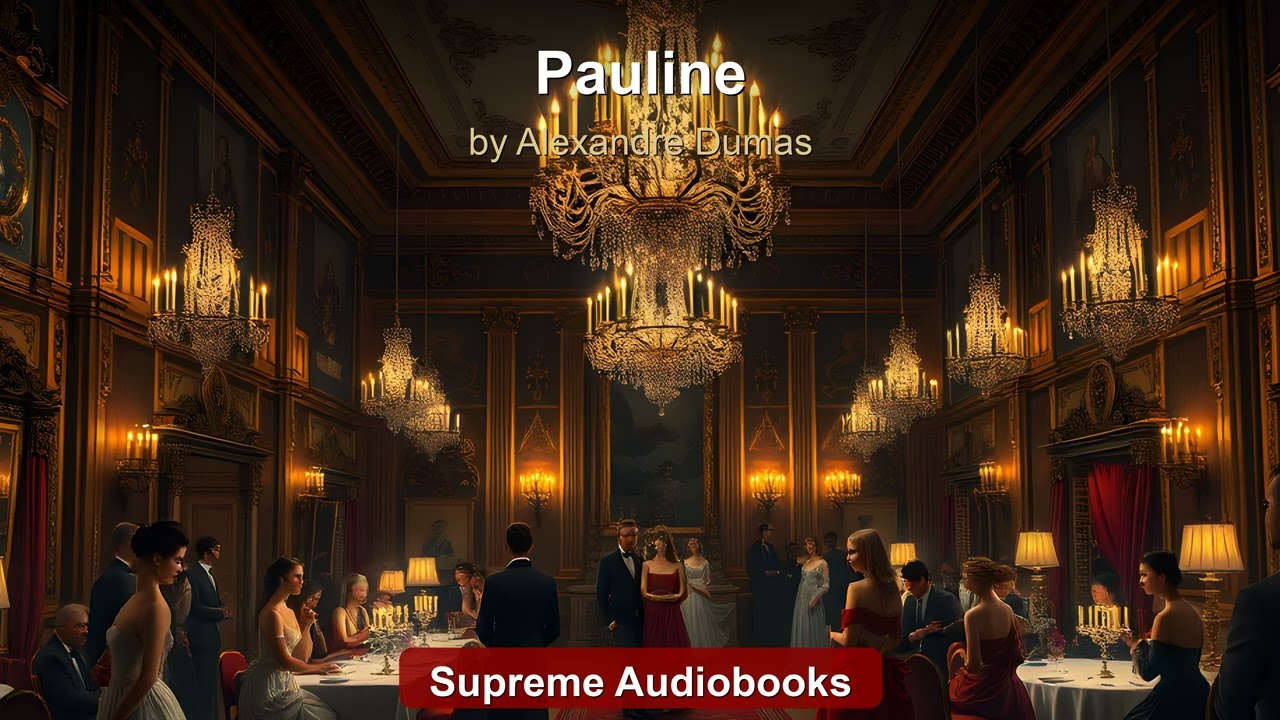
The 4K cinematic visuals accompanying this audiobook are generated by an AI image model from prompts derived from the source text. No copyrighted photos, paintings, or stock footage are used. AI generation is disclosed on every video on our YouTube channel as required by YouTube's altered/synthetic content policy.
English subtitles are transcribed from the LibriVox recording with OpenAI Whisper. Translations into the 11 other supported languages are produced by Meta's NLLB-200 neural translation model. No human translator's copyrighted translation is used.
Questions about sourcing or rights? See our DMCA & Sourcing policy or contact us.
Enjoyed this audiobook?
If you'd like to own a copy of Pauline or hear a professionally produced edition, the links below help support free audiobook production at no extra cost to you.
As an Amazon Associate we earn from qualifying purchases. Audible / print links are affiliate.