Mrs Dalloway
Step into a single day in London, a bustling city alive with echoes of the past and the anxieties of a new century, as seen through the eyes and minds of its inhabitants. Virginia Woolf's Mrs Dalloway is not merely a story; it is an immersion into consciousness itself, a luminous examination of how our interior lives, our memories, regrets, and fleeting perceptions, shape every moment of our existence. It asks us to consider the quiet dramas unfolding within us even as we perform our social roles, making it a profoundly relevant meditation on identity and the human condition that resonates with listeners today, perhaps more so than ever. This is a novel about the profound significance of ordinary moments and the powerful undercurrents beneath a perfectly polished surface. The narrative unfolds on a fine June day in 1923, leading up to a party hosted by Clarissa Dalloway, a high-society woman in her early fifties. As she prepares for her evening event, running errands, selecting flowers, and navigating the city streets, her thoughts drift back through time, bringing to life her youth at Bourton, her passionate friendships, and the choices she made regarding love and marriage. Clarissa is a woman of grace and social adeptness, wife to a Conservative Member of Parliament, Richard Dalloway, and mother to a teenage daughter, Elizabeth. Yet beneath her composed exterior lies a current of reflection on the compromises of life, the nature of happiness, and the profound, often unexpressed, connections between people. Her day is punctuated by chance encounters that stir old feelings, particularly with Peter Walsh, a former suitor recently returned from India, who still holds a complicated place in her heart. Parallel to Clarissa's preparations, another life, far more fractured, plays out across the city. Septimus Warren Smith, a young veteran of the Great War, is struggling profoundly with what was then known as "shell shock" and what we now understand as severe post-traumatic stress disorder. Haunted by visions of his fallen comrade and increasingly detached from the world around him, Septimus endures the well-meaning but ultimately uncomprehending efforts of his Italian wife, Rezia, and the dismissive, even harmful, advice of the medical establishment. His suffering represents the unseen cost of war and society's failure to address deep-seated mental anguish, contrasting starkly with Clarissa's outwardly ordered existence, though their paths will subtly intersect by day's end. The story builds towards Clarissa's evening party, which becomes a nexus where different lives and perspectives briefly converge, revealing the isolation and connection that define human experience. The author, Virginia Woolf, born Adeline Virginia Stephen in London in 1882, was a central figure in the modernist literary movement of the early 20th century. Her childhood was steeped in intellectualism; her father, Sir Leslie Stephen, was a renowned critic and scholar, and her home was a hub for prominent Victorian thinkers. However, her early life was also marked by personal tragedy, including the deaths of her mother and half-sister, and periods of profound mental distress that would recur throughout her life. These experiences profoundly informed her understanding of human psychology and her empathetic portrayal of complex emotional states within her fiction. Woolf, along with her husband Leonard Woolf, founded the Hogarth Press in 1917, which published many important works, including their own and those of T.S. Eliot and Katherine Mansfield. She became a leading voice of the Bloomsbury Group, an informal association of intellectuals, artists, and writers who challenged Victorian social and artistic conventions. Her other acclaimed novels include To the Lighthouse, which reflects on family dynamics and the passage of time, and Orlando, a playful and groundbreaking examination of gender and history. Woolf tragically died by suicide in 1941, leaving behind a legacy that fundamentally altered the landscape of English literature by focusing on interiority and the subjective experience of reality. Among its many dimensions, Mrs Dalloway stands as a powerful statement on the nature of time and memory. Woolf employs the chiming of Big Ben throughout the day, not merely as a marker of the hour, but as a symbolic reminder of time's relentless march, juxtaposed against the fluid, non-linear way human memory operates. Clarissa's mind, for instance, frequently revisits Bourton, her childhood home, where she shared intense moments with Peter Walsh and Sally Seton. These recollections are not sequential; they intrude on her present tasks, shaping her perceptions and revealing how the past constantly informs the present, creating a continuous, layered sense of self. Another pivotal theme is the poignant examination of mental illness and social indifference. Septimus Warren Smith's descent into psychological torment, exacerbated by his experiences in the trenches, is depicted with profound empathy. The novel critiques the medical profession of the time, exemplified by the condescending Dr. Holmes and the socially ambitious Sir William Bradshaw, who fail to understand or treat Septimus's condition beyond recommending rest cures and conformity. His suffering underscores the tragic isolation of individuals whose inner worlds are too painful or unconventional for society to accept or address effectively, highlighting a critical issue that remains relevant today. When Mrs Dalloway was published in 1925, the world was still reeling from the aftermath of the First World War. The immense trauma of the conflict had shattered many pre-war certainties, leading to a sense of disillusionment and a questioning of traditional values. Shell shock was a new and poorly understood phenomenon, and society was grappling with how to reintegrate returning soldiers, many of whom carried invisible wounds. Culturally, there was a shift away from Victorian rigidity, with new freedoms and anxieties emerging for women and the working class, though old class structures largely remained intact. The literary world, in particular, was in a period of intense experimentation, reacting against conventional realism and seeking new ways to represent consciousness and subjective experience. Woolf’s novel was thus a reflection of its tumultuous era, capturing the psychological and social currents that defined post-war Britain. Listening to Mrs Dalloway as an audiobook offers a unique pathway into its deep currents of thought and emotion. The narrator's voice becomes essential in distinguishing between the numerous characters and their internal monologues, guiding listeners through the often-shifting perspectives without the visual cues of chapter breaks or paragraph changes. The run length of six hours and twenty-six minutes is perfectly suited for focused immersion, allowing the listener to absorb the intricate beauty of Woolf's prose in sustained sittings. Pay particular attention to the pacing—how the narrative speeds up during moments of external action and slows to a reflective cadence during inner thoughts. A skilled voice performance can render the subtle distinctions in Clarissa's societal elegance, Septimus's fractured despair, and Peter's critical nostalgia, bringing out the underlying atmosphere of London and the rich texture of human experience that makes this novel such a powerful and enduring work.
Enjoyed Mrs Dalloway? A few ways to support us
Audible & Amazon links are affiliate; we may earn a small commission at no extra cost.
About this production
Human narration by a volunteer reader from LibriVox.org, the public-domain audiobook project. LibriVox volunteers record literary works whose copyright has expired in the United States, releasing the resulting recordings into the public domain.
Mrs Dalloway, first published in 1925 by Virginia Woolf. The underlying text is in the U.S. public domain. We do not republish any modern copyrighted edition, translation, or commentary.
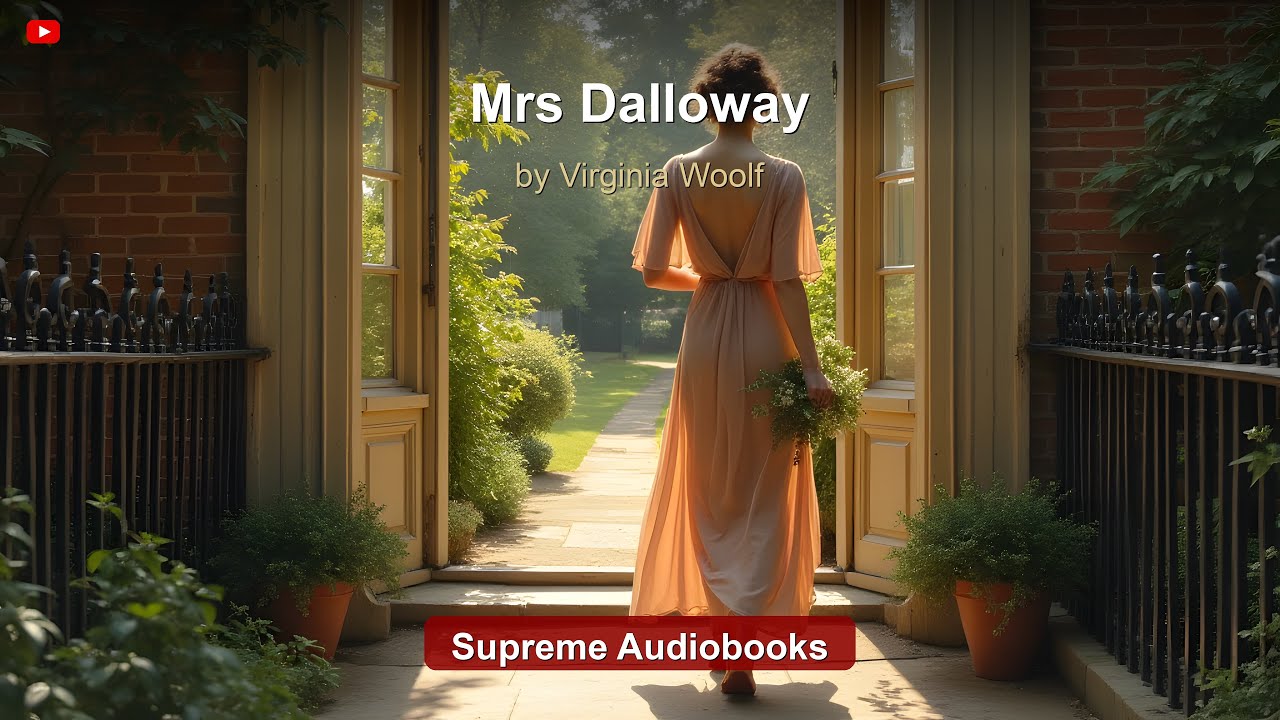
The 4K cinematic visuals accompanying this audiobook are generated by an AI image model from prompts derived from the source text. No copyrighted photos, paintings, or stock footage are used. AI generation is disclosed on every video on our YouTube channel as required by YouTube's altered/synthetic content policy.
English subtitles are transcribed from the LibriVox recording with OpenAI Whisper. Translations into the 11 other supported languages are produced by Meta's NLLB-200 neural translation model. No human translator's copyrighted translation is used.
Questions about sourcing or rights? See our DMCA & Sourcing policy or contact us.
Enjoyed this audiobook?
If you'd like to own a copy of Mrs Dalloway or hear a professionally produced edition, the links below help support free audiobook production at no extra cost to you.
As an Amazon Associate we earn from qualifying purchases. Audible / print links are affiliate.