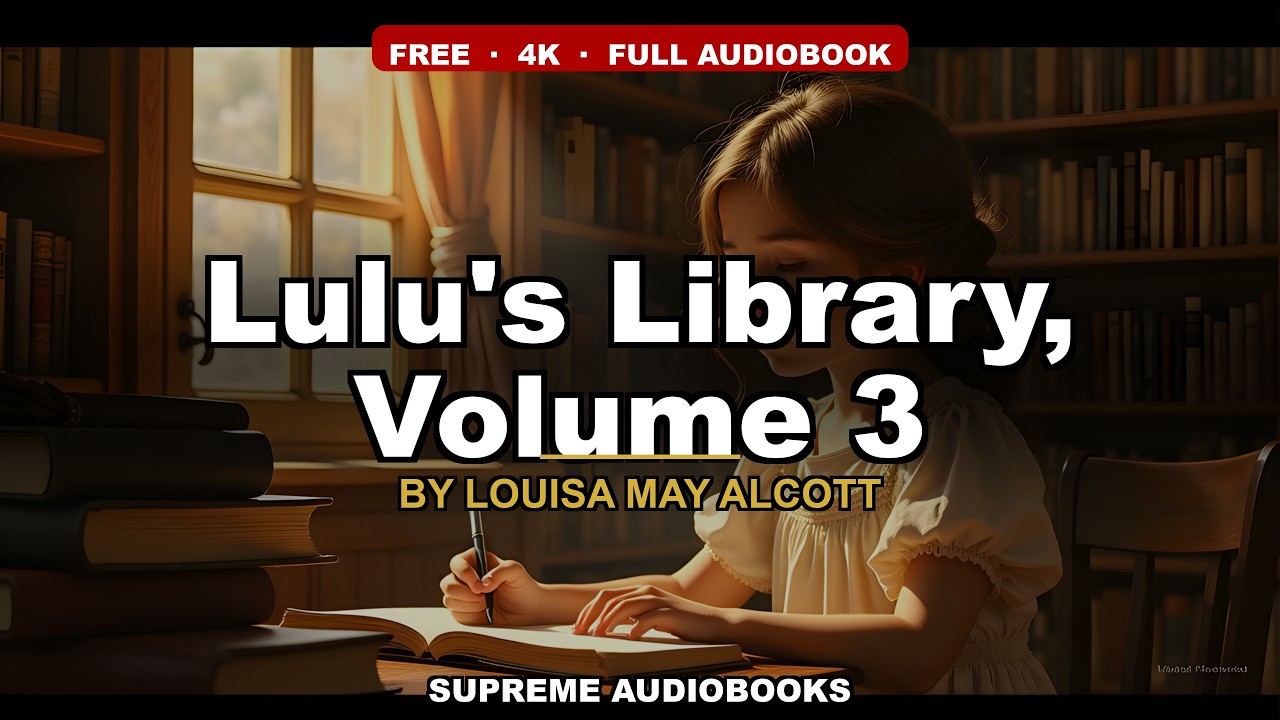
Lulu's Library, Volume 3
Step into a world where everyday adventures hold profound lessons and the wisdom of childhood shines brightly. Louisa May Alcott's Lulu's Library, Volume 3 invites listeners to rediscover the timeless charm of a master storyteller often celebrated for Little Women, but equally brilliant in her short-form narratives. This collection of gentle tales, originally compiled for a younger audience, offers a heartwarming glimpse into the domestic sphere and the simple, yet significant, moral dilemmas that shape young lives. Far from being merely historical curiosities, these stories resonate today by celebrating virtues like kindness, honesty, and perseverance – qualities that remain essential for navigating the complexities of any age. It is a quiet return to fundamental truths, delivered with Alcott's inimitable warmth and insight. Lulu's Library, Volume 3 is an assortment of individual stories, each a window into the lives of ordinary children confronting small challenges and learning valuable lessons. The settings are typically rural or suburban New England homes and communities, places where family, friends, and nature provide the backdrop for growth. One might encounter Ned, a boy learning responsibility through the care of an animal, or perhaps a group of children solving a minor predicament with ingenuity and cooperation. The characters are relatable: earnest boys, imaginative girls, and kindly adults who offer guidance without overt preaching. They face common childhood conflicts—misunderstandings between siblings, the temptation to stray from the truth, or the struggle to overcome shyness. The arc of each story usually involves a relatable situation that tests a young character's budding moral compass. Whether it is a dilemma about sharing a treasured toy, dealing with a pet, or showing compassion to a newcomer, the narrative gently unfolds to reveal the consequences of choices. There are no grand battles or sweeping historical events; instead, the drama unfolds in the quiet corners of home and school. The stories demonstrate how small acts of kindness can ripple outwards, how honesty builds trust, and how patience often leads to unexpected rewards. Alcott’s narratives consistently guide her young protagonists towards self-improvement, fostering empathy and understanding through their experiences. Louisa May Alcott (1832-1888) stands as one of America's most beloved authors, her legacy rooted deeply in her personal experiences and her keen observation of human nature. Born in Germantown, Pennsylvania, she spent much of her formative years in Concord, Massachusetts, a crucible of American transcendentalism. Her father, Bronson Alcott, was an educational reformer and philosopher, counting Ralph Waldo Emerson and Henry David Thoreau among his close friends. This environment exposed Louisa to a world of intellectual ferment and progressive thought, yet her family often grappled with financial hardship. Alcott began working at a young age, taking on various jobs as a teacher, governess, and seamstress, all while nurturing her secret passion for writing. Initially, Alcott penned sensational thrillers and gothic romances under pseudonyms to help support her family. Her experiences as a nurse during the Civil War, chronicled in Hospital Sketches (1863), brought her first significant recognition. However, it was the publication of Little Women in 1868 that catapulted her to international fame. This semi-autobiographical novel, depicting the domestic lives and aspirations of the four March sisters, resonated deeply with readers and became an instant classic. She followed its success with equally popular sequels like Good Wives (1869), Little Men (1871), and Jo's Boys (1886), firmly establishing her place in children's literature. Lulu's Library, Volume 3, published posthumously in 1889, represents some of her later contributions to her extensive body of work for younger readers, collected and shared after her passing, a testament to her enduring appeal and prolific output. Alcott’s work, including the stories within Lulu's Library, Volume 3, is profoundly shaped by several recurring themes. One prominent theme is moral education and character development. Alcott believed deeply in the power of stories to teach virtue, and she skillfully integrated lessons on honesty, generosity, and responsibility into her narratives without sounding preachy. For instance, in a story about a child who carelessly breaks a possession, the consequence is not merely punishment but an internal struggle and the growth of empathy for others' belongings, teaching ownership and reparations through lived experience. Another significant theme is the sanctity and influence of home and family. Even in her shortest pieces, the domestic sphere is presented as the primary classroom for life's most essential lessons. Sibling relationships, parental guidance, and the everyday rituals of home life provide the foundation for character building. A story depicting a child learning to share a prized toy with a younger sibling illustrates how family dynamics provide constant opportunities for practicing compassion and selflessness. These themes solidify Alcott's standing as a foundational voice in children's literature, one who understood the inner lives of children and how to gently steer them towards noble conduct through the power of relatable narratives. When these stories first appeared in various forms during the late nineteenth century, America was undergoing immense transformation. The post-Civil War era saw rapid industrialization, urbanization, and a renewed focus on national identity. Culturally, there was a growing awareness of childhood as a distinct developmental stage, deserving of its own literature. Authors like Alcott, Mark Twain, and Frances Hodgson Burnett were at the forefront of this emerging genre, moving away from purely didactic tracts towards stories that entertained while subtly instructing. Lulu’s Library reflects this era’s prevailing sentiment that good literature for children should cultivate moral character and reinforce societal values. Alcott herself, a prominent figure in the literary landscape, was uniquely positioned to create such works. Her own upbringing, marked by intellectual exposure and practical hardship, instilled in her a pragmatic idealism. She understood the needs of her young readers and the desires of their parents for wholesome, yet engaging, tales. The collection’s posthumous publication in 1889 speaks to the lasting demand for her writing and the publishers' recognition of her brand, continuing to bring her stories to generations of children, long after the passing of their beloved author. Listening to Lulu's Library, Volume 3 as an audiobook offers a particularly charming way to experience these classic tales. With a run time of 4 hours and 50 minutes, it is perfectly suited for family listening during car trips, quiet afternoons, or as a calming series of bedtime stories. The episodic nature of a story collection means listeners can easily dip in and out, enjoying a complete narrative in a single sitting without the pressure of a longer novel. A skilled narrator brings Alcott’s clear, direct prose to life, allowing the gentle humor and profound sincerity of her child characters to truly shine. The pacing is likely to be measured and reflective, creating an atmosphere that invites contemplation and comfort, while the distinct voices given to different characters enhance the charm of Alcott’s natural, insightful dialogue. This auditory presentation allows the listener to fully immerse themselves in the warmth and simple wisdom that makes Alcott’s work endure.
Enjoyed Lulu's Library, Volume 3? A few ways to support us
Audible & Amazon links are affiliate; we may earn a small commission at no extra cost.
About this production
Human narration by a volunteer reader from LibriVox.org, the public-domain audiobook project. LibriVox volunteers record literary works whose copyright has expired in the United States, releasing the resulting recordings into the public domain.
Lulu's Library, Volume 3, first published in 2025 by Louisa May Alcott. The underlying text is in the U.S. public domain. We do not republish any modern copyrighted edition, translation, or commentary.
The 4K cinematic visuals accompanying this audiobook are generated by an AI image model from prompts derived from the source text. No copyrighted photos, paintings, or stock footage are used. AI generation is disclosed on every video on our YouTube channel as required by YouTube's altered/synthetic content policy.
English subtitles are transcribed from the LibriVox recording with OpenAI Whisper. Translations into the 11 other supported languages are produced by Meta's NLLB-200 neural translation model. No human translator's copyrighted translation is used.
Questions about sourcing or rights? See our DMCA & Sourcing policy or contact us.
Enjoyed this audiobook?
If you'd like to own a copy of Lulu's Library, Volume 3 or hear a professionally produced edition, the links below help support free audiobook production at no extra cost to you.
As an Amazon Associate we earn from qualifying purchases. Audible / print links are affiliate.