Dracula (Part 1)
Few stories have so profoundly shaped our collective imagination of horror as Bram Stoker’s Dracula. Published in 1897, this chilling tale introduced the world to an archetype that would forever haunt our nightmares and popular culture: the vampire. More than a century later, the Count’s dark allure and the sheer terror he inspires remain undiminished, a testament to Stoker’s masterful ability to tap into primal fears of the unknown, the foreign, and the monstrous within. To listen to Dracula today is not merely to revisit a classic; it is to confront the genesis of modern horror, to understand where countless subsequent tales of the undead drew their very lifeblood, and to feel a dread that still resonates in our contemporary world. Our story begins through the journal entries of Jonathan Harker, a young English solicitor. He travels to the remote, foreboding land of Transylvania, nestled in the Carpathian Mountains, on what he believes is a straightforward business trip. His assignment is to finalize the purchase of an estate in London for a mysterious client, Count Dracula. The journey itself is fraught with a growing sense of unease. Locals whisper warnings and offer religious talismans, their faces etched with fear at the mention of his destination. Harker, a man of reason and the modern world, initially dismisses these superstitions, but as he draws closer to Castle Dracula, an ancient, crumbling fortress perched high above a terrifying precipice, his composure begins to fray. Upon his arrival, Harker meets the Count, a gaunt, aristocratic figure with piercing red eyes and unnaturally sharp teeth. Dracula is strangely hospitable, yet his habits are peculiar: he is never seen eating, moves with disconcerting silence, and possesses immense strength. As the days turn into weeks, Harker’s initial unease transforms into outright terror. He discovers he is a prisoner in the castle, witnessing inexplicable phenomena and confronting the Count’s predatory nature firsthand. He experiences terrifying encounters with three seductive, vampiric women, barely escaping with his life. Harker realizes the full horror of his situation—the Count is not just an eccentric recluse but something ancient and malevolent, preparing to leave his isolated domain and bring his dark influence to England. Meanwhile, back in England, Jonathan’s fiancée, Mina Murray, and her friend Lucy Westenra, are enjoying a seemingly idyllic summer. Their lives are soon to be irrevocably intertwined with the very evil Jonathan Harker struggles against in the desolate reaches of Transylvania. The creative force behind this enduring horror was Abraham “Bram” Stoker, an Irish novelist and short story writer, born in Clontarf, Dublin, in 1847. Stoker's early life was marked by a mysterious illness that left him bedridden until the age of seven. During this time, his mother entertained him with local folklore and terrifying tales, a formative experience that surely fueled his later imagination. He later attended Trinity College Dublin, where he excelled academically and athletically, before pursuing a career as a civil servant at Dublin Castle. However, his passion lay in the arts; he wrote theatre reviews for a local newspaper, becoming known for his insightful critiques. Stoker's life took a significant turn when he met the acclaimed actor Henry Irving. So impressed was Irving with Stoker’s managerial skills and dedication that he hired him as his business manager for the Lyceum Theatre in London. This position immersed Stoker in the bustling world of late Victorian theatre for over two decades. It afforded him extensive travel, introduced him to a diverse array of personalities—from royalty to common stagehands—and exposed him to the grand scale of dramatic presentation, all of which undeniably contributed to the theatricality and scope of his literary creations. Though he wrote several other novels and collections of short stories, including The Jewel of Seven Stars and The Lair of the White Worm, it was Dracula, published towards the end of his career in 1897, that secured his place as a titan of Gothic literature and the undisputed architect of the modern vampire myth. Stoker passed away in 1912, leaving behind a single, towering legacy that continues to cast its long shadow across fiction. Dracula resonates with a host of potent themes that made it so compelling in its time and continue to grip audiences today. A central concern is the chilling fear of the unknown and the foreign. Harker's journey into Eastern Europe takes him from the ordered rationality of Victorian England into a world of ancient superstition, where the familiar rules of civilization unravel. Dracula himself embodies this foreign threat, an alien presence with a primal, predatory nature, seeking to corrupt and conquer the supposedly pure, rational West. This is vividly shown in Harker’s increasing isolation and terror within the castle, where every shadow seems to conceal menace, and the Count’s bizarre customs clash violently with Harker's English sensibilities, pushing him to the brink of sanity. Another prominent theme is the clash between ancient superstition and scientific rationality. Characters like Dr. Seward, a man of science, initially struggle to comprehend the inexplicable events unfolding around them, trying to diagnose supernatural affliction with clinical precision. It takes the wisdom of the more open-minded Professor Van Helsing—a character who readily acknowledges the existence of forces beyond scientific understanding—to introduce the ancient folklore and traditional methods necessary to confront the Count. The novel also powerfully foregrounds Victorian anxieties surrounding sexuality and societal decay. The seductive power of the vampire women and Lucy’s dramatic transformation into a creature of dark desire speak to latent fears about female sexuality and the transgression of moral boundaries prevalent in the late 19th century. The Count’s gradual draining of life represents a broader anxiety about the corruption and decline of society itself, a terrifying inverse of the era's ideals of purity and progress. The late 19th century, the era in which Dracula was conceived and published, was a period marked by profound social, political, and cultural shifts. Victorian England, at the zenith of its imperial power, simultaneously grappled with underlying anxieties about its own stability and future. Rapid scientific advancements, from Darwin's theories of evolution to nascent understandings of medicine and psychology, challenged traditional religious beliefs and notions of humanity. This created a fertile ground for a renewed interest in spiritualism, the occult, and the supernatural, as people sought meaning beyond the purely rational. Culturally, there was a growing fascination with the exotic and the "other," often tinged with fear and xenophobia, as the vast British Empire brought disparate cultures into uneasy contact. Dracula taps directly into these societal nerves, presenting a horrifying inversion of imperial expansion—a foreign, ancient evil invading the very heart of London, threatening its women and its foundational values. The novel’s emergence in this specific historical moment reflects a society grappling with the perceived decline of traditional morality, the unsettling implications of scientific progress, and a deep-seated fear of what lay beyond its well-ordered, civilized borders. Listening to Dracula (Part 1) as an audiobook offers a uniquely immersive and powerful experience. The novel’s original epistolary format—comprising diary entries, letters, and newspaper clippings—lends itself perfectly to audio narration. The listener is pulled directly into the distinct perspectives and escalating dread of each character. You can hear Jonathan Harker's initial scholarly tone gradually give way to stark terror, the hopeful innocence of Mina Murray, and the scientific observations of Dr. Seward, all rendered with nuance and dramatic pacing. The run length of eight hours and six minutes is ideal for settling in and allowing the atmospheric tension to slowly build. A skilled narrator can amplify the chilling silence of Castle Dracula, the frantic whispers of the villagers, and the ominous sounds of London at night, making the gothic horror feel palpably present. This is not merely a reading; it is a direct vocal transmission of Stoker's chilling vision, allowing the spoken word to truly embody the story's pervasive sense of unease and mounting terror.
Enjoyed Dracula (Part 1)? A few ways to support us
Audible & Amazon links are affiliate; we may earn a small commission at no extra cost.
About this production
Human narration by a volunteer reader from LibriVox.org, the public-domain audiobook project. LibriVox volunteers record literary works whose copyright has expired in the United States, releasing the resulting recordings into the public domain.
Dracula (Part 1), first published in 1897 by Bram Stoker. The underlying text is in the U.S. public domain. We do not republish any modern copyrighted edition, translation, or commentary.
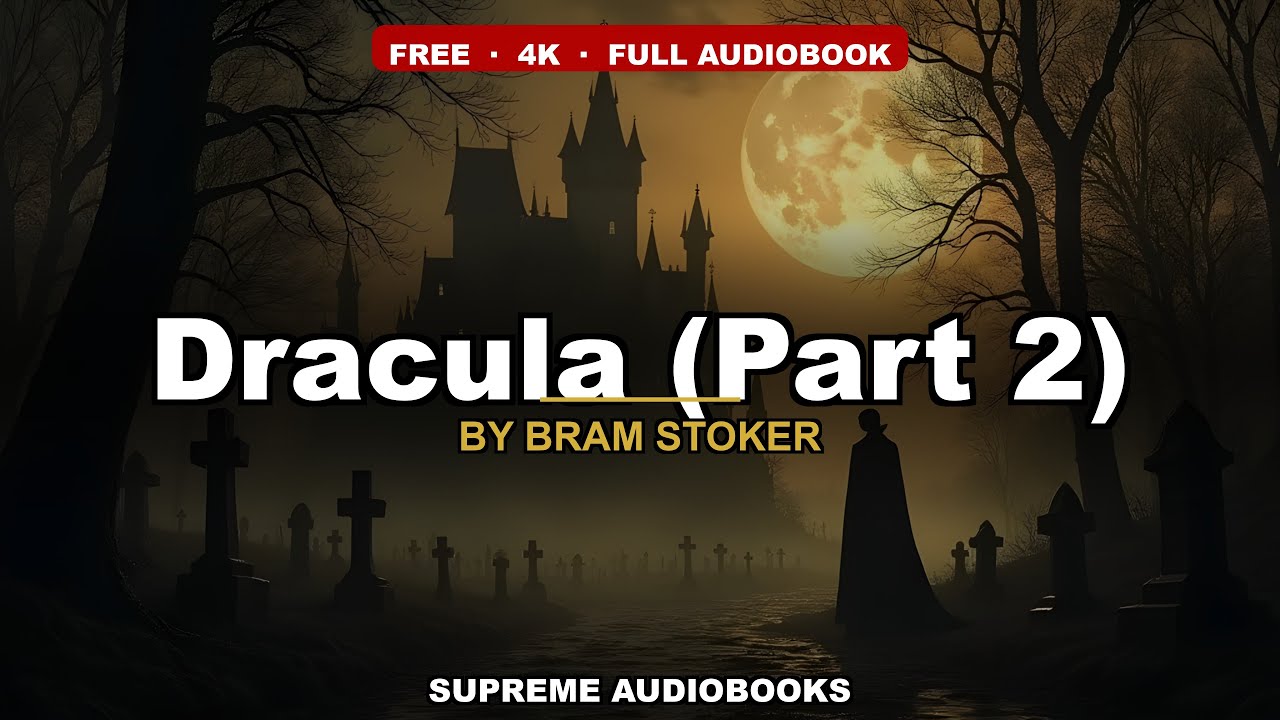
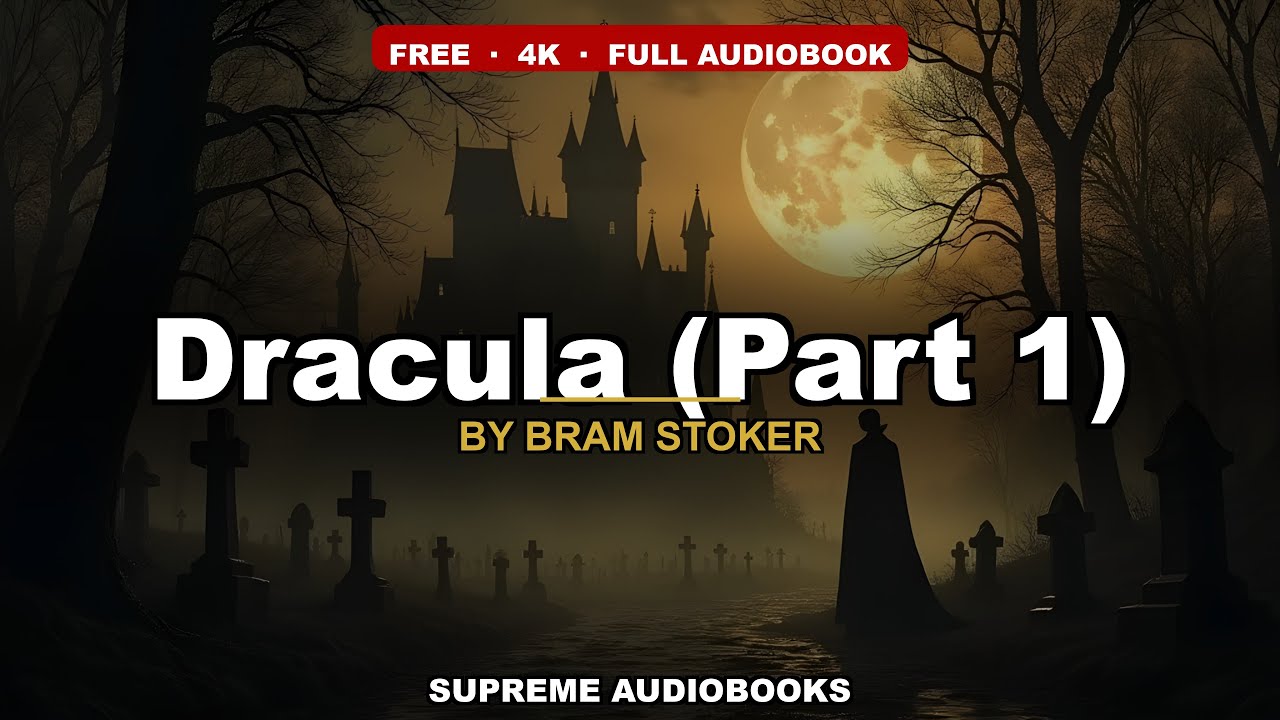
The 4K cinematic visuals accompanying this audiobook are generated by an AI image model from prompts derived from the source text. No copyrighted photos, paintings, or stock footage are used. AI generation is disclosed on every video on our YouTube channel as required by YouTube's altered/synthetic content policy.
English subtitles are transcribed from the LibriVox recording with OpenAI Whisper. Translations into the 11 other supported languages are produced by Meta's NLLB-200 neural translation model. No human translator's copyrighted translation is used.
Questions about sourcing or rights? See our DMCA & Sourcing policy or contact us.
Enjoyed this audiobook?
If you'd like to own a copy of Dracula (Part 1) or hear a professionally produced edition, the links below help support free audiobook production at no extra cost to you.
As an Amazon Associate we earn from qualifying purchases. Audible / print links are affiliate.