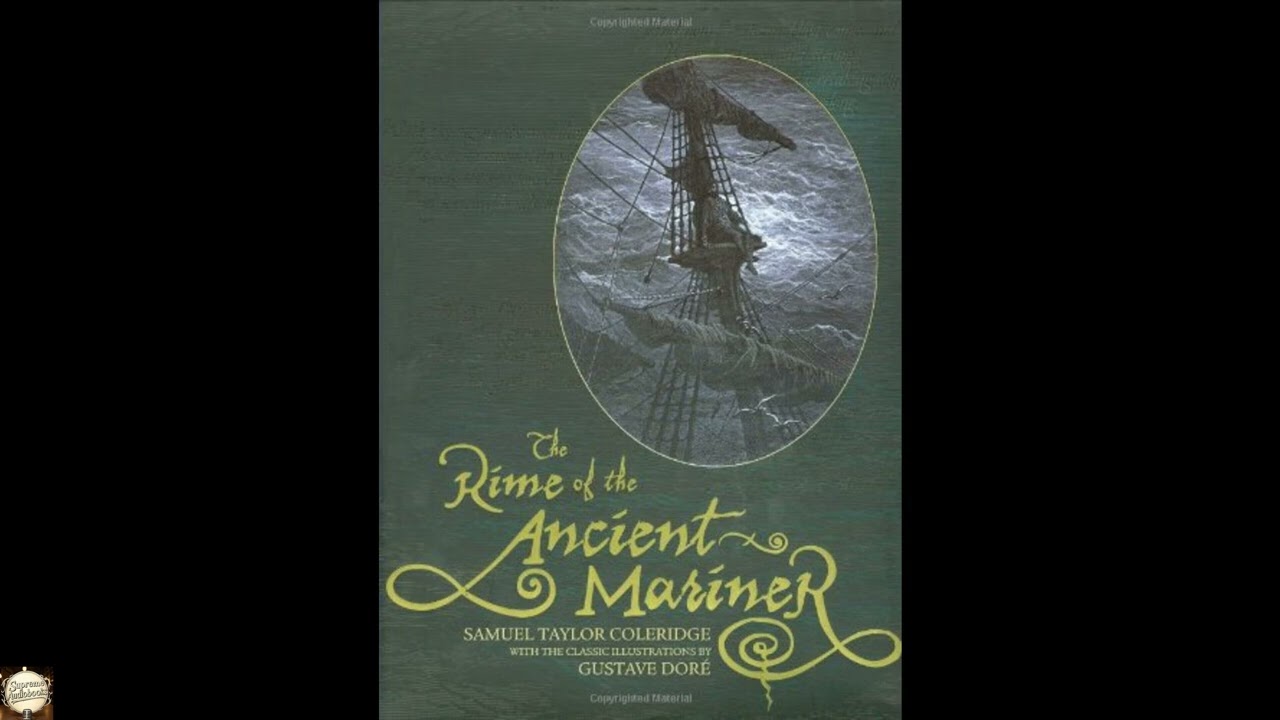
The Rime of the Ancient Mariner
Step into a world where the sea whispers secrets and the air crackles with unseen forces. Samuel Taylor Coleridge's "The Rime of the Ancient Mariner" is not merely a poem; it is an unforgettable experience, a descent into the profound and the terrifying that has gripped readers and listeners for over two centuries. This foundational work of English Romanticism confronts us with timeless questions about guilt, consequence, the sacredness of nature, and the redemptive power of a story told from the depths of the soul. It remains as relevant today as ever, a stark reminder of humanity's delicate place within the vast, awe-inspiring natural world and the enduring weight of our actions. The narrative unfolds through the eyes of an old sailor, the Ancient Mariner, who accosts a Wedding-Guest on his way to a joyous celebration. With a hypnotic gaze and an insistent voice, the Mariner begins his strange, sorrowful tale. He recounts a voyage long ago, a ship setting sail from a bustling harbor into the sun-drenched tropics, then venturing south into icy, uncharted waters where strange, beautiful icebergs loom like cathedrals of frozen light. Amidst the desolate grandeur, an albatross appears, a bird of good omen, guiding the ship through the perilous fog and ice. The crew welcomes it as a harbinger of hope, feeding it and seeing it as a companion. Yet, in a moment of inexplicable cruelty, the Mariner shoots the innocent bird with his crossbow. This rash act unleashes a chain of supernatural horrors. The fair winds that had propelled the ship vanish, leaving it becalmed under a scorching sun, "as idle as a painted ship upon a painted ocean." The crew, initially angry at the Mariner, eventually become complicit by condoning his deed, and they too begin to suffer. Thirst torments them, their tongues shrivel, and they are surrounded by the decaying bodies of sea creatures, all while the dead albatross hangs around the Mariner's neck, a grotesque symbol of his transgression. The living shipmates eventually succumb to a spectral visitation, leaving the Mariner utterly alone, his solitary vigil on the death-ship marking the nadir of his spiritual torment. He witnesses spectral forms and endures an isolation that pushes him to the brink of madness, until a moment of unbidden grace begins his arduous path towards a peculiar form of penance. Samuel Taylor Coleridge, born in 1772 in Ottery St Mary, Devon, was a central figure in the emergence of English Romanticism. A brilliant but often troubled individual, his early life was marked by intellectual promise and a deep fascination with literature and philosophy. He attended Jesus College, Cambridge, though he never completed his degree. It was his profound friendship and collaboration with William Wordsworth that truly ignited his literary career. Together, they published Lyrical Ballads in 1798, a collection that reshaped English poetry and established them as pioneers of a new literary sensibility. Coleridge's life was also shadowed by personal struggles, including a growing dependency on opium, which he initially took for pain relief. Despite these challenges, his literary output was significant and varied. Besides "The Rime of the Ancient Mariner," he also penned the enigmatic "Kubla Khan," a dream-like vision of an exotic paradise, and the unsettling gothic fragment "Christabel." Beyond his poetry, Coleridge was an influential literary critic and philosopher, whose Biographia Literaria remains a seminal text in critical theory, offering insights into his creative process and the nature of imagination. He spent his later years in Highgate, London, under the care of his physician, continuing to write and engage in intellectual discourse until his death in 1834. At its core, "The Rime of the Ancient Mariner" grapples profoundly with the theme of guilt and atonement. The Mariner's spontaneous, senseless act of killing the albatross unleashes not only physical torment for him and his crew but also a profound spiritual burden. The image of the dead bird hung around his neck vividly symbolizes the crushing weight of his transgression, a visible mark of his sin that follows him even after his shipmates perish. His eventual, unconscious blessing of the sea creatures, born not of intent but of a sudden surge of love for life, marks a pivotal moment in his long, drawn-out process of redemption, demonstrating that true atonement often begins with an unforced shift in perspective and compassion. Another powerful theme woven throughout the poem is humanity's connection to the natural world and the consequences of its desecration. Coleridge presents nature not as a benign backdrop but as a living, reacting entity. The ocean, the sun, the wind, and even the creatures of the deep respond directly to the Mariner's cruel act. The becalmed ship, the parched throats, the supernatural specters—all are manifestations of nature's offended spirit. The poem argues for a reverent understanding of all living things, positing that an act of violence against even the seemingly least significant creature can disrupt the delicate balance of existence and incur cosmic retribution. "The Rime of the Ancient Mariner" emerged at a critical juncture in European history, published in 1798. This was the twilight of the Enlightenment, an era that had championed reason, order, and scientific inquiry, and the dawn of Romanticism. The French Revolution, with its promises of liberty and its subsequent descent into terror, had left a deep impression on intellectual and political thought. Coleridge and Wordsworth, alongside other Romantics, sought to counter what they perceived as the cold rationalism of their age. They yearned to reintroduce wonder, imagination, emotion, and the spiritual into art and life. Their Lyrical Ballads was, in many ways, a poetic manifesto. Wordsworth aimed to make the ordinary extraordinary, finding beauty in everyday life, while Coleridge was tasked with making the extraordinary believable, bringing a sense of the supernatural into the realm of human experience. "The Rime of the Ancient Mariner" perfectly embodies this latter goal, drawing on elements of folklore, gothic horror, and spiritual allegory to craft a narrative that feels both ancient and strikingly new. It was a call to acknowledge forces beyond human comprehension, to feel rather than simply to think, and to re-engage with the mystery and majesty of the world. Listening to "The Rime of the Ancient Mariner" as an audiobook transforms the already powerful poem into an immersive, haunting experience. The poem's origins as a ballad, meant to be recited and heard, truly come alive through skilled narration. The rhythm and rhyme, sometimes simple, sometimes startlingly complex, are given their full due, guiding the listener through the Mariner's harrowing tale with an almost hypnotic quality. A good narrator will capture the Ancient Mariner's weary urgency, the Wedding-Guest's evolving reactions from irritation to fear to profound wisdom, and the desolate, awe-inspiring atmosphere of the open sea. The several hours of its duration allow the listener to sink deeply into its strange world, letting the ancient sounds of the sea and the weight of the Mariner's confession wash over them, making the experience a truly personal encounter with one of literature's most compelling narratives.
Enjoyed The Rime of the Ancient Mariner? A few ways to support us
Audible & Amazon links are affiliate; we may earn a small commission at no extra cost.
About this production
Human narration by a volunteer reader from LibriVox.org, the public-domain audiobook project. LibriVox volunteers record literary works whose copyright has expired in the United States, releasing the resulting recordings into the public domain.
The Rime of the Ancient Mariner by Samuel Taylor Coleridge. The underlying text is in the U.S. public domain. We do not republish any modern copyrighted edition, translation, or commentary.
The 4K cinematic visuals accompanying this audiobook are generated by an AI image model from prompts derived from the source text. No copyrighted photos, paintings, or stock footage are used. AI generation is disclosed on every video on our YouTube channel as required by YouTube's altered/synthetic content policy.
English subtitles are transcribed from the LibriVox recording with OpenAI Whisper. Translations into the 11 other supported languages are produced by Meta's NLLB-200 neural translation model. No human translator's copyrighted translation is used.
Questions about sourcing or rights? See our DMCA & Sourcing policy or contact us.
Enjoyed this audiobook?
If you'd like to own a copy of The Rime of the Ancient Mariner or hear a professionally produced edition, the links below help support free audiobook production at no extra cost to you.
As an Amazon Associate we earn from qualifying purchases. Audible / print links are affiliate.