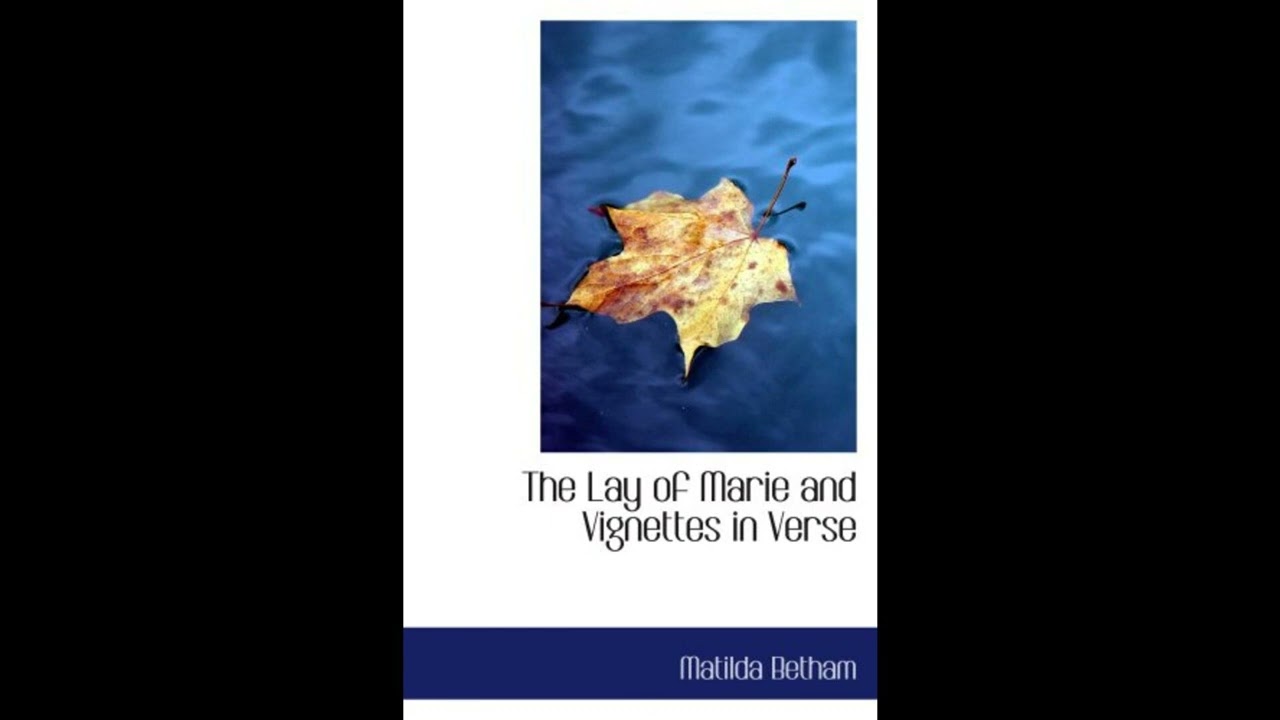
The Lay of Marie and Vignettes in Verse
Step into a literary landscape where the echoes of a bygone age resonate with surprising immediacy, presented through the elegant voice of a remarkable poet. Matilda Betham's The Lay of Marie and Vignettes in Verse offers more than just a collection of historical poetry; it provides a direct line to the sensibilities, moral quandaries, and artistic inclinations of the early nineteenth century, filtered through a distinctly female perspective. This audiobook allows a modern audience to experience the lyrical beauty and narrative power of a writer who, though often overshadowed by her male contemporaries, contributed significantly to the Romantic movement, leaving behind a body of work that deserves renewed attention and appreciation today. The collection commences with its titular narrative, "The Lay of Marie," a moving verse tale that transports listeners to a medieval world imbued with courtly love, societal expectations, and personal dilemmas. The poem centers on Marie, a woman of noble lineage, whose quiet life is suddenly upended by circumstances beyond her control. Her story unfolds within a setting of ancient castles and feudal loyalties, where reputation and family honor are paramount. As Marie grapples with a situation that forces difficult choices upon her, the narrative focuses on her inner fortitude and the steadfastness of her spirit. The story builds around a central conflict, perhaps a forced betrothal, a misunderstood love, or a secret burden, requiring Marie to navigate a treacherous path that tests her resilience and integrity. Betham renders Marie's quiet determination and moral strength with tender insight, allowing the listener to witness her struggles and growth without revealing the ultimate resolution of her predicament. Complementing "The Lay of Marie" are the "Vignettes in Verse," a series of shorter, evocative poems that broaden the scope of the collection considerably. These pieces offer glimpses into a diverse array of subjects, from vivid descriptions of natural scenes to poignant reflections on human relationships and the passage of time. One might find an ode to a pastoral landscape, a meditation on friendship, or a gentle observation of domestic life within these vignettes. Each stands as a self-contained poetic moment, yet together they form a mosaic of early nineteenth-century thought and sentiment, showcasing Betham's versatility and her keen eye for both the grand sweep of human emotion and the quiet details of everyday existence. The evocative power of these verses speaks to the talent of their creator, Matilda Betham (1776-1852), a significant figure of the English Romantic era whose life was as intellectually rich as her writing. Born in Suffolk, the daughter of a clergyman, Betham possessed a restless intellect and a drive for professional accomplishment that often challenged the social norms for women of her period. While she trained and practiced as a successful miniature portrait painter, a profession that afforded her a degree of financial independence, her true passion lay in literature and scholarship. She cultivated friendships and correspondences with many of the leading literary figures of her day, including Charles Lamb, Samuel Taylor Coleridge, and Robert Southey, all of whom recognized and respected her considerable abilities. Beyond The Lay of Marie and Vignettes in Verse, Betham's most notable contribution to letters is arguably her A Biographical Dictionary of Celebrated Women (1804). This pioneering work compiled the stories of accomplished women throughout history, ranging from ancient queens to contemporary artists and writers. It stands as a testament to Betham's deep interest in female agency, intellectual achievement, and the often-overlooked contributions of women to culture and history. Her commitment to scholarship and her distinctive poetic voice cemented her place within the Romantic movement, even as she navigated the complexities of being a professional female author in an era that often marginalized such voices. Betham represents a compelling and often underappreciated talent, whose work helped to expand literary themes and forms, creating pathways for future generations of women writers. Betham's keen insights, evident throughout her writing, give rise to a range of compelling themes. Central to "The Lay of Marie" is the theme of moral fortitude and individual agency, as the protagonist must make profound personal decisions in the face of societal pressure. Listeners will observe Marie's struggle, for example, as she confronts a difficult choice that could bring either social approval or personal sacrifice, revealing her unwavering commitment to her own sense of right. Another prominent theme, particularly in the "Vignettes," is the appreciation of nature and its restorative power. Betham frequently paints detailed word-pictures of rural landscapes, presenting a scene where a quiet stream flows through a sun-dappled meadow, offering solace and reflection amidst life's complexities. Additionally, the collection consistently addresses the role of women in society, showcasing both the constraints placed upon them and their capacity for intellectual and emotional depth. Through Marie's narrative, Betham subtly critiques the limitations imposed upon women, while simultaneously celebrating their inner strength and their ability to shape their own destinies within those confines. A vignette might focus on a domestic scene, yet imbue it with a sense of dignity and purpose that elevates the ordinary. Finally, the collection touches upon the enduring power of storytelling and verse itself, affirming the capacity of poetry to convey profound truths and stir human emotions across time. The intellectual currents that shaped Betham's perspectives were deeply rooted in the broader historical shifts of her era, the early nineteenth century. This was a period of immense change in Great Britain and across Europe, marked by the aftermath of the Napoleonic Wars, the stirrings of industrialization, and a profound shift in artistic sensibilities. The literary world was transitioning away from the rigid classicism of the previous century towards the more emotionally charged, individualistic ideals of Romanticism. Poets and writers began to privilege emotion, imagination, the sublime in nature, and the common person as subjects worthy of artistic rendering. Betham's work emerged from this fertile ground, reflecting the Romantic emphasis on individual experience and the power of feeling, while also engaging with a growing awareness of social issues and the distinct challenges faced by women within that evolving society. Her narratives and reflections speak to a moment when the personal was becoming increasingly political, and the voices of women were beginning to gain a stronger, though still contested, platform in the public sphere. Bringing such a work to life through spoken word offers a unique gateway to its inherent charms. An expertly crafted narration allows the listener to fully absorb the lyrical rhythm and meter of Betham's verse, making the poetry breathe in a way that silent reading sometimes cannot achieve. The run length of several hours makes this a perfect companion for thoughtful, immersive listening, whether during quiet evenings at home or as a stimulating accompaniment to a long drive. Listen for the nuanced vocal performances that convey the shifting moods of Marie's determination, the serene beauty of the natural descriptions, and the quiet wisdom embedded in the vignettes. The narrator's pacing will guide the listener through the emotional landscape of each poem, allowing the period language to flow naturally and reveal its clarity and depth. This auditory presentation ensures that Betham's voice, her artistry, and her unique vision are preserved and presented with the resonance they truly deserve.
Enjoyed The Lay of Marie and Vignettes in Verse? A few ways to support us
Audible & Amazon links are affiliate; we may earn a small commission at no extra cost.
About this production
Human narration by a volunteer reader from LibriVox.org, the public-domain audiobook project. LibriVox volunteers record literary works whose copyright has expired in the United States, releasing the resulting recordings into the public domain.
The Lay of Marie and Vignettes in Verse by Matilda Betham. The underlying text is in the U.S. public domain. We do not republish any modern copyrighted edition, translation, or commentary.
The 4K cinematic visuals accompanying this audiobook are generated by an AI image model from prompts derived from the source text. No copyrighted photos, paintings, or stock footage are used. AI generation is disclosed on every video on our YouTube channel as required by YouTube's altered/synthetic content policy.
English subtitles are transcribed from the LibriVox recording with OpenAI Whisper. Translations into the 11 other supported languages are produced by Meta's NLLB-200 neural translation model. No human translator's copyrighted translation is used.
Questions about sourcing or rights? See our DMCA & Sourcing policy or contact us.
Enjoyed this audiobook?
If you'd like to own a copy of The Lay of Marie and Vignettes in Verse or hear a professionally produced edition, the links below help support free audiobook production at no extra cost to you.
As an Amazon Associate we earn from qualifying purchases. Audible / print links are affiliate.